
Few strategic frameworks in post-Cold War international relations have proven as consequential or as contested as the doctrine attributed to Yevgeny Primakov, Russia's former Prime Minister. It is an overarching strategic policy aimed at preserving Russia’s status as a great power. Russian scholars consider articulation of Primakov Doctrine as a continuation of Russia’s historical national security imperatives and not a post-cold war construct as viewed by the West. It positioned Russia not as a revisionist power but as a stabilizing counterweight to Western hegemony.
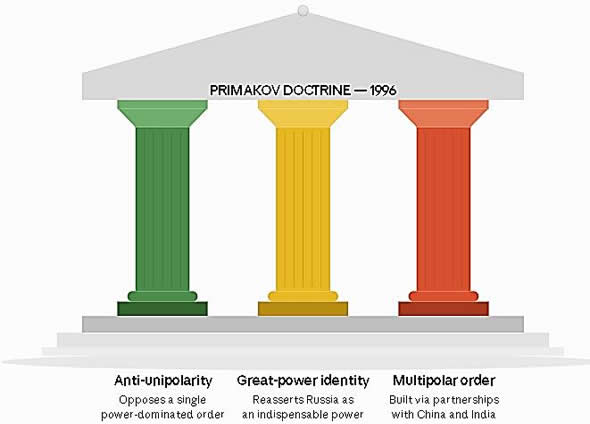
First articulated in 1996, the 'Primakov Doctrine' was balanced on three pillars: opposition to American unipolarity, assertion of Russia’s great-power identity, and cultivation of a multipolar order (Figure 1).
Figure 1: Primakov Doctrine – 1996
Sources: Ms. Ekaterina, 2023, “Russian Crossroads” (Yale University Press 2003)
This is reflected in the promotion of strategic cooperation under the Russia, India, China (RIC) framework, opposition to NATO expansion and support for multilateral institutions.
This insight aims to examine the evolution of the Primakov doctrine from its original format during the 1990s towards Russia’s contemporary security framework.
Primakov articulated his vision within a specific historical conjuncture: post-Soviet chaos, NATO eastward expansion and growing American Unipolarity. He argued that NATO's eastward expansion represents a direct challenge to Russian strategic interests. The evolution of European security institutions without considering Russia’s genuine security concerns, and Russian disillusionment with its own earlier pro-Western rapprochement (1991-93), enhanced insecurity and mistrust among Russian policy experts towards the West.
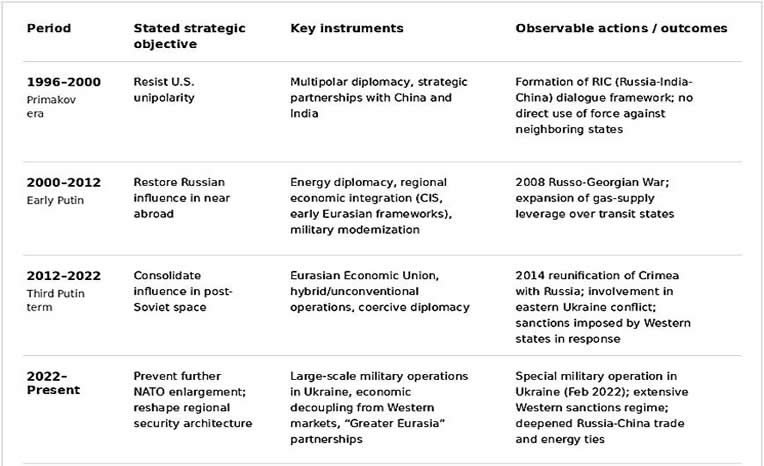
Incorporation of former Soviet states in NATO alliance constituted strategic encirclement activating Russian deterrence doctrine. The Primakov Institute of World Economy and International Relations (IMEMO RAS) framed the doctrine as 'defensive’ balancing against Western hegemonic dominance and emphasised multilateral balancing over unipolarity. This has remained the foundational pillar during the evolution of Russian National Strategic Policy since the 1990s (Figure 2).
Figure 2: Evolution of Russian National Strategy Policy
Sources: Self-compiled data from various sources: Habibe Özbek, "Russian Eurasianism: An Ideology of an Empire," Orta Asya ve Kafkasya Araştırmaları, no. 9 (2010): 156-18; Dmitri Trenin, Post-Imperium: A Eurasian Story (Washington, DC: Brookings Institution Press, 2011).
The Western efforts to legitimise NATO expansion, citing justifiable security concerns, became Russia’s central justification for defending its strategic sphere of influence. NATO intervention in Kosovo in 1999 and eventually the promise of NATO membership to Georgia and Ukraine during the 2008 NATO Bucharest Summit became the key catalysts that deepened Russia’s sense of insecurity. The West frames the Russian actions to protect its perceived strategic interests, such as naval exercises in the Baltic Sea, the war in Georgia (2008) and Russian actions in Crimea (2014), as expansionist and hostile. West also accuses Russia of asymmetric responses through alleged interference in Ukrainian Elections 2004 (Orange Revolution), alleged campaigns to influence the U.S elections (2016) and Brexit referendum on UK (2016) and use of Gazprom’s energy leverage. The ongoing conflict in Ukraine became the decisive rupture in relations between the West and Russia.
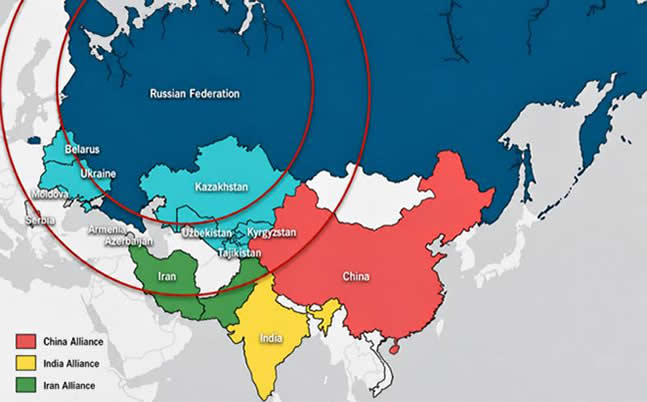
Russia’s Great Power identity, as envisioned in the Eurasian ideology, is essentially the second pillar of Primakov doctrine. The Eurasianist ideology holds Russia as an ancient civilisation spanning across Europe and Asia and destined to lead a multipolar bloc against Western liberal hegemony. Russia views Eurasianist ideology as an attempt to restore its sovereignty and its strategic alliances (Figure 3).
Figure 3: Russia’s Strategic Sphere and Global Alliance
Sources: Jeffery Mankoff, “Constructing Russia’s Strategic Space: Empire, Identity, and Geopolitics”, National Bureau of Asian Research, Learning from History (blog), August 23, 2023.
President Vladimir Putin’s third term represents a pivotal shift in Primakov doctrine with increasing incorporation of the Eurasianist ideology. Dugin’s Foundations of Geopolitics (1997), influential within Russian military and strategic circles, helped frame states such as Ukraine, Georgia and the Baltic States as “near abroad” territories requiring integration into the Russian Sphere. This is usually framed by the western powers as “Russian Monroe Doctrine” and a blueprint for expansion.
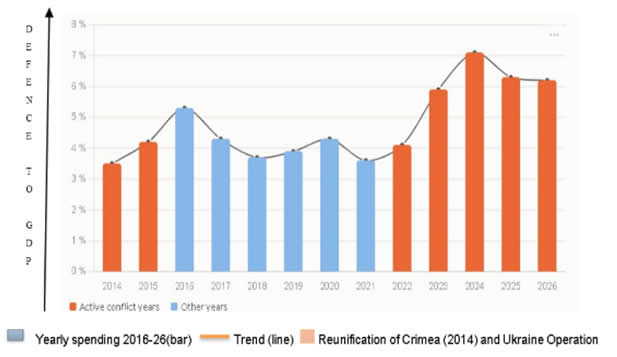
Russian military expenditure (as a share of GDP) rose from 5.3% in 2016 to 7% in 2024 due to wars in Europe (Figure 4). Western strategists view this trajectory as projection rather than deterrence alone. This increase can be interpreted differently arguing that rise in defense expenditure is consistent with the periods of active conflicts. In contrast, Russian strategists argue that US spends up to $877 billion as opposed to Russia’s $86 billion (2023 figures) amounting to 39% of the global spending which is more than the next ten global spenders combined.
Figure 4: Russia Defence Spending as Percentage of Federal Budget (Russia TASS agency 2016 and Interfax 2025)
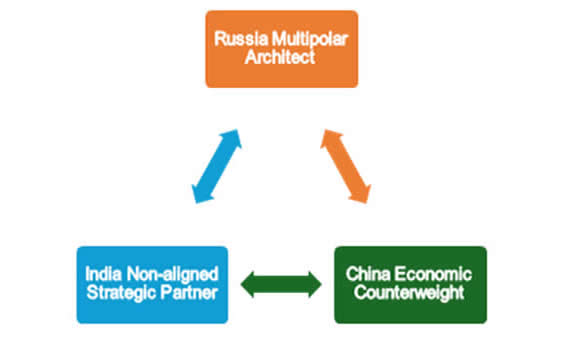
The evolution of the Primakov Doctrine demonstrates Russia's enduring pursuit to maintain the status quo of the multipolar world order. Russian Foreign Minister Lavrov invoked Primakov's framework at the 2026 Primakov Readings forum as the intellectual foundation for Russia's current multipolar diplomacy. Central to the Primakov vision was the proposed Russia-India-China (RIC) strategic triangle (Figure 5), first articulated in 1998. & The aim was to counterbalance American unipolarity while preserving each other’s independent foreign policy.
Figure 5: Primakov Triangle/RIC Triangle
Sources: Ogden, C. (2021) International Affairs, 97(3), 801-819)
RIC evolved into BRIC by inclusion of Brazil in September 2006 on the sidelines of the United Nations General Assembly. This established an informal dialogue which evolved into a formal institutional body in 2009 that expanded with inclusion of South Africa into BRICS (2010). This expanded Primakov’s idea of three-way coordination into a larger multipolar bloc with the goal of de-dollarizing trade and creating alternative financial and governance institutions.
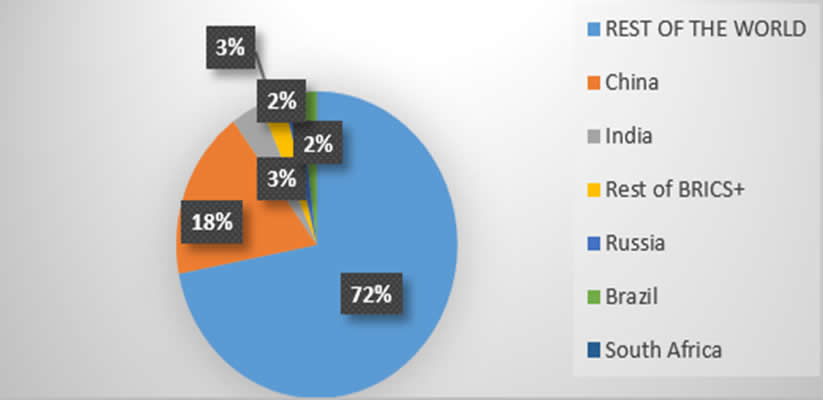
Further manifestation appears in BRICS+ (2023), which includes states like Egypt, Iran, Saudi Arabia, and the UAE, extending the same concept into a Global South-oriented counterweight to Western-dominated institutions. Collectively, BRICS+ contributes roughly $33.75 trillion out of the world's projected $126.3 trillion total GDP making approximately 26.7% of the Global Economy (Figure 6).
Figure 6: BRICS Contribution to Global GDP 2026
Sources: International Monetary Fund, Word Economy Outlook, April 2026. Statistical Appendix, Washington, DC: International Monetary Fund, 2026
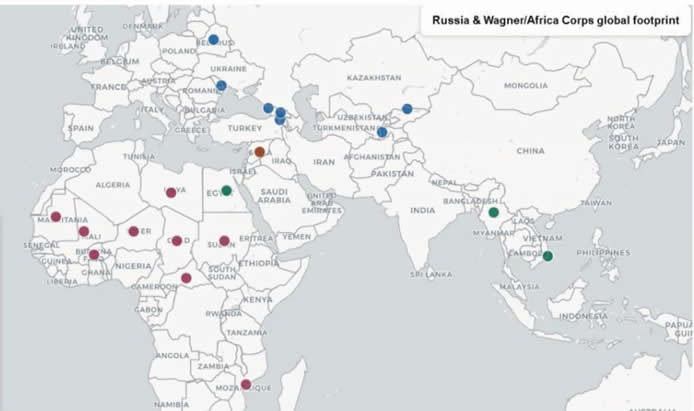
Within the Multipolarity realm, there is a security sphere where Russia asserts influence across multiple regions to advance its strategic interests. In the Post Soviet space, the Collective Security Treaty Organisation (CSTO) utilises the doctrine by providing a security umbrella for the Central Asian states. Russia’s Africa Corps allegedly maintains an ongoing presence in states like Mali, Central African Republic and Burkina Faso by offering alternative security ties free of western conditions. (Figure 7) In South Asia Primakov-inspired approach balance ties between India and Pakistan.
Figure 7: Russian Military Global Footprint
Sources: Kimberly Marten, “Russia’s Use of Semi-State Security Forces: The Case of the Wagner Group,” Post-Soviet Affairs 35, no. 3 (2019): 181–204. New Lines Institute, “Russia’s Extraterritorial Military Deployments,” New Lines Institute. Accessed August 5, 2026.
In conclusion, the Primakov Doctrine reflects Russia’s principles of sovereignty and self-defence against encirclement by Western-led security incursions. From a Russian strategic perspective, these policies are defensive measures to maintain regional stability and sustain a multipolar world order. But western thinking interprets such policies as an expansionist ideology. The diametrically opposed interpretation of the Primakov Doctrine will continue to remain central to contemporary Eurasian geopolitics in the foreseeable future.
Recent Insights

The views expressed in this Insight are of the author(s) alone and do not necessarily reflect the policy of ISSRA/NDU.