
Since independence in 1947, Pakistan’s transport infrastructure has undergone a significant structural shift from being a railway-centric system to a road-centric logistics network. This article argues that an integrated transport strategy is essential for Pakistan's sustainable economic development, with railways prioritised for bulk and long-distance freight and roads focused on passenger transport and last-mile connectivity.
Pakistan inherited a robust railway system that carried approximately 70% of inland freight during the 1950s and 1960s. The First Five-Year Plan (1955–60) reflected this priority by allocating more than half of the transport development budget to railways, while roads received a substantially smaller share. During this period, Pakistan Railways operated a network extending over 8,700 kilometres and served as the backbone of the country's freight transport system. From the 1970s onward, however, transport policy increasingly shifted in favour of road infrastructure.
This transition accelerated with extensive highway development and was further institutionalised through the establishment of the National Highway Authority (NHA) in 1991 and the expansion of the motorway network during the last two decades. As a result, rail's share of inland freight declined from about 70% in the early decades to around 4–5% by the early 2000s, where it has largely remained, while road transport now carries approximately 95% of the country's freight.
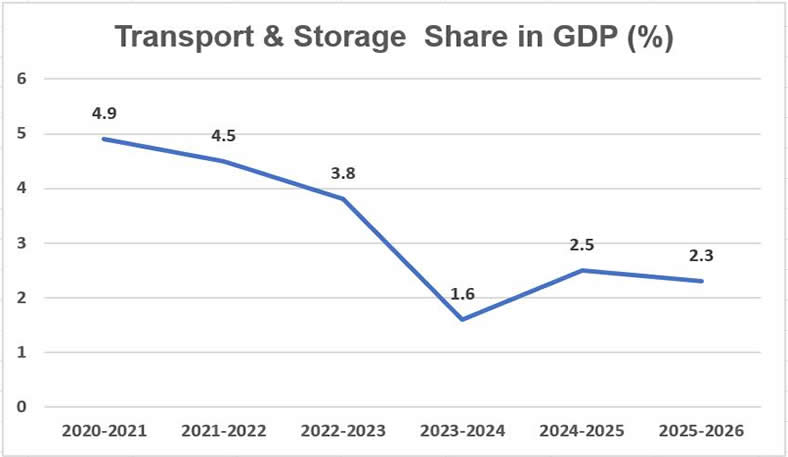
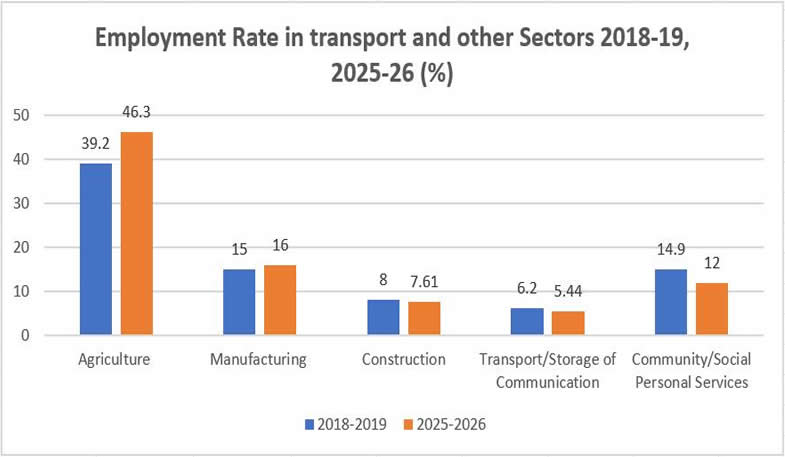
Currently, the transport sector contributes approximately 2.3% to Pakistan's GDP and employs more than 5.4% of the labour force, as shown in Figures 1 and 2.
Figure 1
Sources: Pakistan Economic Survey
Figure 2
Sources: Pakistan Economic Survey
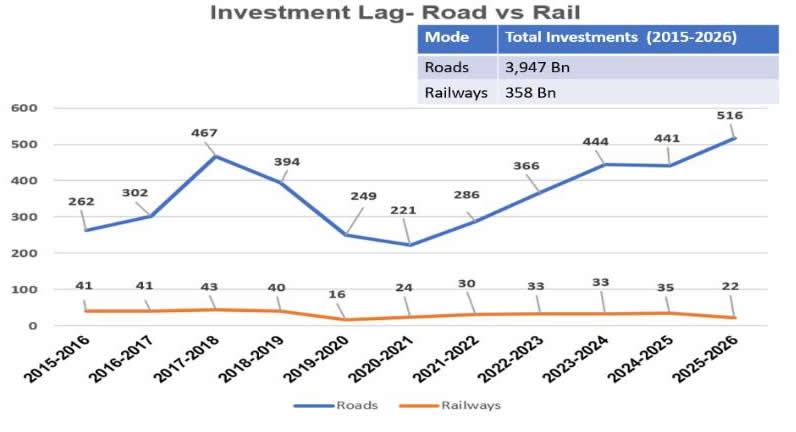
The gradual shift toward road transport, illustrated in Figure 3, has been accompanied by a growing disparity in public investment between the road and railway sectors. Between FY2015–16 and FY2025–26, approximately PKR 3,947 billion was allocated to the National Highway Authority (NHA), whereas Pakistan Railways received only about PKR 358 billion. Consequently, public investment in road infrastructure was nearly eight times more than that in the railway sector, highlighting the long-standing political preference for road-based transport.
Figure 3
Sources: Author: Engr. Faizan Ali Deputy Chief T&C, Planning Commission Title: Planning Commission Perspective and Vision and Policy Seminar Title: Road vs Rail Rethinking Pakistan’s Transport Strategy for Domestic & Regional Connectivity
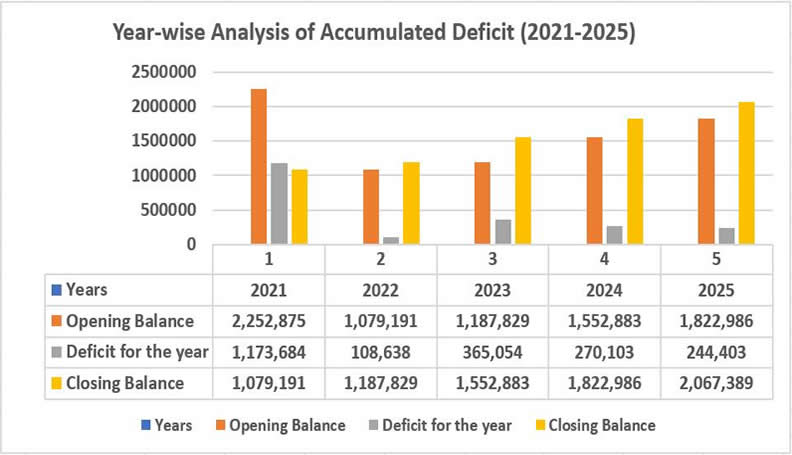
NHA’s financial position indicates a gradual strengthening of its capacity for internal resource generation and operational self-reliance. The Authority finances a substantial share of its managerial and operational expenditures through revenues generated from toll collections, right-of-way (ROW) charges, rentals, police fines, and build-operate-transfer (BOT) projects. These diversified revenue streams generate positive net cash inflows, reducing NHA’s reliance on the Federal Government for routine operations and enhancing its financial autonomy. While government support remains important for large-scale infrastructure development, NHA’s growing reliance on internally generated resources represents a positive step towards improving financial sustainability and reducing pressure on the national exchequer. However, despite NHA’s strong revenue generation and positive operating cash flows, its reported deficits over the last 5 years (Figure 4) are largely attributable to non-cash accounting items, including finance costs, exchange losses on foreign-currency loans, and depreciation charges.
Thus, while the accumulated deficit remains substantial, it does not necessarily reflect equivalent cash losses, and NHA’s positive operational cash position indicates comparatively sound underlying financial health.
Figure 4
Sources: Data taken from National Assembly Secretariat 27th Session
Recognising the strategic importance of the railway sector, the Government of Pakistan introduced the National Transport Policy (2018) and the National Freight and Logistics Policy (2020) to promote a more balanced, efficient, and integrated transport system. These policy frameworks emphasise modernising railway infrastructure, increasing rail freight’s modal share, improving commercial efficiency, encouraging private-sector participation through public-private partnerships, and developing a multimodal logistics network.
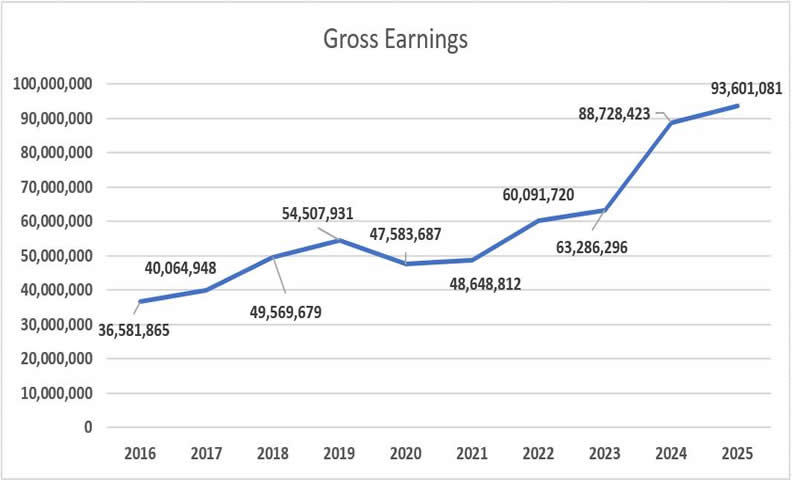
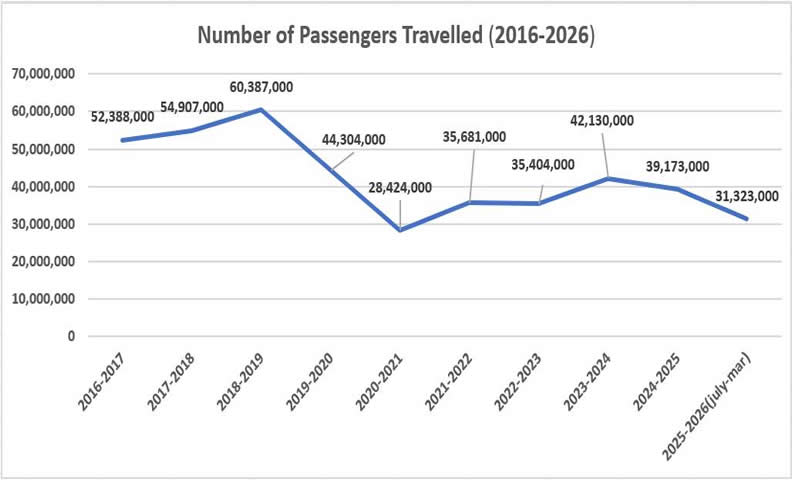
In addition, digital reforms, including the implementation of Enterprise Resource Planning (ERP) systems and online ticketing, along with successful public-private partnership initiatives such as the Business Express service, demonstrate the sector's potential for operational and commercial transformation. Recent developments indicate that Pakistan Railways’ gross earnings increased by approximately 21% in FY2025, as shown in Figure 4, while nearly 31 million passengers travelled by rail during the first nine months of the fiscal year, as shown in Figure 5.
Figure 5: Last 10 years trend of Gross Earnings
Sources: Pakistan Railway Yearbook
Figure 6: Last 10 years trend of the number of passengers travelled
Sources: Pakistan Railway Yearbook
During the last four years, Pakistan Railways has recorded an improvement in gross earnings despite weaker passenger traffic. This increase has been driven largely by stronger freight earnings, improved operational efficiency, and higher non-passenger revenues, rather than growth in passenger demand. In FY2024–25, passenger traffic remained below the planned target, with the government attributing the decline partly to reduced passenger travel and disruptions in Balochistan, while total revenue reached Rs93.6 billion.
These gains, supported by digital reforms, public-private partnership initiatives, and improved operational management, indicate a strengthening of the railway’s commercial and operational performance. However, the impact of these reforms on the sector’s underlying infrastructure remains limited, as Pakistan Railways continues to face the consequences of decades of underinvestment and infrastructure deterioration.
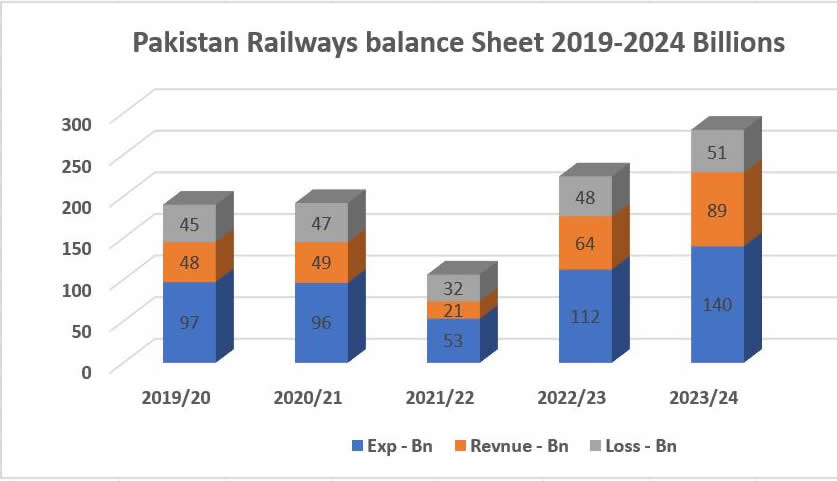
Despite these improvements, Pakistan Railways continues to face the consequences of decades of institutional neglect, underinvestment, and infrastructure deterioration, including ageing infrastructure, limited operational capacity, outdated rolling stock and signalling systems, reliance on obsolete technology, inability to evolve (e.g., electrification), and financial constraints, as shown in Figures 6 & 7. Currently, only about 65% of the railway network is fully operational, while rail accounts for less than 5% of the national freight market, well below the government's target of 20%.
Figure 7: Track, Locomotives, Passenger and Freight Wagons Data from (2020,21 - 2024,25)
Sources: Data taken from Railway Yearbooks from 2020,2022 to 2024-25
Furthermore, legacy pension liabilities account for almost two-thirds of Pakistan Railways' total expenditure, exerting significant pressure on its financial sustainability and restricting its capacity to invest in modernisation and service improvements.
Pakistan’s future transport strategy requires a shift from a road-dominated model towards an integrated multimodal system in which roads and railways complement each other. Strengthening railways alongside an efficient road network can reduce logistics costs, improve energy efficiency, support environmental sustainability, and enhance domestic and regional connectivity.
However, achieving these objectives requires reforms that extend beyond infrastructure investment. Pakistan needs to adopt a more integrated approach to transport governance by establishing a unified Ministry of Transport responsible for strategic planning, coordination, and policy alignment across all transport modes.