In June 2021, Pakistan was closing a fiscal year seen at the time as a policy success: growth of 5.74%, reserves climbing toward an all-time high of $27.07 billion, a rupee near Rs 152 to the dollar, and stable Moody's and Fitch ratings. Weeks later, the chaotic US withdrawal and Taliban's return to power in Kabul on 15 August 2021 set off the shocks that followed. Five years on, several economic indicators have partly recovered from the severe 2022–23 crisis—but on most measures Pakistan has not returned to its mid-2021 position, and on security, external threat, and political stability it stands considerably worse off.
This Insight compares the period between 30 June 2021 and 1 July 2026 across four factors: economy, security, diplomacy and political stability.
Pakistan's economy has moved through a full boom-bust-recovery cycle without closing the loop. FY21 growth reached 5.74% with a rare current-account surplus; a severe crisis then unfolded in 2022–23, inflation peaking at 31.4% before easing to roughly 9% by mid-2026 alongside 3.7% provisional growth — still below the FY21 pace.
The rupee has not recovered at all, moving to near Rs 279, a cumulative devaluation of some 45%, while reserves have fallen to $16–$22 billion and Moody's 2021 B3 rating remains higher than 2026's Caa1 despite recent upgrades. The KSE-100 index is the one unambiguous riser, up roughly 285%. FY26's near-balanced current account is remittance-driven rather than export-led, and Pakistan's clearest gain—exiting the FATF grey list in October 2022, having still been listed in June 2021—is one of the few unambiguous five-year improvements.
No factor has deteriorated more sharply than security. Terrorism deaths had fallen to a low of 365 in 2019 and remained subdued into mid-2021, with Pakistan ranked a comparatively low 7th on the Global Terrorism Index. The US withdrawal from Afghanistan, resulting in the Taliban's August 2021 return, reversed this almost immediately, producing the largest year-on-year fatality increase in a decade: 748 in 2023, 1,081 in 2024, and 4,001 in 2025. By August 2026, Pakistan was ranked the world's single most terrorism-affected country, with over 3,145 incidents recorded since the start of the year alone.
Relations with the Afghan Taliban collapsed from border skirmishes in October 2025 into formally declared 'open war' by February 2026, following cross-border strikes on both sides.
Separately, a four-day conflict with India in May 2025—the most serious exchange between the two in decades—ended in a ceasefire. Conditions essentially absent five years ago now define Pakistan's external environment.
In June 2021, relations with Washington were already cold; a chill that persisted through the 2021 US withdrawal from Afghanistan.
Relations improved only later and for different reasons: the U.S. administration credited itself with brokering the May 2025 ceasefire, with Pakistan by early 2026 described as a “go-to partner” for U.S. diplomacy even as U.S.-India ties cooled.
On the multilateral track, Pakistan has moved from a weaker position (grey-listed in June 2021) to a stronger one (clear of the list since October 2022)— though FATF has cautioned that exit is “not immunity”.
Comparative Matrix, June 2021 vs. Mid-2026 (Scored 1–10)
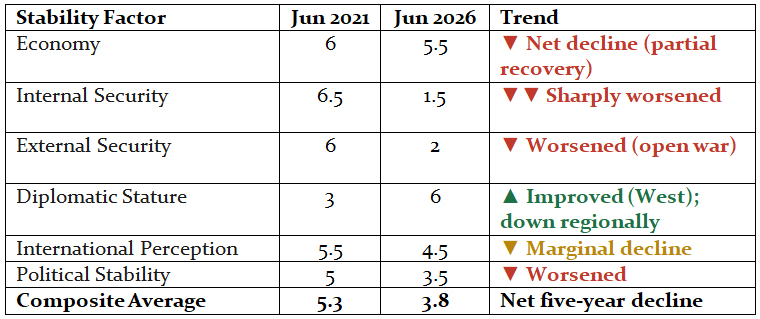
Read over five years, Pakistan's trajectory looks like a mixed bag. June 2021 was, in retrospect, a relative high point: strong growth, record-bound reserves, a stable credit profile, and a government facing no active war. The chain of shocks that followed—economic crisis, sustained political contestation, and a worsened security situation — has left Pakistan only partially recovered. On currency, reserves, credit rating, and political stability, mid-2026 remains worse than mid-2021. Security is the sharpest decline of all. The clearest genuine five-year gains are narrower than they first appear: FATF exit and a transactional reset with Washington, achieved partly at regional cost.
In summary, the central lesson is that the post-2021 “recovery” is a partial rebound from an avoidable crisis, not a five-year improvement in Pakistan's underlying stability.
Recent Insights
The views expressed in this Insight are of the author(s) alone and do not necessarily reflect the policy of ISSRA/NDU.