
Since the end of the Cold War, Africa has emerged as a central arena of US-China strategic rivalry. Once a peripheral region in global geopolitics, it is now a vital node. Due to its geostrategic positioning, the presence of rich mineral resources, oil and gas reserves, and booming youth, competition for influence on the African continent is an undeniable geopolitical reality.
Figure 1: Map of Africa
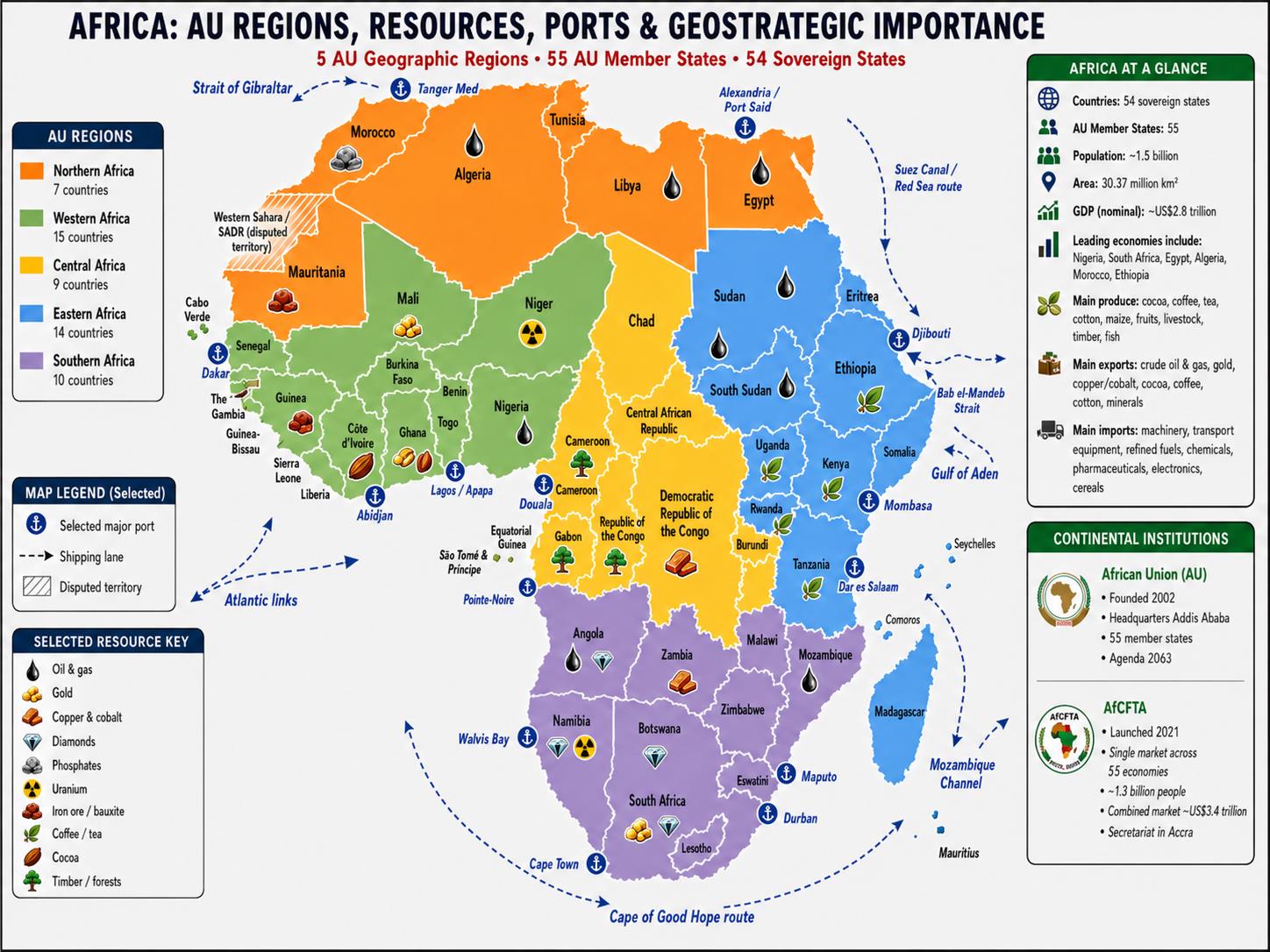
Sources: Data compiled by Author, Image is AI generated
The geopolitical competition between US and China in Africa is multi-domain. However, for the scope of this insight, it will be analysed in four major domains: trade, investment, security and diplomatic/political. The data used will be from the early 2000s to 2025.
During and after the Cold War, the US and the wider West (Europe) retained considerable influence across Africa through the historical weight of colonial-era aid, security partnerships, and peacekeeping support. Nonetheless, this balance was altered by China’s entry into the continent by the early 2000s. Over the past two decades, China established itself not only as a major strategic actor but also emerged as a counterweight to US and Western influence while reshaping Africa’s geopolitical outlook.
In the early 2000s, Africa’s external trade landscape was largely shaped by the US and the EU, while China’s presence remained limited. EU was the largest trading partner as a bloc, with total trade of $139.5Bn, while US trade stood at around $39Bn and China at roughly $10-12Bn. This shifted in 2009 with China-Africa trade expanding rapidly. China overtook the US as Africa’s largest single-country trading partner as China-Africa bilateral trade reached approximately $91Bn, marginally exceeding US-Africa trade of about $87Bn.
By 2025, China-Africa trade had risen to around $348Bn, with the US trailing at $83.4Bn. However, the EU has still retained the strongest overall position with a total trade of approximately $500Bn.
Figure 2: Trade Comparison (US, China, EU)
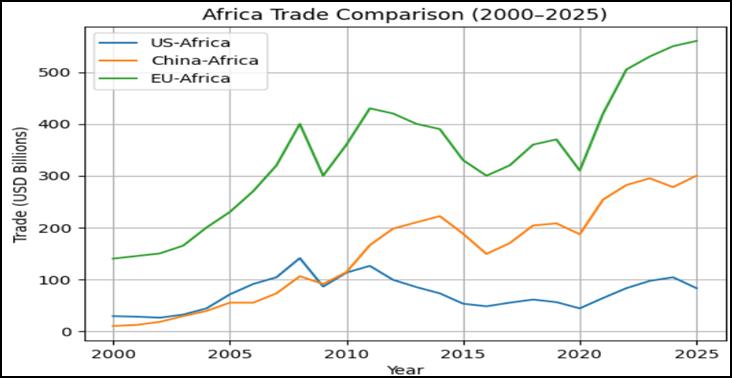
Sources: World Bank, IMF
The US has tried to boost trade through African Growth and Opportunity Act (AGOA), the US-Africa Leaders Summit, but China’s demand for raw materials, large-scale exports, and infrastructure-linked commerce have driven much faster growth.
However, trade data alone understates China’s footprint. Since Chinese influence in Africa extends beyond market flows, into grants, concessional lending, debt financing, infrastructure delivery, and construction contracts.
Figure 3: FDI Data for US, China and EU in Africa
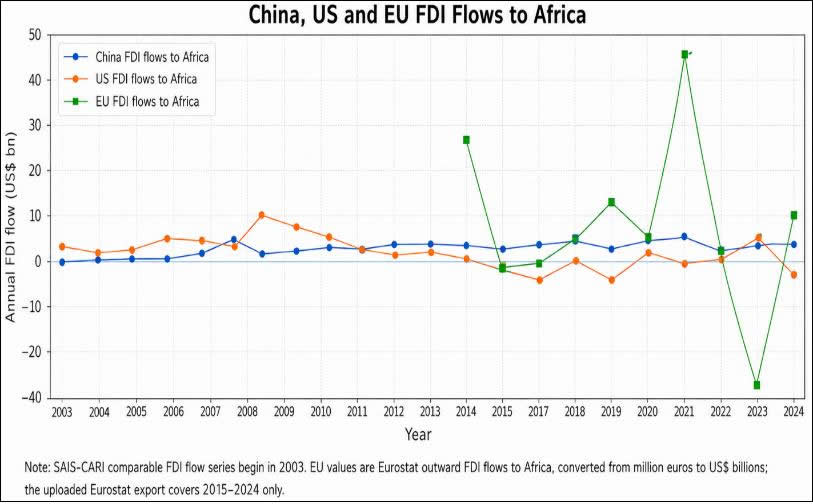
Sources: UN Comtrade Database, United Nations Statistics Division and Eurostat
In terms of investment, the US presence in Africa has remained significant but uneven. US FDI flows were slightly above $2 billion annually in the early 2000s, rose to around $10 billion in 2009, and fluctuated in later years. By 2023, the US FDI position in Africa stood at about $53 billion. Chinese FDI stock in Africa also expanded sharply, rising from less than US$1 billion in 2003 to over $40 billion by 2023.
The EU, however, remains Africa's largest structural investor, with FDI stock estimated at approximately $270.5 billion in 2024, substantially exceeding both US and Chinese FDI stock levels. Yet, China is increasingly narrowing the investment gap. At the Forum on China-Africa Cooperation (FOCAC) summits in 2024 China pledged $50bn in financial aid to African nations in the next three years becoming the largest lender and contractor to Africa.
In Africa’s security paradigm, Europe has been predominantly the main actor due to the colonial legacy. The colonial legacy created enduring political, military and institutional linkages between European powers and African states, which continued after decolonisation through defence arrangements, military deployments and diplomatic relationships. However, this traditional European security role has recently come under pressure, particularly with its military withdrawals in the Sahel region from Mali, Burkina Faso, Niger and Chad.
Post-Cold War conflicts saw the UN emerge as a central framework for managing African conflicts and peacekeeping, providing the US with an avenue to engage in African security and influence peacekeeping priorities through its financial contributions. The US initially played a limited role, but its intervention in Somalia highlighted the risks of direct military engagement.
The US security role gradually expanded through counterterrorism partnerships, military training and security assistance programmes, as well as its military presence in Djibouti, particularly at Camp Lemonnier. Since 9/11, the US counterterrorism network has extended across North Africa, East Africa and the Sahel, with major training and support programmes in countries such as Kenya, Somalia, Tunisia and Nigeria.
This expanding role was further institutionalised through the establishment of AFRICOM in 2007. Initially, it operated as a sub-unified command of US European Command (EUCOM) headquartered in Stuttgart, reflecting the continuing institutional link between the emerging US security role and the established European security framework. AFRICOM became an independent geographic combatant command in October 2008, marking a formal shift towards a dedicated US security architecture for Africa.
By contrast, China remains a newer entrant in Africa’s hard-security space with limited military footprint. Its first overseas military base, established in Djibouti in 2017, complements its railway and port investments while challenging US influence along the Red Sea corridor. More recently, however, China has broadened its security engagement, maintaining successive three-ship naval deployments in the Gulf of Aden in 2025-26 and expanding joint military exercises with Tanzania, Mozambique, and Egypt, indicating a gradual shift towards a more diversified security footprint in Africa.
Unlike the post-Cold War era, when US influence helped sustain wider UNSC consensus, today China and Russia increasingly stress sovereignty, host-state consent and narrower mandates, making UN peacekeeping more contested and less expansive. However, continued convergence between Europe and the US in Africa’s security and strategic engagement could constrain the space available for China to expand its influence.
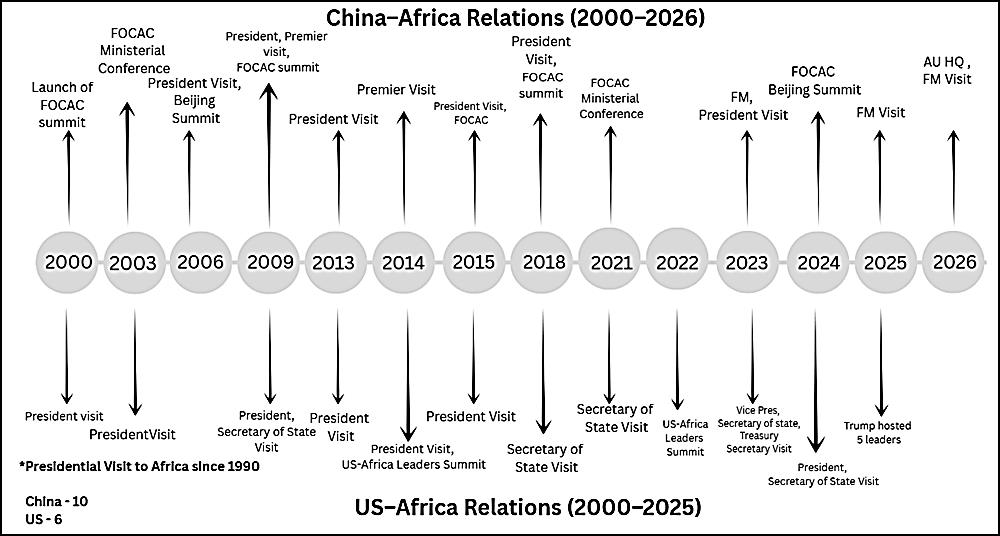
Diplomacy connects the economic and security layers. China has institutionalised Africa engagement through FOCAC, recurring summits, high-level leadership visits and a symbolic annual rhythm. These visits usually arrive with financing, infrastructure, trade or industrial cooperation packages. These summits all served as platforms to consolidate multi-year cooperation plans, making Chinese diplomacy predictable and highly visible. For 36 consecutive years, Africa has been the Chinese foreign minister’s first overseas destination.
Figure 4: Diplomatic & Political Visits
Sources: Self-Compiled
In contrast, US engagement with Africa has been more episodic, often shifting with political transitions in Washington. Obama hosted the first US-Africa Leaders’ Summit in 2014, Trump reframed Africa policy around countering China and Russia, and Biden revived summit diplomacy in 2022. While AGOA (2000), Prosper Africa (2018), and Power Africa (2013) remain important, their momentum is less synchronised than China’s FOCAC-led approach, with AGOA still dependent on congressional renewal.
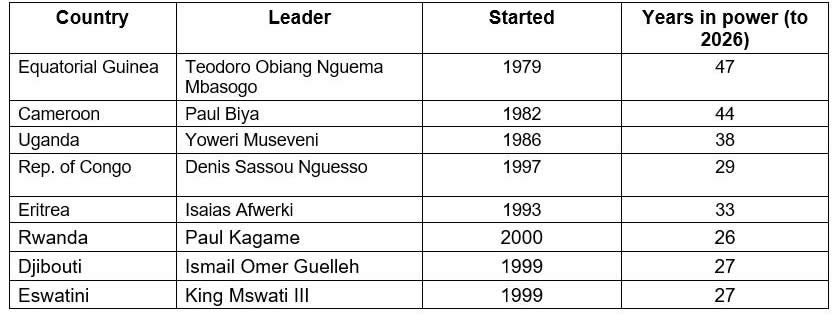
An often-overlooked area in this competition is Africa’s political system. As shown in the table, several African leaders have remained in power for decades, combining control of the electoral process while maintaining stability and external ties. The US/West has often supported such regimes, criticising human rights abuses while sustaining security and economic partnerships due to their pro-Western alignment.
Figure 5: Longest Serving African Leaders
Sources: Self-Compiled
This reflects a preference for strategic stability, with electoral concerns and conditionalities such as AGOA eligibility applied inconsistently.
China, while formally adhering to non-interference, exercises influence through economic leverage, including loans and infrastructure financing. Looking ahead, Africa’s strategic relevance will only deepen with time. Its minerals, markets, youth, population and infrastructure needs will keep it central to US-China rivalry. However, for the foreseeable future, the next phase will be judged less by promises and more by delivery: jobs, value addition, technology transfer, and sustainable financing. For African states, the challenge will be to convert external rivalry into internal transformation rather than dependency. Africa’s “third way” is therefore not neutrality, but strategic bargaining in a multipolar environment.