
Genetically modified (GM) seed technology has improved agricultural productivity, pest management, and climate resilience globally. Bt cotton is a GM variety containing a gene from the soil bacterium Bacillus thuringiensis (Bt) that protects against bollworms, reducing the need for insecticides. Pakistan formally commercialised Bt cotton in 2010 as its only widely adopted GM crop.
Yet despite Bt cotton accounting for an estimated 95% of the country's cotton area by 2022, national cotton production has fallen to a 40-year low. While many factors have contributed to this decline, including pests beyond Bt cotton's targeted bollworms, diseases such as Cotton Leaf Curl Virus, climate change and evolving crop economics; weaknesses in GM seed governance remain an important part of the story. This insight examines Pakistan's GM seed governance through the case of Bt cotton.
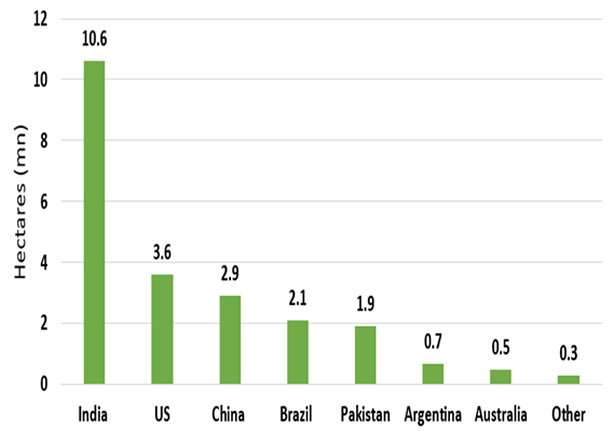
GM crops have been commercially cultivated since 1996 and, by 2025, were grown in 30 countries on 216 million hectares. GM cotton accounted for 76.7% of global cotton area, with Pakistan in fifth place (Figure 1).
Figure 1: GM Cotton Area
Sources: AgbioInvestor
Yet large-scale adoption has not translated into sustained gains (Fig. 2). India offers a useful regional comparison given similar adoption timelines and production systems.
India’s cotton yield more than doubled from 191 kg/ha in 2002 to 440 kg/ha in 2024, reaching 511 kg/ha in 2016. Pakistan initially recorded a substantially higher yield of 622 kg/ha and peaked at 815 kg/ha in 2011, but subsequently experienced considerable volatility, falling to 390 kg/ha in 2022 before recovering to 590 kg/ha in 2024. Consequently, Pakistan's initial yield advantage over India narrowed substantially, suggesting that its early productivity streak was not sustained.
Figure 2: Bt Cotton Yield per Hectare: India & Pakistan (2001-2025)
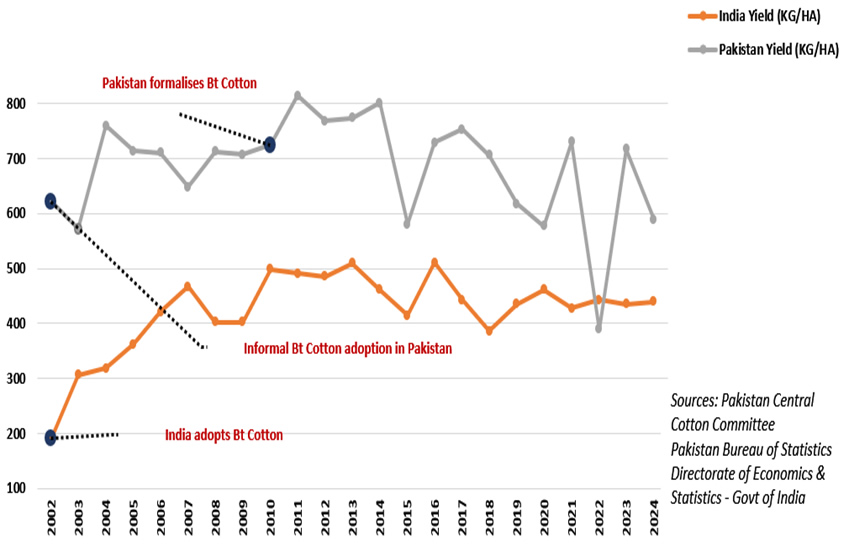
Bt cotton, based largely on Monsanto’s first-generation Cry1Ac (MON531) technology, entered Pakistan informally around 2002, before effective systems for biosafety, variety registration and seed quality assurance were in place. By 2007, an estimated 60% of Pakistan's cotton area was already planted with unregulated Bt cotton. Despite formal commercialisation in 2010, regulatory oversight struggled to catch up with the established informal market. By 2012, 52 Bt varieties were being cultivated, but only nine were officially approved. Around 85% of seed samples had an unknown origin and only 1% met the required Bt toxin level.
Consequently, these factors increased Bt-targeted pest resistance and secondary pests, pushing farmers back towards pesticide use. Cotton area declined from 3.2 million hectares in 2014–15 to 1.9 million hectares by 2025, with pink bollworm alone estimated to cause annual losses of around one million bales. Furthermore, first-generation Cry1Ac technology remained widely used even as its effectiveness declined.
The experience also highlighted the importance of conserving cotton’s genetic diversity. Studies found a narrow genetic base among cultivated varieties in Pakistan, while gene flow between Bt and non-Bt cotton was documented in Faisalabad. These findings raise concerns about cross-contamination and the long-term preservation of indigenous varieties and genetic resources essential for future breeding.
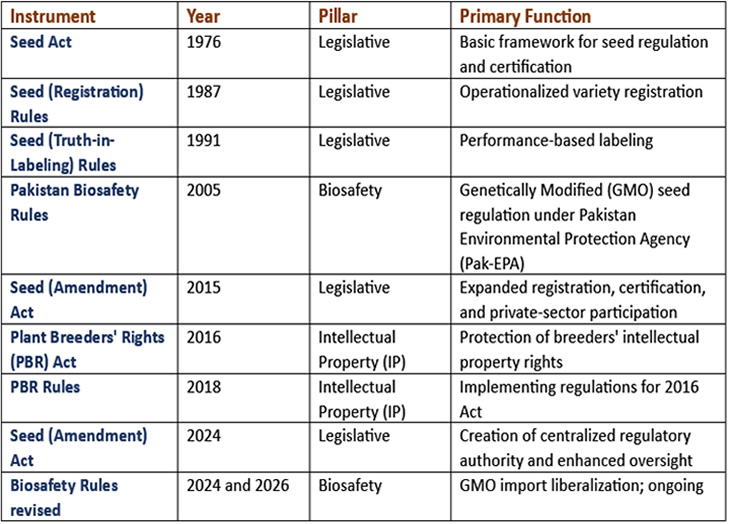
Pakistan has introduced a series of reforms to strengthen GM seed governance (Fig. 3). Together, they provide a stronger institutional foundation than existed during the early years of Bt cotton adoption. However, important gaps remain.
Figure 3: GM Seed Governance
Sources: Self-compiled
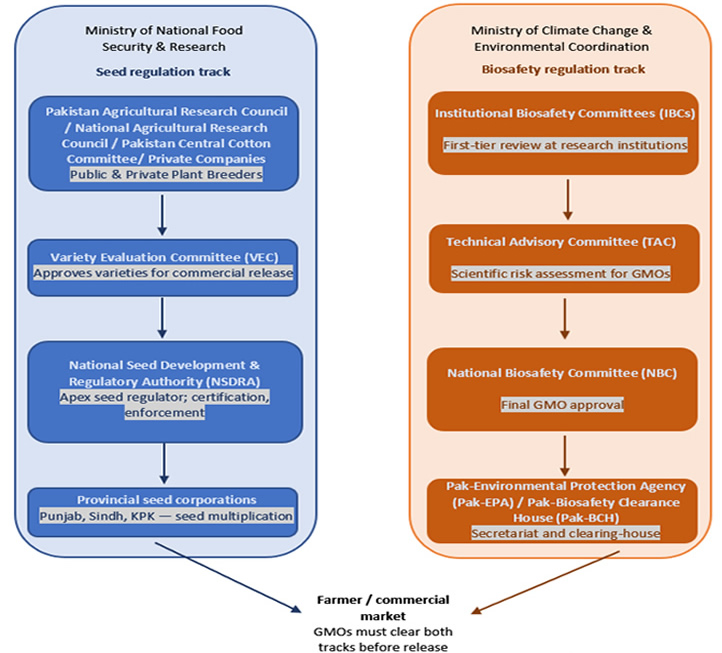
The first gap is institutional coordination. GM crops must complete two separate regulatory processes: biosafety approval by the National Biosafety Committee (NBC) and seed certification and variety registration by the National Seed Development & Regulatory Authority (NSDRA) (Fig. 4). Yet, neither the Pakistan Biosafety Rules 2005 nor the Seed (Amendment) Act 2024 explicitly establishes a formal mechanism for coordination or information-sharing between the two authorities. A joint coordination mechanism could ensure that biosafety approval, seed certification, and post-release oversight inform one another throughout a GM variety’s lifecycle.
Figure 4: GMOs Dual-Track Institutional Architecture
Sources: Self-compiled via government sources
The second gap concerns post-release monitoring. While institutions such as the Pakistan Central Cotton Committee (PCCC) generate technical evidence, provincial agriculture departments are better placed to monitor crops in the field and identify local changes in crop performance and pest pressure. A formal linkage between provincial field monitoring, research institutions, and NSDRA could ensure that such evidence informs national seed regulation and future approvals.
The third gap is research capacity. Sustained research and resistance monitoring are essential to maintaining GM crops’ effectiveness. Globally, documented cases of practical resistance to Bt crops rose from three in 2005 to 16 by 2016. Pakistan’s constrained agricultural research funding, including financial challenges at PCCC, underscores the need for stable funding for varietal evaluation, resistance monitoring and preservation of genetic diversity.
GM maize is the next test for Pakistan’s seed governance. Maize covers 1.59 million hectares, with production estimated at 8.79 million tonnes in 2025–26. Unlike Bt cotton, which spread informally before effective regulation, GM maize is now being considered through a government-led commercialisation framework, with coexistence of GM and non-GM maize under discussion.
Safeguards should therefore be established before widespread adoption, including traceable seed, post-release monitoring and a clear biosafety framework. Designated cultivation zones, alongside appropriate isolation distances, could further limit cross-contamination between GM and non-GM maize, protecting non-GM production and preserving genetic diversity.
In conclusion, Pakistan’s Bt cotton experience shows that technological adoption without strong governance can limit long-term gains. As GM agriculture expands, Pakistan must strengthen regulation, monitoring, research, and stewardship before adoption outpaces oversight.
Recent Insights



The views expressed in this Insight are of the author(s) alone and do not necessarily reflect the policy of ISSRA/NDU.