
Post 9/11, the use of force against non-state actors (NSAs) operating across borders has increased significantly worldwide. States have repeatedly invoked the inherent right of self-defence against cross-border terrorist sanctuaries (CBTS) without territorial-state consent.
This insight examines emerging scholarly writings and state practice on the threshold of the use of force against CBTS in light of international law principles, drawing on recent global practice and case studies from South Asia.
In principle, states are prohibited from the use of force under Article 2(4) of the United Nations (UN) Charter, subject to two exceptions: the right of self-defence under Article 51 or UN Security Council (UNSC) authorisation.
Over time, Article 51 has been extended to include attacks against NSAs, particularly following UNSC Resolutions 1368 and 1373, resulting in the United States (US) invasion of Afghanistan in 2001. Other instances include Colombia’s incursion into Ecuador in 2008; Türkiye’s operations in Iraq and Syria; and Kenya’s Operation Linda Nchi against Al-Shabaab, etc.
The trend continued with Israel's invasion of Palestine, invoking self-defence against Hamas post-October 2023 and extending the same rationale to the Lebanon invasion in 2024.
States have expanded the usual Article 51 interpretation and started justifying attacks against NSAs under the unable-or-unwilling doctrine (UUD) when the actions of NSAs are not attributable to the territorial or host state, but the state is unable or unwilling to act against them.
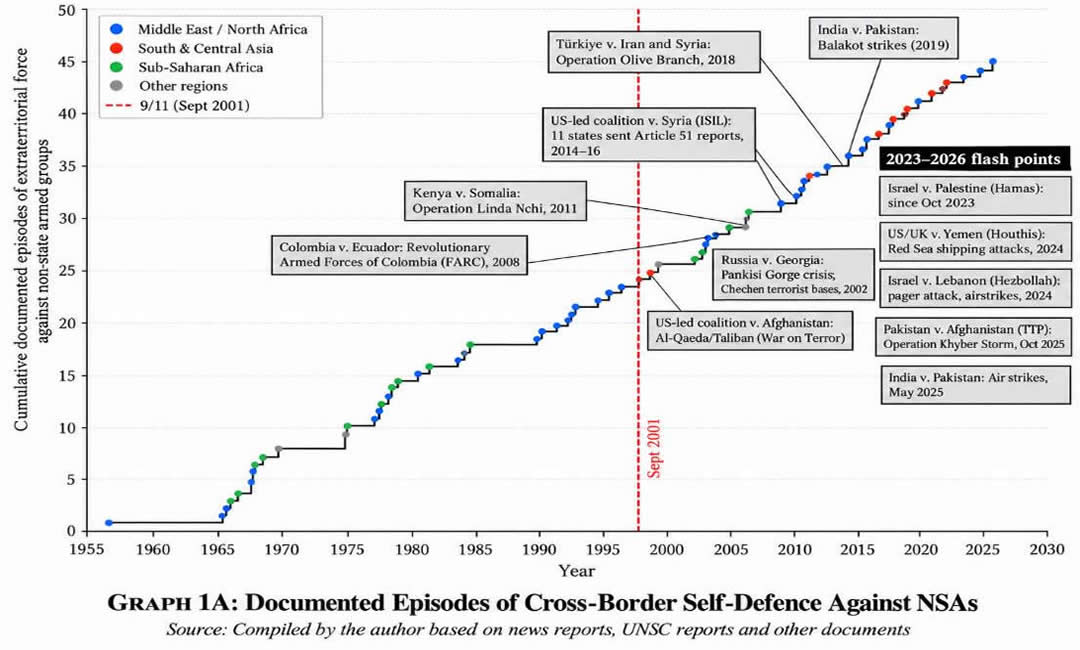
This doctrine can be traced back to the 1970s, to an attack by the Nixon administration against North Vietnamese forces in Cambodia. It gained prominence since the US 2014 campaign against the Islamic State of Iraq and the Levant (ISIL) in Syria.
However, the customary nature of UUD remains ambiguous. The jurisprudence on the application of Article 51 towards attacks against NSAs in foreign territory has evolved through ICJ judgments, which state that the legality of such an act can only be justified if the actions of the NSAs can be attributed to the territorial state. State practice, however, continues to expand, demanding settled parameters for the application of UUD.
Scholarly writings identify three requirements for UUD. The three-tiered test criteria have been synthesised from leading scholarship, including the Bethlehem Principles (16 principles governing self-defence against NSAs) alongside established international law principles.
The first criterion requires the threat to be imminent. The second requires force to be proportionate to the threat. Third, force to be used only if necessary as a last resort, following the exhaustion of reasonable diplomatic remedies and clear and convincing evidence that the territorial State is unwilling or unable to act despite a genuine opportunity to do so.
In South Asia, attacks under UUD have gained prominence as a counter-terrorism measure. Two notable case studies include India's 2019 and 2025 transgressive strikes and Pakistan’s 2026 invocation of the right of self-defence against CBTS in Afghanistan.
In case of India, the 2019 and 2025 strikes occurred shortly after the alleged terrorist incidents, without supporting evidence linking the attacks to the claimed militant group or alleged involvement of Pakistan. The occurrence of a completed attack did not, by itself, establish that a further armed attack was imminent. Hence, India failed to provide an objective basis to show that another attack was sufficiently probable, or to present evidence attributing the incidents to the militant group allegedly operating from Pakistan. Thereby, the criteria of imminence and necessity does not stand fulfilled.
India’s response was not proportionate to the alleged threat posed. The 2025 attacks resulted in significant civilian casualties and expanded the hostilities beyond a proportionate response to an alleged threat.
Both the 2019 and 2025 strikes were followed by days of continuing military confrontation. Most importantly, the threat did not exist beyond an isolated event, hence failing the proportionality test.
Finally, the absence of communication with Pakistan and any demand or opportunity to act first means India cannot establish Pakistan’s unwillingness or inability to eliminate the threat. Thus, India failed the UUD’s last-resort requirement.
Assessing Pakistani strikes against Afghanistan following the same three-tiered test produces different results. To satisfy the imminence criteria, Pakistan has presented evidence beyond its own intelligence assessments. The UN’s Analytical Support and Sanctions Monitoring Team reported in February 2025 that the Afghan Taliban were paying TTP’s emir roughly $43,000 monthly and hosting new TTP training camps across five provinces. Pakistan raised these findings at the UNSC in 2025, and its Permanent Representative cited nearly 6,000 TTP fighters across more than sixty Afghan camps. The UN's 2026 report also cites BLA fighters being trained alongside the TTP in Afghanistan.
Imminence is further supported by the continuing nature and scale of the cross-border threat. TTP and BLA-backed attacks in Pakistan, particularly in Khyber Pakhtunkhwa (KP) and Balochistan, are averaging 3 per day. Terrorism from Afghanistan was called the “gravest threat” to Pakistan’s national security in the UNSC, with Pakistan ranking No. 1 on the Global Terrorism Index.
Regarding proportionality, Pakistan’s operations in Afghanistan have been conducted amid continuous terrorism since the establishment of the Taliban government in 2021. BLA and TTP-linked violence has contributed to more than 4,000 fatalities in 2024-2025, including 1479 security-force deaths. Pakistan’s strikes were directed exclusively against terrorists rather than against the Afghan State or civilians.
Before resorting to force, Pakistan has repeatedly exhausted diplomacy first. The Ministry of Foreign Affairs summoned Afghanistan’s chargé d’affaires in December 2023, demanding that Kabul “apprehend and hand over” the TTP’s leadership and take positive action against BLA leadership and the same was also raised in Doha and Istanbul talks in 2025, yet no substantial action was taken by Afghanistan.
Taliban spokesman Zabihullah Mujahid has answered by calling these NSAs “Pakistan’s internal issue,” and Kabul has consistently declined Pakistani requests to expel BLA and TTP. Only after such diplomatic attempts did Pakistan resort to force.
In conclusion, while the state practice is emerging, it is imperative to adhere to the cumulative requirements of imminence, proportionality, and necessity. Subject to these requirements, Pakistan reserves its right to eliminate threats posed by CBTS, including TTP, BLA or any other non-State actor that continues to operate from foreign territory.
Failure to observe these safeguards risks enabling expansionist regimes like India, Israel, the US and others to misuse UUD for political gain with impunity. Therefore, these safeguards are essential to prevent the erosion of territorial sovereignty under international law. State practice is emerging, but it is imperative to adhere to the cumulative requirements to ensure such attacks are not used for political gain with impunity.
Recent Insights


The views expressed in this Insight are of the author(s) alone and do not necessarily reflect the policy of ISSRA/NDU.