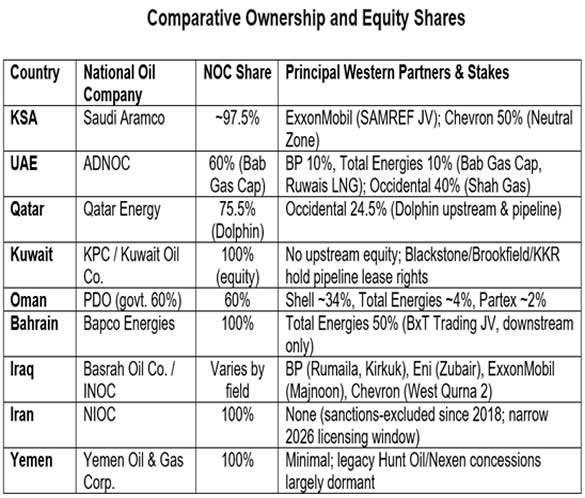
The Gulf holds roughly half of the world's proven oil reserves and a comparable share of its gas. Upstream title across the nine littoral states rests with national oil companies since the nationalisation wave of the 1970s–80s; Western supermajors instead hold minority equity, service contracts, or downstream control over refining, trading, and insurance.
This Insight surveys that architecture state by state, then asks what the US-Israel War against Iran of 2026 and China's growing stake change about it.
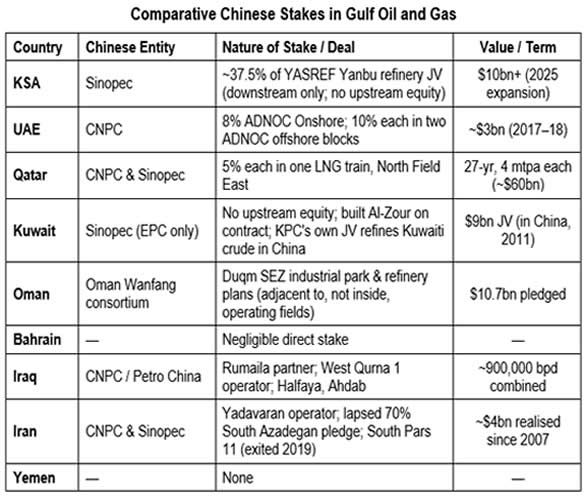
Saudi Aramco is about 81.5 % state-owned and 16 % owned by the Public Investment Fund. Western majors hold no upstream equity but keep downstream ventures— ExxonMobil's SAMREF refinery and Chevron's Neutral Zone stake. China holds no upstream equity either; Sinopec instead holds roughly 37.5 % of the YASREF Yanbu refinery joint venture.
ADNOC holds 60 % of the 2026 Bab Gas Cap concession, with BP and Total Energies at 10 % each, a pattern repeated across ADNOC LNG and Ruwais; Occidental holds 40 % of Shah gas. China sits inside the same concessions: CNPC paid $1.8 billion for 8 % of ADNOC Onshore and $1.2 billion for 10 % in two offshore blocks.
Qatar Energy controls the North Field and is expanding LNG output toward 160 million tonnes a year; Occidental holds 24.5 % of Dolphin's upstream project and pipeline. CNPC and Sinopec each took a first-ever 5 % stake in one North Field East LNG train, tied to matching 27-year, $60 billion offtake deals.
Kuwait's constitution bars foreign equity in hydrocarbons, so KPC restricts international firms to service contracts; Western capital entered instead via a 2026 sixteen-billion-dollar pipeline lease to Blackstone, Brookfield, and KKR. Chinese contractors built Al-Zour on contract only; KPC's own Sinopec joint venture instead refines Kuwaiti crude in China.
Petroleum Development Oman, roughly 70 % of national output, is a joint venture of the Omani government with Shell, Total Energies, and Partex. China's stake sits alongside, not inside, that structure: the $10.7 billion Oman Wanfang industrial park at Duqm, separate from the Oman-Kuwait-owned refinery.
In Bahrain, BAPCO was nationalised in 1997 and now sits under state-owned Bapco Energies; Total Energies co-owns the BxT trading joint venture, and Iranian missiles struck Bahrain's refinery during the 2026 war. China's direct stake here is negligible.
Iraq runs its fields through service contracts —BP at Rumaila, Eni at Zubair, Chevron replacing Lukoil at West Qurna 2 after 2025 sanctions, and Total Energies' twenty-seven-billion-dollar Basra portfolio. China outweighs the West in volume: CNPC and affiliates operate Rumaila, West Qurna 1, Halfaya, and Ahdab, near 900,000 barrels a day combined.
NIOC has held a monopoly since 1951; sanctions since 2018 have excluded Western majors, with only a narrow window opened by the 2026 ceasefire. China is Iran's dominant partner on paper — a 25-year pact and Sinopec's Yadavaran operatorship — yet realised investment is only about $4 billion since 2007, a fraction of Chinese capital in Saudi Arabia, since sanctions risk outweighs alignment.
Yemen's fragmented sector has seen only marginal activity since 2015; the abandoned tanker FSO Safer is now an environmental liability rather than an investment site. Contested sovereignty offers no enforceable contract for outsiders, Chinese or Western alike.
The US-Israel War against Iran in 2026 produced genuine claims that Iranian strikes on Al Udeid, Al Dhafra, and Bahrain's Fifth Fleet headquarters mark the end of American primacy in the Gulf. That reading conflates a military setback with structural withdrawal. None of the equity or contract positions above changed hands in the strikes; Rumaila, SAMREF, and Bab Gas Cap were untouched by fighting that damaged US bases around them.
Basing is a bilateral choice Gulf monarchies keep renewing; great powers rarely abandon strategic real estate, and rulers who need the same umbrella against Iran have every reason to keep it.
In US-Israel War against Iran, the US military primacy has been contested, but Western commercial and financial primacy has not moved — it never depended on invulnerability, but on equity, contracts, and insurance a missile cannot reach.
A parallel thread is the US-China rivalry, in which the Gulf functions as leverage rather than battleground. China takes roughly 38 % of all Hormuz-transiting crude and sources close to half its imports through the strait, plus most of Iran's exports and a third of its Gulf LNG. US bases in Bahrain and Qatar double as a forward fortress against China's naval reach in the Indian Ocean.
War-risk insurance, sanctions enforcement, and escort decisions—all Western-controlled—can be tightened on grounds Beijing cannot easily contest, though the effect falls disproportionately on Chinese cargo. China's own growing equity compounds rather than offsets this: stakes are heaviest where contracts are enforceable—Iraq, the UAE, Qatar—and thinnest in aligned Iran, and Beijing almost everywhere holds minority slices, never the majority control which ADNOC, Aramco, or Qatar Energy retain. This is a hedge against Hormuz risk, not a bid for control, and Beijing fields no fleet to protect it—so as Chinese equity rises, so does its exposure to the same Western-controlled levers.
Ownership is only part of Western leverage; the rest runs through pricing and insurance. Dated Brent, assessed by S&P Global Platts in London, remains the reference price for Gulf crude, reaching $131.97 a barrel in April 2026 as Hormuz disruption widened the physical-futures gap. Freight is benchmarked via the Baltic Exchange's TD3C route; war-risk cover runs mostly through London's Lloyd's market, where Hormuz premiums rose from 1–3 % of hull value to 7.5–10 % at the war's peak, roughly $20 million per large tanker. With roughly a fifth of global oil transiting Hormuz, this financial architecture gives the West a grip a missile strike does not touch.
Across the nine states, national oil companies hold upstream title while Western firms hold minority equity, contracts, and downstream control over pricing and insurance. Iranian strikes on US bases in 2026 were real, but touched no equity stake or contract. China's expanding but thin, minority-heavy footprint—deepest in Iraq, thinnest in Iran—adds a layer: Beijing hedges Hormuz exposure without a fleet of its own, inside the same Western-controlled architecture. Western primacy is shifting shape, from bases toward equity and insurance; on present evidence, it is not disappearing.
Iran's missiles reached the bases; they did not reach the balance sheets — and China’s growing stake in the Gulf sits inside that same balance sheet.
Recent Insights

The views expressed in this Insight are of the author(s) alone and do not necessarily reflect the policy of ISSRA/NDU.