
The Arctic region, north of the Arctic Circle, comprises only 4% of Earth’s surface. The Arctic Ocean covers about 15.6 million square kilometers, is largely covered by sea ice, and is surrounded by eight Arctic states.
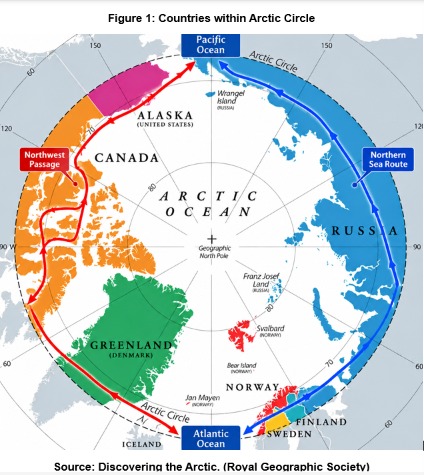
The Arctic’s strategic importance lies in its geography and resources. It connects North America, Europe, and Asia, making it important for global security, trade, and transport. Rising temperatures and shrinking ice are opening the Northern Sea Route and Northwest Passage, which connect the Pacific with the Atlantic and offer alternatives to traditional shipping routes. The region's vast reserves of oil, gas, and critical minerals add to its political weight.
This insight analyses how competition over the Arctic’s critical minerals and new shipping routes is shaping the strategic interests of four major power centers: the US, Europe, Russia, and China.
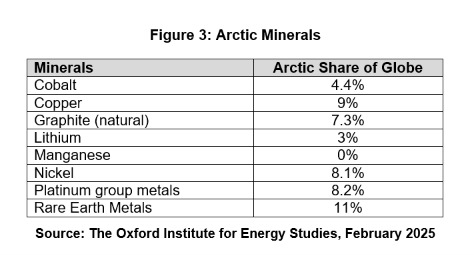
The Arctic holds about 30% of the world’s undiscovered gas and 13% of the world’s undiscovered oil, along with large supplies of strategic minerals, including copper, nickel, and platinum-group metals (Figure 2).
Figure 2: Treasure Map of the Arctic Region
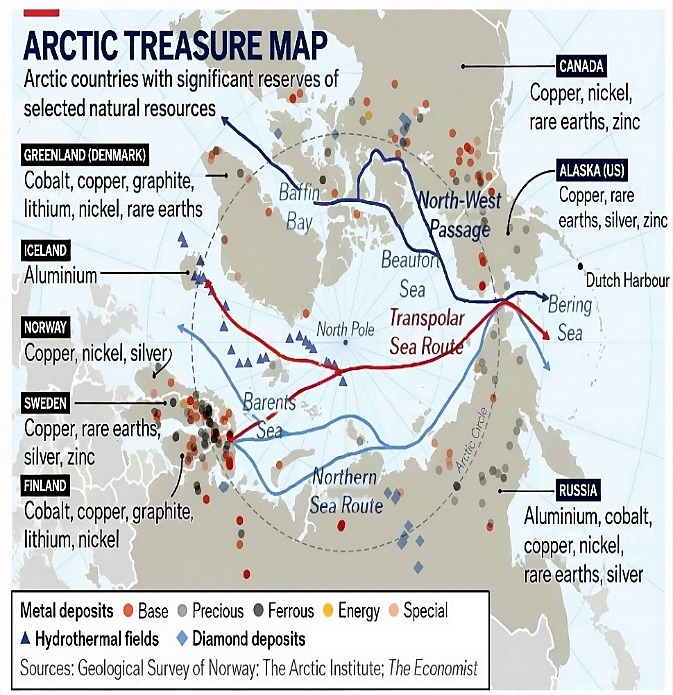
Source: Geological Survey of Norway: The Arctic Institute; The Economist
Greenland alone ranks eighth globally in rare-earth reserves, drawing the interest of major world powers. These resources are now contested by two blocs: the US and Europe, backed by NATO and its Nordic members; versus Russia-China.
At present, no single comprehensive treaty regulates the Arctic and its stakeholders. The United Nations Convention on the Law of the Sea (UNCLOS), in force since 1994, governs maritime boundaries and seabed claims. The Arctic Council, established in 1996, is a non-binding forum of the eight Arctic states that promotes environmental protection and sustainable development but excludes military security. Even these mechanisms are weak: the US has not joined UNCLOS, Russia claims the Northern Sea Route as its own waters, and the Arctic Council has worked only in limited form since the Russia-Ukraine war began in 2022.
Besides the US, Europe, Russia, and China, some other actors also hold stakes in the Arctic. South Korea operates the Dasan Arctic research station and India runs the Himadri research station, both in Svalbard, while Japan is building the Mirai II, its first icebreaking Arctic research vessel. Meanwhile, Canada is expanding its defense and icebreaking capabilities.
Among the four power centers, the US leads the Western bloc, backed by NATO and its Nordic allies. It holds roughly 15% of the Arctic region through Alaska. Its Arctic interests are resources, defense, and sea routes.
Since 2025, a presidential executive order has fast-tracked critical mineral projects in Alaska, including the Ambler Road, and an October 2025 memorandum approved new Arctic icebreakers to secure access to Arctic Sea routes.
Greenland is central to US strategy because of its location and minerals. It lies between North America and Europe, hosts the US Pituffik Space Base, which tracks missile threats, and overlooks the Greenland, Iceland, and the United Kingdom (GIUK) gap, the sea passage that Russian submarines use to reach the Atlantic. It also holds two of the world’s largest rare-earth deposits, Kvanefjeld and Tanbreez. Tanbreez matters to the US because Critical Metals Corp, a US-listed company, is developing it to supply Western markets
On September 22, 2026, the US, Denmark, and Greenland signed an agreement at the UN General Assembly allowing the US to expand its military presence on the island. It restricts Russia, China, and other non-NATO countries from establishing military bases, while Denmark keeps its sovereignty over Greenland.
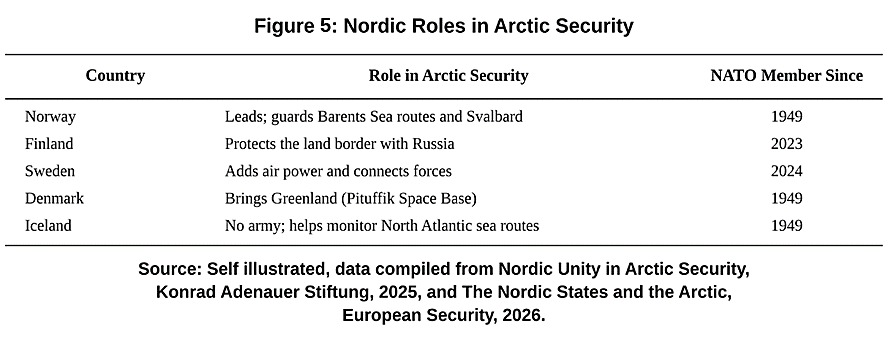
All the Nordic countries including Denmark, Norway, Sweden, Finland, and Iceland, play a key role in the US-led Arctic security bloc. Since Finland joined NATO in 2023 and Sweden in 2024, every Arctic state except Russia is now a NATO member. Norway leads the Nordic countries in Arctic security because it has a long Arctic coast, controls Svalbard, and faces Russia in the Barents Sea, while the others play supporting roles under NATO’s overall command (Figure 5).
The second Western power center, Europe, engages the Arctic through the European Union (EU), whose members Finland, Sweden, and Denmark are Arctic states.
To reduce its dependence on China for critical minerals, the EU signed a raw materials partnership with Greenland in 2023 and opened an office in Nuuk in 2024, while Sweden’s LKAB found Europe’s largest known rare-earth deposit near Kiruna in 2023.
Although the EU is the main destination of Arctic shipping routes from Asia, its sanctions on Russia keep European shipping off the Northern Sea Route, leaving Russia and China as the route’s main users. Moreover, the EU has no Arctic military role, relies on NATO for security, and lacks full observer status in the Arctic Council.
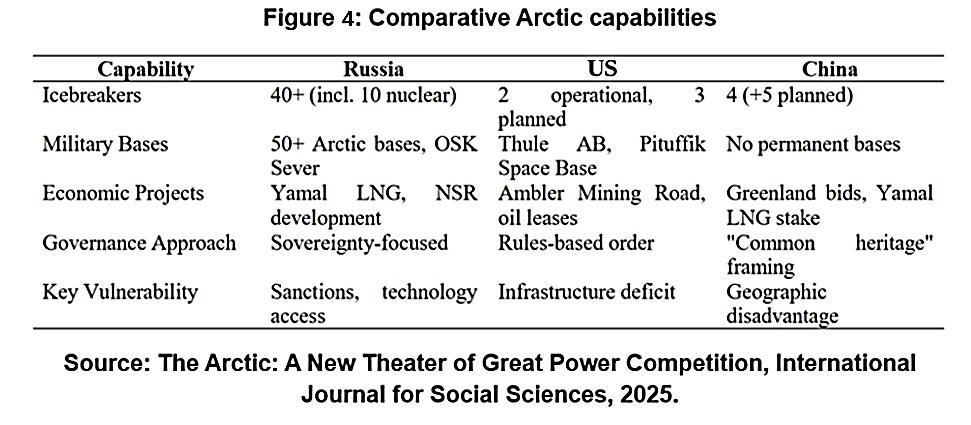
For Russia, the Arctic is central to its identity and security (Figure 4). It controls about 53% of the coastline and the largest share of the region’s undiscovered oil and gas reserves. Russia operates 32 continuously attended Arctic military sites, nearly half on the Kola Peninsula around its Northern Fleet headquarters at Severomorsk, with the rest stretching along its northern coast to the Bering Strait (Figure 6).
Figure 6: Arctic Military Sites by Country
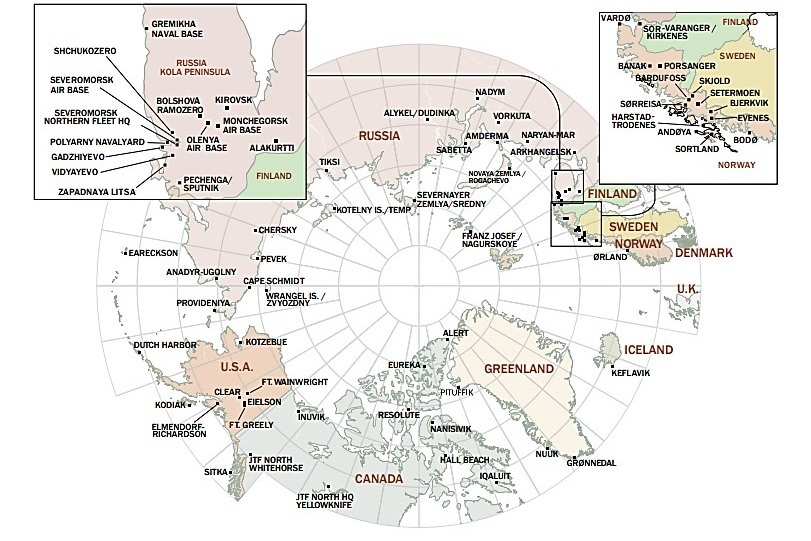
Russia: 32 | US-led NATO bloc: 37
(Norway 15, US 10, Canada 8, Denmark (Greenland) 3, Iceland 1)
Source: Newsweek, February 2025, based on data from The Simons Foundation Canada, 2024
Russia also maintains the world’s largest icebreaker fleet, with more than forty polar icebreakers compared with three operated by the US (only two fully operational) and four by China, and in August 2020 it allocated an estimated $2 billion for new nuclear-powered icebreakers to keep the Northern Sea Route open. Moscow plans to become the world’s second-largest rare-earth producer by 2030 by investing $1.5 billion; however, Western sanctions constrain it.
China, though not an Arctic state, calls itself a “near-Arctic state” and invests in infrastructure, diplomatic ties, and scientific cooperation. It is increasingly drawn to Arctic routes, which offer a shorter path to Europe and could gradually strengthen its position in great power competition.
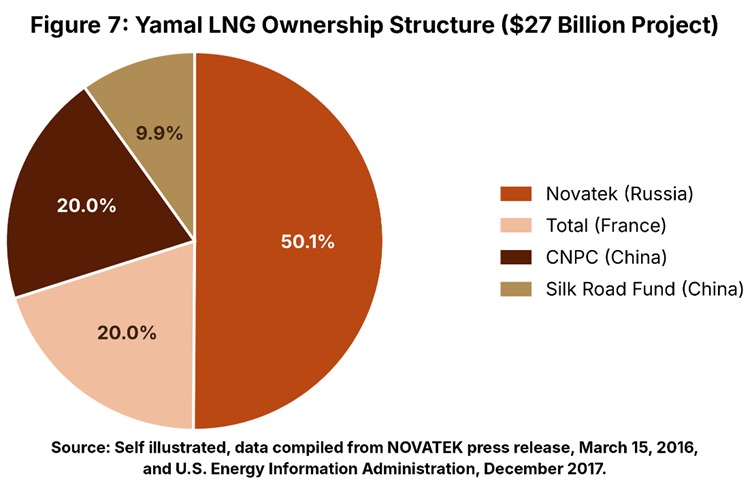
In rare-earth minerals, China’s Shenghe Resources holds about 6% of Energy Transition Minerals, the developer of Greenland’s Kvanefjeld deposit. For energy, China holds a combined 30% stake in Russia’s $27 billion Yamal liquefied natural gas (LNG) project through China National Petroleum Corporation and the Silk Road Fund (Figure 7). Through its “Polar Silk Road” plan, it has partnered with Russia to develop the Northern Sea Route, which is about 40% shorter than the Suez route. Chinese container voyages on the route doubled from 7 in 2023 to 14 in 2025.
The US backed by NATO, and Nordic countries, remains the most influential Arctic power. Russia’s military presence and geography combined with China’s economic influence and their growing partnership, show that the competition is expanding beyond traditional security concerns. As each power seeks to shape Arctic rules in its favor, no formal binding framework exists. Without one, the race for Arctic minerals and routes will bring rivalry before it brings stability.
Recent Insights



The views expressed in this Insight are of the author(s) alone and do not necessarily reflect the policy of ISSRA/NDU.