
After taking office in 2013, President Xi Jinping launched a comprehensive anti-corruption campaign that is widely regarded as one of the most significant in Chinese modern history. This insight analyses President Xi’s anti-corruption campaign, focusing on its effectiveness, challenges, and the lessons it offers.
Like any other country, China faced corruption in public sector since independence. During the Mao Zedong era, the government launched two major anti-corruption campaigns, the “Three Antis” (anti-corruption, anti-bureaucratism, and anti-waste) and “Five Antis” (anti-Bribery, anti-theft of state property, anti-tax evasion, anti-cheating on government contracts and anti-stealing of state economic intelligence) in 1951 and 1952, respectively. After launching these anti-corruption campaigns, registered cases rose from 2,864 in 1950 to 12,748 in 1951 and 29,744 in 1952. By 1972, a total of 1.227 million cases were registered, and 299,248 corrupt officials were sentenced.
During President Deng Xiaoping’s 1978 economic reforms, the Chinese economy shifted from a rigid command system to a market-oriented one, which also fueled corruption. In particular, the introduction of a two-track pricing system, in which commodities had both a lower state-planned price and a higher open-market price, led to increased corruption as officials capitalised on it by diverting state-allocated goods into the open market. From time to time, governments attempted institutional and disciplinary reforms, but corruption continued to expand, and by 2010, scandals involving many senior Communist Party of China (CPC) officials also appeared.
In earlier governments, anti-corruption measures were treated as a political campaign: decentralised, periodic, lenient to flies, and largely incapable of countering high-ranking officials. However, President Xi expanded and centralised the Central Commission for Discipline Inspection (CCDI) and its investigative mechanisms across the state apparatus, making it the highest anti-corruption agency. Another key institutional development was the establishment of National Supervisory Commission (NSC) in 2018, which extended nationwide supervisory authority beyond CPC members to all public officials.
After taking office in 2012, President Xi started a large-scale anti-corruption campaign targeting both senior officials (tigers) and lower-level officials (flies) to ensure legitimacy and party discipline. The number of corruption-related cases, formally filed by Chinese disciplinary authorities, increased from 0.155 million in 2012 to 1.012 million in 2025, representing more than a tenfold increase. The conviction rate increased from 0.18 million in 2013 to 0.98 million in 2025.
The anti-corruption campaign’s effectiveness lies in its ‘tigers’ and ‘flies’ adaptation strategy, which targets and holds accountable both senior and junior officials. From 2012 to 2025, more than 500 ministerial-level officials, 30,000 Bureaucratic officials, 250,000 county-level officials, around 1 million township-level officials, and several million grassroots officials were investigated. This sharp expansion demonstrates growing investigative capacity of disciplinary institutions and sustained intensity of anti-corruption enforcement, which has remained active for more than a decade since its launch.
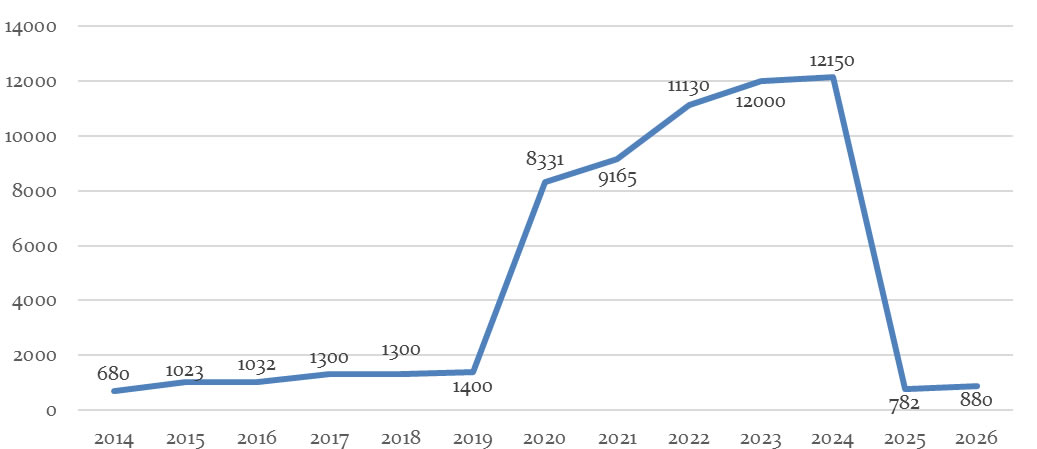
In 2015, the scope of the anti-corruption campaign expanded beyond China’s territorial boundaries when the 1980 Criminal Law was amended, which enabled the punishment of Chinese nationals engaged in corruption internationally. Under the Fox Hunt operation, China officially launched regular anti-corruption operations to target corrupt officials who fled overseas. Under these operations, authorities arrested criminals, including government officials charged with monetary corruption from 120 countries. From 2014 to 2026, authorities returned more than 47,873 fugitives to China and successfully recovered assets (Figure 1).
Figure 1: Number of Fugitives Returned in Successful Cases 2014-26
Sources: Global Times, Xinhua, China Daily
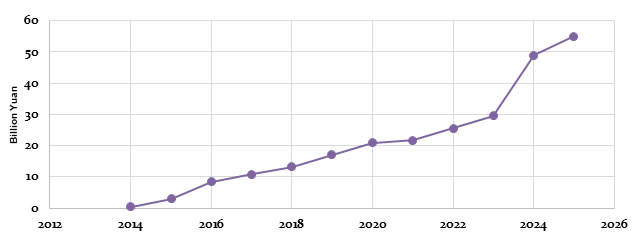
By 2025, authorities had recovered approximately 88 billion Yuan in identifiable assets, demonstrating that the campaign not only strengthened party discipline but also generated substantial fiscal returns to China’s treasury. Of this amount, authorities recovered 38.7 billion Yuan from domestic, and 55 billion Yuan from overseas cases (Figure 2).
Figure 2: Cumulative Financial Asset Recovery from Overseas
Source: China Daily, Global Times, Lin
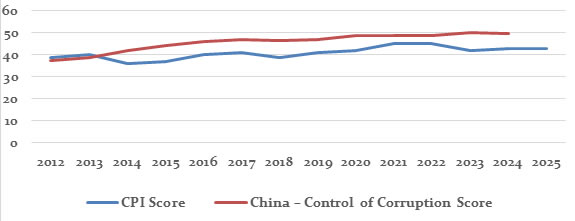
The campaign has successfully reduced citizens' perceptions of corruption, while strengthening public assessments of the Chinese government’s pledge to combat corruption. The Transparency International Corruption Perceptions Index (CPI) shows a modest long-term improvement in public perception regarding corruption in China (Figure 4). Alongside domestic-level indicators shown by CPI, China’s performance in the anti-corruption index is also reflected in international indices like World Bank's Control of Corruption Score (Figure 3). In 2012, when the anti-corruption campaign began, China’s score was 37.6, and in 2024 it improved to 49.7. The World Bank data complement the Chinese claim.
Figure 3: Corruption Perception Index Score and Control of Corruption Score (Higher score = lower perceived corruption) and Control of Corruption Score
Source: Transparency International, World Bank
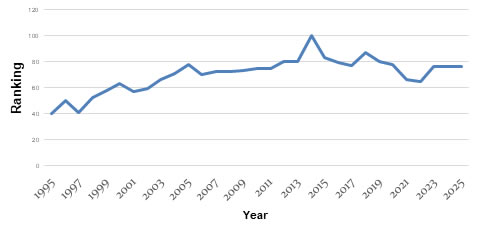
Transparency International's historical CPI data also confirm a decline in corruption in China. In 2014, China ranked as the 100th most corrupt country in the world, and by 2025 its ranking had fallen to 76th (Figure 4).
Figure 4: China's Rank in Corruption 1995-2025
Source: Transparency International
Despite significant successes, President Xi’s anti-corruption campaign also faces notable challenges. The most pressing is bureaucratic risk aversion. Officials fear disciplinary actions for corruption charges, prevents them from initiating new initiatives. This fear eventually slows decision-making across departments.
In 2016, President Xi introduced ‘three distinctions’ to reduce officials' fear of punishment and encourage them to take initiative. It separates honest mistakes from deliberate misconduct, distinguishes between inexperience and wrongdoing, and differentiates fault tolerance from error correction. The mechanism of the three distinctions is applied by investigation officers in corruption cases through examination of the circumstances. They assess whether the official made an honest mistake or acted deliberately. If an honest mistake or wrong action is found due to inexperience, then officials are given an opportunity to correct it. This ensures that corrupt officials are punished and prevents officials from hesitating to take initiative for fear of investigation.
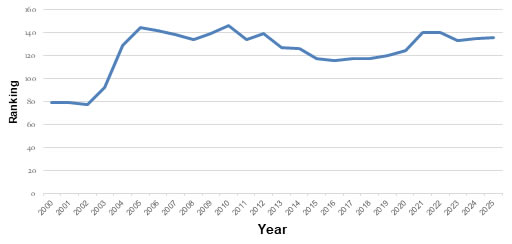
In the CPI ranking, Pakistan ranked 79th in 2000 and 136th in 2025 (Figure 5). Over the past 25 years, Pakistan's corruption ranking indicates that the country is experiencing rising corruption in the public sector.
Figure 5: Pakistan's Ranking in Corruption 2022-2025
Source: Transparency International
President Xi’s anti-corruption campaign has achieved significant successes because of strong political will. It paved the way for targeting corrupt officials from ministers to village chiefs. In Pakistan, corruption has increased manifold (Figure 5). It needs an anti-corruption drive backed by strong political will, built on national debate, should be transparent and not used for political victimisation. Until it becomes a subject of national discourse, no anti-corruption campaign can succeed.
Recent Insights



The views expressed in this Insight are of the author(s) alone and do not necessarily reflect the policy of ISSRA/NDU.