
Located at the southern tip of the Arabian Peninsula, Yemen enjoys a strategic location which contributes to its consistent presence in global geopolitics. This insight analyses how fragmentation and weak unification, intensified by external intervention, have contributed to prolonged instability in Yemen.
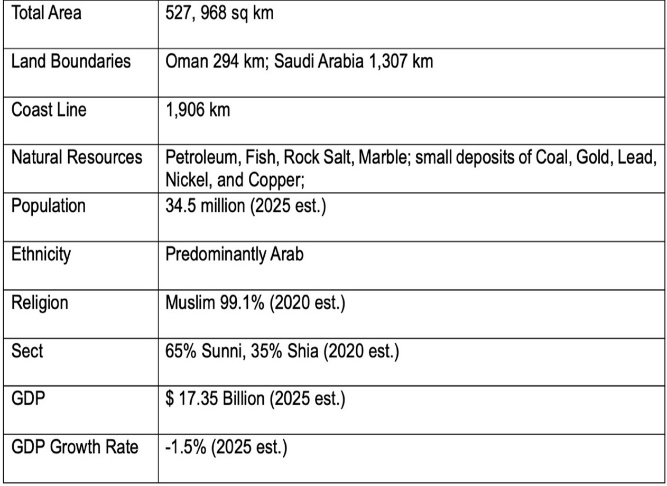
Figure 1: Country Profile
Source: The World Factbook
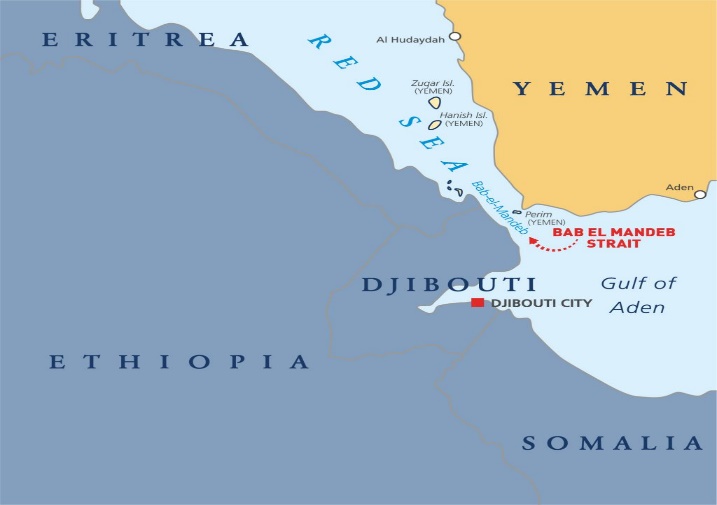
Yemen shares borders with the Kingdom of Saudi Arabia in the north, Oman in the east, the Red Sea in the west, and the Gulf of Aden and the Arabian Sea in the south (Figure 1). Due to its proximity to the Bab El Mandeb Strait, it occupies a sensitive geopolitical location. This important maritime route connects the Red Sea to the Gulf of Aden and further to the Indian Ocean. According to estimates, 7% of global trade and 30% of the global oil supply pass through this strait, making it significant in global geopolitics (Figure 2).
Figure 2: Bab EI Mandeb Strait
Source: Nakilat
Figure 3
Source: Stratfor
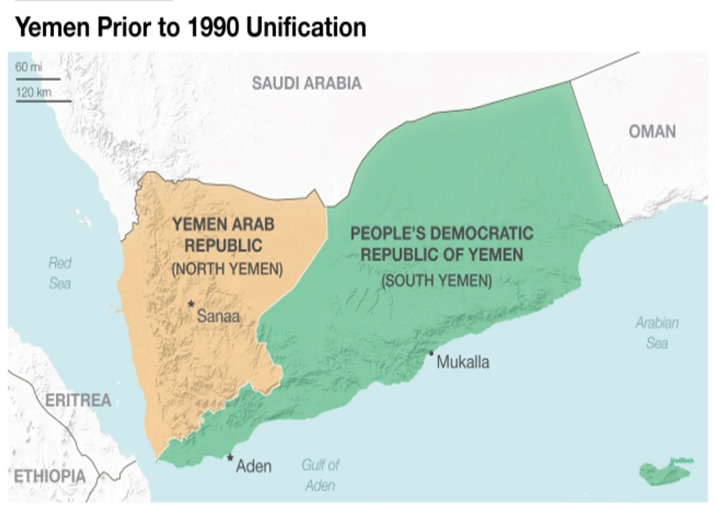
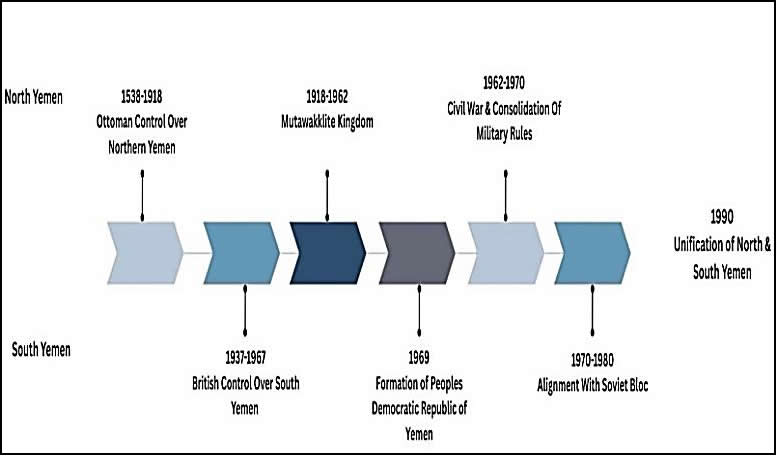
Instability in Yemen stems from consistent internal fragmentation, intensified by external intervention. Historically, Yemen did not function as a unified state (Figure 3). Northern Yemen governance revolved around Zaydi imamate traditions, tribal autonomy, and Ottoman influence. The 1962 revolution led to the establishment of the Yemen Arab Republic in the North.
Contrastingly, Southern Yemen came under British Colonial rule and developed maritime trade institutions. After the British withdrawal in 1967, South Yemen emerged as a Soviet aligned socialist state. These different approaches to governance established regional authority that later hindered state consolidation. Divergences were further reinforced by opposing blocs during the Cold War. North Yemen maintained links with Western and Gulf states, while South Yemen remained Soviet-aligned (Figure 4).
Figure 4: Timeline till Unification
Source: Self-Compiled
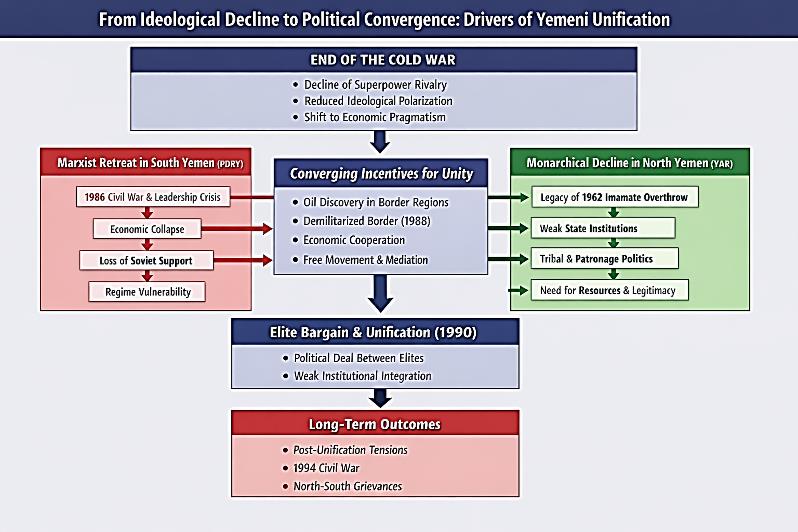
Efforts for unity between South and North Yemen began with the Cairo Agreement in 1972 and the Kuwait Agreement in 1979, but materialised in 1990. The end of the Cold War was pivotal for the unification of Yemen. While North Yemen’s links with Western and Gulf States continued to foster, South Yemen lost soviet patronage. This created asymmetries that influenced unification (Figure 5).
Figure 5: Drivers of Yemen’s Unification
Source: A History of Modern Yemen
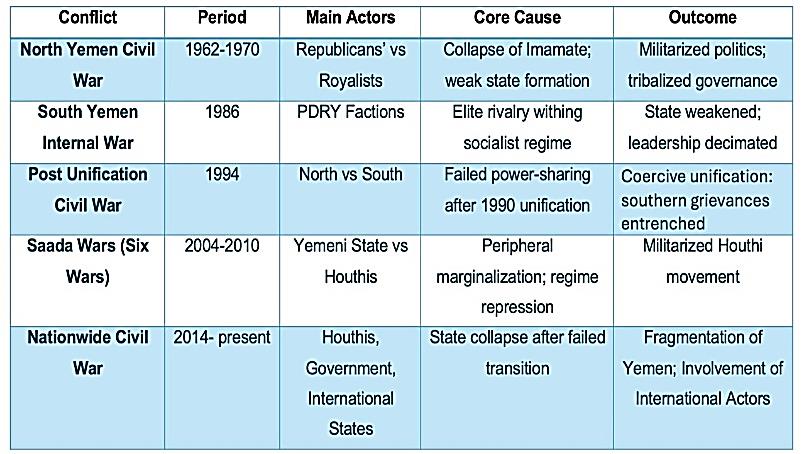
The Yemen Arab Republic and the People’s Democratic Republic of Yemen unified officially on 22nd May 1990. The unification of Yemen did not consolidate governance but instead preserved dual power structures in Sanaa in the North and Aden in the South. Despite unification, leadership remained centralised in Sanaa. In the South and certain areas of the North, fragmentation was preserved through weak institutional integration and continued marginalisation. This resulted in the 1994 civil war and the failed post-Arab Spring transition in 2011. These events reproduced fragmented authority instead of addressing post-unification divisions.
Figure 6: Major Wars in Yemen
Source: Self-Compiled
Within this context, the Houthis emerged from the Zaydi Population in Northern Yemen in the 1990s. The Houthis rose due to longstanding peripheral marginalisation, becoming a key political and military force. They were originally a revivalist movement seeking to consolidate political authority while defending the interests of Zaydi communities. They were able to capitalise on the fragmentation of the elite, dissatisfaction with the new government, and institutional collapse, seizing the capital Sanaa and leading to the outbreak of a full-scale civil war in 2014 (Figure 6).
As the conflict persisted, regional and international actors intervened to secure strategic interests, internationalising the civil war. The Houthis reportedly received support from Iran since the 1990’s. Iran’s support reflects its interests in countering the KSA and Gulf influence, while gaining leverage in the Red Sea without deploying forces.
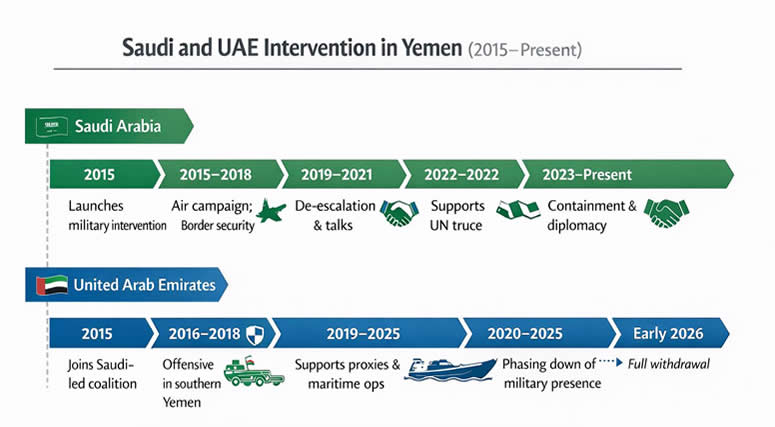
KSA led a coalition of nine regional partners in March 2015 to prevent the consolidation of the Iran-aligned government and to restore Yemen’s internationally recognised government. KSA reinforced militarisation over political solutions, prioritising its strategic position on its southern border. The US aided the KSA by providing the Saudi-led coalition with arms, intelligence, and logistics in its aim to protect maritime security.
Figure 7: Saudi and UAE Intervention in Yemen (2105 – Present)
Source: Self-Compiled
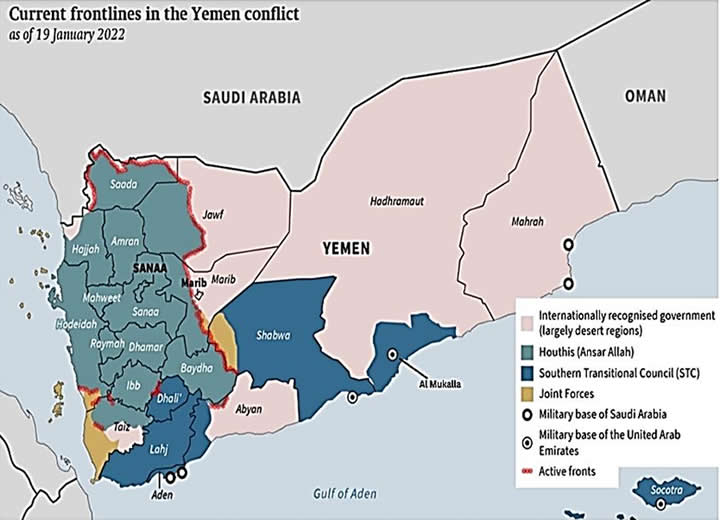
The UAE joined KSA to counter the Houthis in 2015 (Figure 7). Later, they pursued an independent policy, focused on securing strategic ports and maritime routes. They remained focused on keeping stability and preserving the Red Sea trade route. UAE withdrew its troops in 2026 after its diplomatic split with KSA. However, influence persists through its proxy, the Southern Transitional Council, which controls vital ports, including Aden, Mukalla, and Socotra (Figure 8).
Figure 8
Source: Sharqforum
Following Israel’s genocidal actions in Gaza in November 2023, the Houthis attacked Israel-linked targets in the Red Sea. Citing protection of maritime routes, strikes were carried out jointly by the US and Israel in Sanaa and the Hodeida region of Yemen in September 2025. Recognition of Somaliland in December 2025 by Israel is also seen as an effort to secure strategic depth and access in the Gulf of Aden. These developments represent a broader effort to expand its strategic interests in the Red Sea.
China’s interests in Yemen stem from its economic and maritime priorities. Yemen's proximity to the Bab El Mandeb Strait in the Red Sea makes it significant for Chinese trade and oil imports. However, the state has pursued a strategy of non-interference amidst the Red Sea crisis. The state’s approach reflects its broader interest in maintaining maritime trade routes, relying on diplomatic and economic tools rather than direct military intervention.
Taken together, continued fragmentation and external intervention have contributed to Yemen's increased prominence in global geopolitics. Yemen’s proximity to the Bab El Mandeb Strait has contributed to its significant role in regional escalations. Amidst the Persian Gulf conflict, recent Houthi threats of disruption in the Red Sea, alongside missile attacks launched towards Israel on 28 March 2026, highlight Yemen’s role in regional conflicts.
This is likely to prompt a joint US-Israel response, including naval deployments in the Red Sea, and air strikes on Houthi positions, to secure the maritime route. When viewed alongside the closure of the Strait of Hormuz, any simultaneous disruption in the Bab El Mandeb Strait will disrupt supply chains, contributing to wider economic instability worldwide.
As these dynamics intensify, the consequences faced by global states will increase. Within these circumstances, Yemen is likely to remain a critical juncture where fragmentation and global strategic interests intersect.