West Asia remains the only major region of the international system without a comprehensive, inclusive architecture through which its own states can manage disputes among themselves. Europe built the Organisation for Security and Co-operation (OSCE) out of the Helsinki process; East Asia, despite deep rivalries, developed the Association of South East Asian Nations (ASEAN) Regional Forum and related mechanisms. West Asia has produced no equivalent. The result is a recurring pattern: every serious crisis is settled, or mismanaged, by powers from outside the region rather than by the states most affected by it.
The record of the last four decades illustrates this pattern starkly — from the two Gulf Wars, through Israel's campaigns in Gaza, Lebanon and Syria, to the 2026 war in which the US and Israel struck Iran and martyred its Supreme Leader, Ali Khamenei. Iran's retaliatory closure of the Strait of Hormuz froze one of the world's principal oil chokepoints and triggered a US-led naval blockade and air campaign to reopen it. A fragile ceasefire was mediated in April 2026, and later, the Islamabad Memorandum of Understanding (MoU) in June 2026, which has not yet resolved the underlying dispute over transit rights in the Strait.
In parallel, the Houthis' blockade-style attacks have repeatedly closed the Red Sea's Bab-el-Mandeb corridor to Israeli-linked and, more recently, Saudi shipping, drawing in US, UK and European naval task forces on a semi-permanent basis. Each crisis has drawn a different set of external militaries into the region, rather than a regional mechanism managing it.
Existing Arab and Islamic bodies do not fill this gap. The Gulf Cooperation Council (GCC), formed in 1981, comprises only six Arab monarchies and was never designed to include Iran, Iraq or Yemen. The 22-member Arab League includes non-Gulf Arab states but structurally excludes Iran and Türkiye altogether, and its consensus procedures have repeatedly produced paralysis rather than action; Gulf commentators openly describe the League as a “structural guarantee of inaction” and have called for a smaller, more decisive coordination council in its place.
The 57-member Organisation of Islamic Cooperation (OIC) is broader still, but its requirement of full consensus and recurrent Saudi-Iran rivalry within it has left it unable to act decisively even on issues central to its founding mandate. None of these bodies can serve as a genuine table around which Gulf Arab states, Iran, Türkiye, Iraq, Syria, Lebanon, Yemen and Pakistan can sit as equals. A more promising and already-existing nucleus is the Economic Cooperation Organisation (ECO). Founded in 1985 by Iran, Pakistan and Türkiye as a successor to the Regional Cooperation for Development (RCD) framework of 1964, ECO expanded in 1992 to ten members spanning a region of over 460 million people.
Crucially, ECO already contains the three non-Arab states whose absence hollows out Gulf-Arab bodies: Iran, Türkiye and Pakistan. Extending ECO's membership or observer status to the GCC states —Iraq, Syria, Lebanon, and Yemen—or using its charter, the Treaty of Izmir, as a template for a new, purpose-built West Asian forum, would cost far less political capital than starting from a blank page. That such a mechanism is wanted, not merely theorised, was demonstrated in 2026 itself.
Pakistan hosted direct US-Iran talks in Islamabad in April, helped broker the ceasefire that paused the war, and kept channels open through further rounds that produced the Islamabad MoU—a role Washington and Tehran both came to trust despite Pakistan's marginal formal standing in West Asia.
In the war's aftermath, an informal grouping of Saudi Arabia, Qatar, Egypt, Pakistan and Türkiye emerged outside the GCC framework altogether—evidence that regional states are already improvising the cross-cutting coordination that no standing institution currently provides.
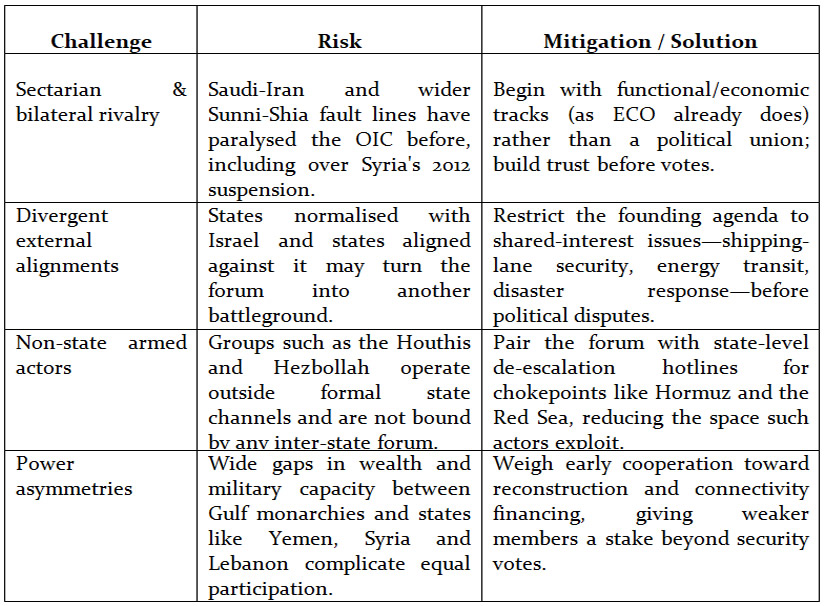
An institutionalised forum would convert these ad-hoc coalitions into a durable habit of regional self-management. No such forum will emerge without resistance. Four challenges stand out, alongside a corresponding path through each. A fifth and irreducible risk is that of spoilers. External powers whose regional leverage depends on West Asia's fragmentation, and regional actors who benefit from bilateral patronage relationships, have every incentive to resist a forum that reduces their room for manoeuvre.
This resistance should be expected rather than treated as a reason for inaction: no regional architecture anywhere in the world was built with the unanimous consent of the powers it constrained. The test is not whether a West Asian consultation mechanism can eliminate outside involvement, but whether it can give the region's own states a seat at the table before, rather than after, the next external intervention.
The Gulf Wars, the Israel-Palestine Conflict, Syria and the US-Israel War on Iran in 2026, all share a common feature: their resolution, however partial, has depended on powers from outside West Asia. Pakistan's mediating role in 2026 shows both the demand for regional problem-solving and the diplomatic capital available to build it. Extending ECO, or building a parallel forum on its model, offers the region a realistic starting point for the consultation mechanism it has lacked since the modern state system took shape in West Asia—one built, this time, by the region's own states.