
India is currently the third-highest emitter of CO2 in the world, accounting for 8% of global emissions, raising environmental safety concerns for other countries in the region, including Pakistan, Bangladesh, Nepal, Afghanistan, Bhutan, and Sri Lanka. Multifaceted concerns arise in international environmental law when one state’s industrial and developmental waste causes significant air pollution across its borders.
This insight analyses how India's expanding cross-border emissions and transboundary pollution affect its neighbouring countries, especially Pakistan, and evaluates this in light of environmental law principles governing transboundary harm and environmental responsibility.
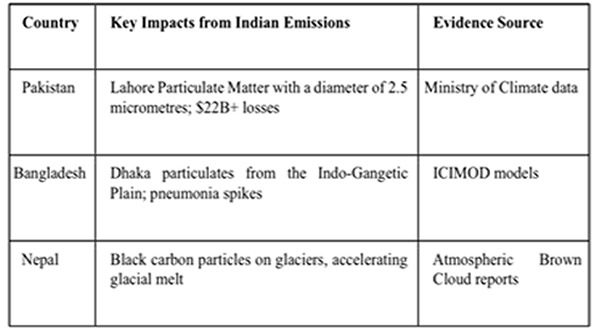
Sources: Pakistan Senate Standing Committee on Climate Change (2025); ICIMOD Indo-Gangetic Plain Air Quality Dashboard (2024); UNEP Atmospheric Brown Cloud Report (2008).
According to a 2025 Carbon Brief, India accounted for 31% of global growth in energy-sector emissions from 2014 to 2024, while Air Visual recognised that 22 of the 30 most polluted cities in the region are in India.
By contrast, Pakistan accounts for less than 1% of global CO2 emissions. Despite this minimal contribution, Pakistan remains among the most climate-vulnerable countries in the world. According to the German watch Global Climate Risk Index, Pakistan is ranked the 5th most vulnerable country to climate change, facing disproportionate risks from extreme weather events, glacial melt, and air pollution.
NASA satellite imagery from November 2024, along with Pakistan's Ministry of Climate Change data on plume movement and wind direction, confirms that a significant portion of Lahore’s PM 2.5 smog originates from India's industrial emissions and agricultural burning.
Indian and Pakistani Punjab form a single shared airshed. India is the primary polluter in this airshed, imposing a disproportionate burden on Pakistan’s side of Punjab. Research reveals that approximately 30% of Lahore’s smog originates from crop residue burning across the border, particularly in Haryana and Punjab, India. No governing authority exists to manage transboundary pollution across this airshed, making cross-border contamination structurally inevitable.
India's transboundary pollution extends beyond the airshed, inflicting measurable harm on Pakistan's glaciers. Black carbon from India’s cross-border agricultural burning and industrial emissions deposits on the Himalayas-Karakoram-Hindu-Kush (HKH) glaciers. This accelerates melting and threatens the Indus Basin's glacier-fed irrigation, linking air pollution to water stress and food insecurity.
India's transboundary pollution has caused significant, documented economic losses to Pakistan. According to the 2022 World Bank Pakistan Country Climate and Development Report, climate-related damage from the 2022 floods alone cost the country more than $30 billion in economic losses.
These economic and health costs, borne by Pakistan, amount to 5% of Pakistan’s GDP, and therefore should be considered under the polluter- pays principle recognised by the United Nations Conference on Environment and Development (UNCED).
States can be held financially liable for transboundary environmental harm; one recent example is the Certain Activities Carried Out by Nicaragua in the Border Area case, in which the ICJ confirmed that measurable transboundary environmental damage gives rise to monetary liability.
The Trail Smelter Arbitration, between the US and Canada, established that no state can use its territory to cause significant pollution in another state's territory, recognised as customary international law under the ''no-harm rule'', reaffirmed in many cases, including the Pulp Mills on the River Uruguay Case. This rule provides a basis for state responsibility where transboundary pollution is attributable to activities within a state’s jurisdiction.
International law norms prohibit one state from causing harm to another, and India's emissions volumes demand accountability under UN frameworks, especially Principle 16 of the Rio Declaration (1992), which asserts, polluter should bear the cost of pollution. This aligns with the broader norm of common responsibility, acknowledges the varying roles of different countries, and argues that nations that contribute more to pollution should assume greater responsibility.
Under the Paris Agreement's Common but Differentiated Responsibility (CBDR) principle, larger emitters within a shared ecological region bear greater responsibility, while all states must simultaneously strengthen domestic environmental governance.
As Pakistan faces significant transboundary harm at India’s behest, it has significant grounds to pursue legal recourse under international law. However, taking a case to the ICJ on this matter is problematic for Pakistan, as the court has contentious jurisdiction, which requires the consent of both parties. India is unlikely to meet this requirement. It has repeatedly disregarded the jurisdiction of international courts. Most recent evidence of this is seen in its categorical rejection of the Permanent Court of Arbitration’s awards under the Indus Waters Treaty.
Presently, Pakistan's most productive course of action is to pursue a structured legal roadmap. Pakistan should approach the UN human rights forums, specifically the UN Human Rights Council (UNHRC) and the UN Special Rapporteur on Human Rights and the Environment, where India's consent is not required. These forums can issue country-specific resolutions and frame transboundary PM2.5 exposures as violations of the rights to life and health. Although these are non-binding, they carry significant reputation and can serve as a foundation for binding legal mechanisms in the future.
Although Pakistan is facing multiple vulnerabilities at the behest of India’s transboundary pollution, this establishes a clear basis for India's liability under the polluter-pays principle. But at the same time, in the context of environmental interdependence, cooperation cannot entirely be abandoned.
Therefore, in the long run, Pakistan may use existing forums. While SAARC has been paralysed since 2016 due to India's boycott, the Shanghai Cooperation Organisation (SCO), which includes both India and Pakistan, offers a more functional forum, having adopted a dedicated Air Quality Initiative in April 2026. The International Centre for Integrated Mountain Development (ICIMOD) can also be approached to advocate for a binding mechanism in the region that institutionalises emission disclosure and joint monitoring as obligations rather than voluntary commitments.
However, even if Pakistan chooses cooperation, it should simultaneously continue to build its evidentiary data to make its case book, maintain standardised monitoring data, and document every diplomatic effort, so that when a mechanism emerges that allows Pakistan to hold India accountable, Pakistan comes with a case, not merely a grievance.