
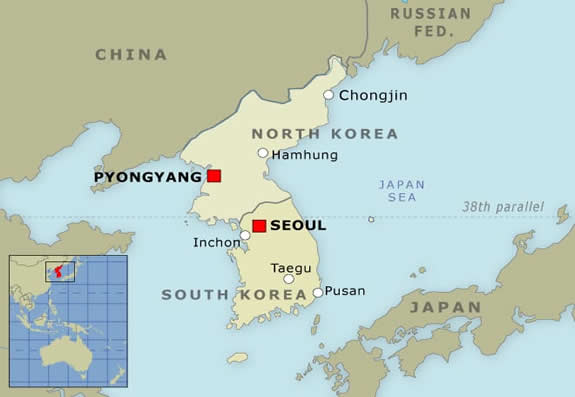
The Korean Peninsula represents a sub-region where interests of world's four major powers: United States (US), China, Russia, and Japan meet and compete simultaneously. It is a small land mass of about 220,000 square kilometres connecting the continental landmass of Eurasia with the maritime resources of the Pacific Ocean. This insight explores the ongoing influence of strategic competition between US and China on inter-Korean relations.
Figure 1
Sources: Red24
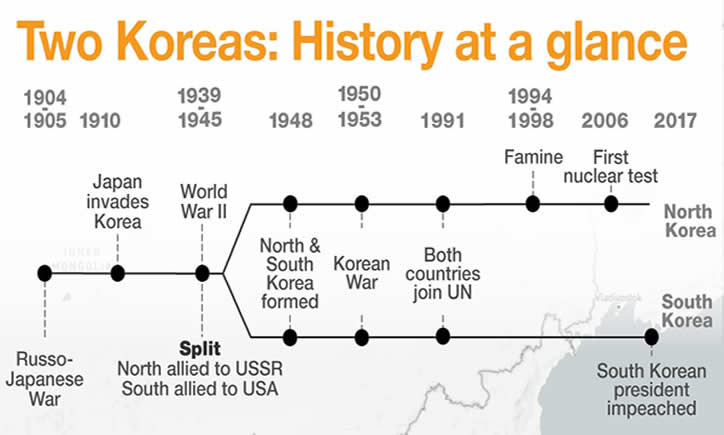
Korean peninsula has historically been under constant influence of foreign powers. In 20th century, great power rivalry marked by Sino-Japanese and Russo-Japanese Wars, culminated in Japanese colonial rule over Korea for 35 years (1910-1945) . In the aftermath of World War II, US and Soviet Union’s confrontation led to the division of Korea along the 38th parallel. The Korean War (1950-1953) with US and USSR-China on opposing sides, entrenched this division. Finally, the 1953 Armistice paused the war, but didn’t end it.
This culminated in the establishment of the world’s most militarised border between North and South Korea, commonly known as the Demilitarised Zone (DMZ).
Figure 2
Sources: Al Jazeera
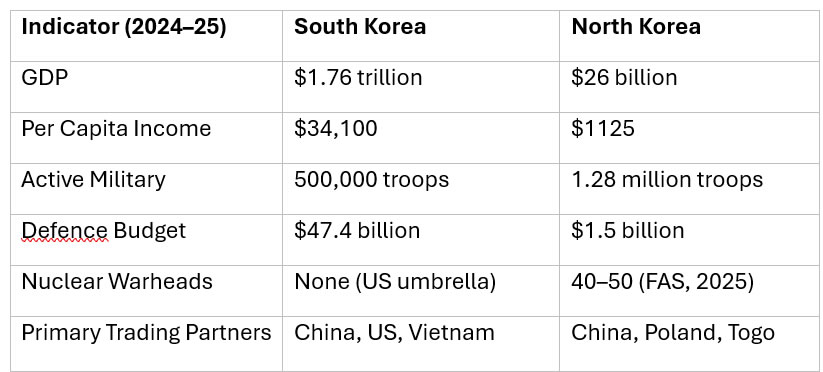
During the Cold War, South Korea continued leveraging its security alliance with the US to build a modern, high-tech economy. In contrast, North Korea remained under Soviet influence. In the post-Cold War period, South Korea became a functional democracy with regular elections. North Korea, on the other hand, prioritised regime survival through parallel military and economic development, known as the Byungjin line (strategic policy of Kim Jong Un calling for parallel development of nuclear weapons and the civilian economy), and China became Pyongyang’s main patron.
Figure 3
Sources: World Bank; SIPRI Military Expenditure Database 2025; IISS Military Balance 2025; Federation of American Scientists (FAS) Nuclear Notebook, 2025; World’s Top Exports
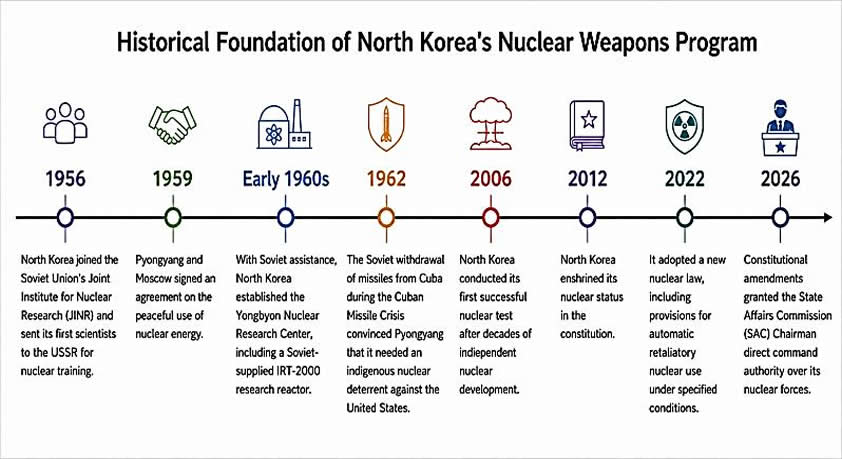
The deployment of US troops in South Korea since 1953 heightened North Korea’s insecurity. North Korea pursued nuclear weapons for lacking conventional military parity and constitutionalized the status in 2012.
Figure 4: Self-compiled
Sources: National Committee on North Korea
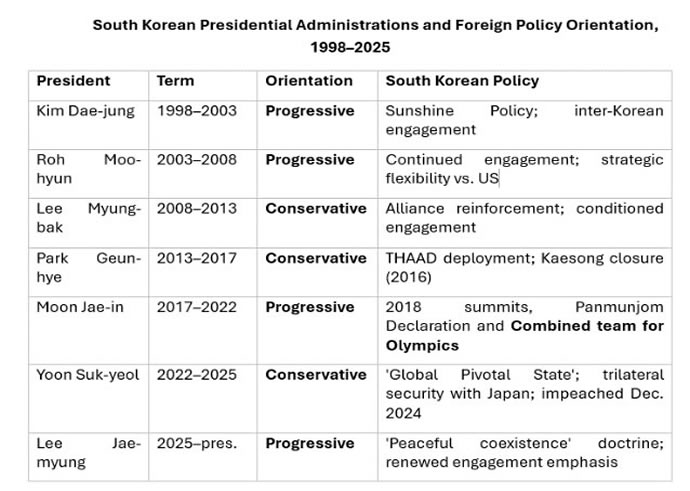
Ever since the Korean War, reunification has remained a priority for both states; however, all efforts have been constrained by great-power rivalry. For South Korea, reunification efforts oscillate between the ruling camp, a two-party system divided into a progressive camp and a conservative camp ('progressive' and 'conservative' refer to ideological camps, while the specific parties within those camps have changed names, merged, or reorganised over time). The progressive administrations (like Kim Dae-jung, Roh Moo-hyun, and Moon Jae-in) demonstrate strategic flexibility toward China and pursue engagement with North Korea.
In contrast, conservative administrations (under Lee Myung-bak, Park Geun-hye, and Yoon Suk Yeol) emphasise deterrence through the US alliance and strengthening security cooperation with Japan.
Figure 5
Sources: Ministry of Foreign Affairs, Republic of Korea; Korea Democracy
North Korea's position throughout rested on its Three Principles of National Reunification: independence, peaceful reunification, and national unity, with foreign troops removed from the peninsula. It also called for confederation, not absorption. Seoul’s response appears to be influenced by the US security alliance, which rejects permanent political division, envisioning the absorption of North Korea into a unified Korea with democratic governance, a market economy, and shared identity.
Several efforts have been made to improve inter-Korean relations. South Korea’s Sunshine Policy (1998–2008), which promoted dialogue and economic cooperation, faltered after North Korea’s 2006 nuclear test. In 2013, Pyongyang's offer to suspend nuclear tests in exchange for halting US-South Korea military exercises failed as the exercises continued. The two Koreas marched together under one flag at the 2000, 2004, and 2006 Olympic Games, and fielded their first and only joint team at the 2018 PyeongChang Winter Olympics. Alongside the 2018 inter-Korean summits, which revived high-level dialogues, these developments raised hopes for better relations. However, optimism faded after the collapse of the 2019 denuclearization Summit in Hanoi, where Kim Jong Un and Trump failed to reach an agreement. Each attempt at reconciliation failed partly under external pressure.
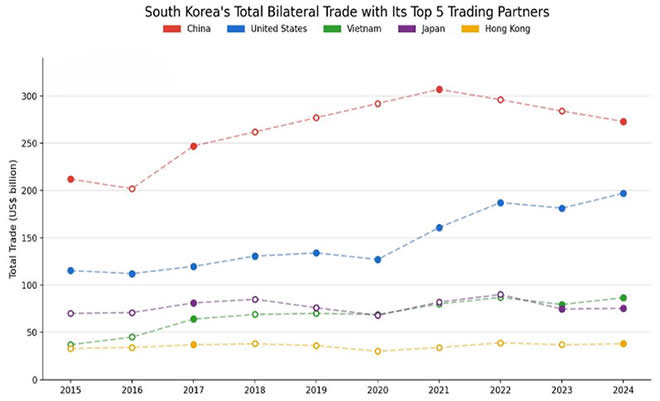
In the bigger picture today, Korea sits at the centre of US-China competition in East Asia. The US has stationed about 28,500 personnel in South Korea, framing it as deterrence against North Korea. Seoul shares cost under the Special Measures Agreement, set to rise to $1.13 billion in 2026. Alternatively, Beijing continues engagement with Seoul on trade, remaining South Korea’s top trading partner for 21 years, with bilateral trade reaching $328 billion in 2024, as shown in Figure 6 in comparison to other partners.
Figure 6: Self-compiled
Sources: US Census Bureau (US); Hudson Institute Analysis of Korea Customs Service data (China): MOTIE/KITA via congthuong.vn (Vietnam); OEC/Harvard Growth Lab (Japan, Hong Kong anchor years).
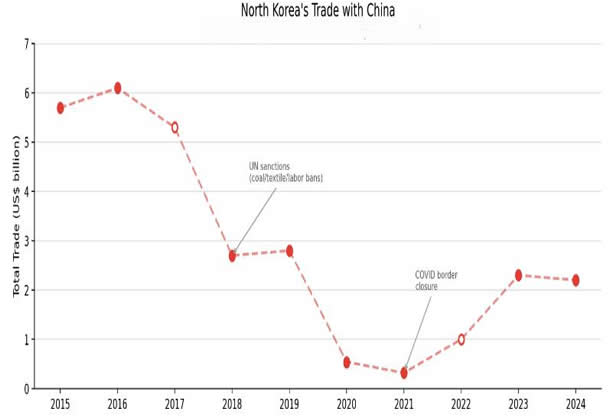
China maintains a close alliance with Pyongyang, viewing it as a strategic buffer against the expansion of US forces near its border. The status quo largely serves China’s strategic interests. In June 2026, Xi Jinping visited Pyongyang for the first time in seven years, but reunification was not part of the talks. China remains Pyongyang's dominant trading partner, accounting for 90%-95% of external trade, with estimates for other trading partners varying across sources. The US-China rivalry also affected South Korea's domestic politics.
Figure 7
Sources: KOTRA Annual Reports; UN Security Council Panel of Experts Reports, 2017-2024
In 2024, US-aligned President Yoon Suk-yeol declared martial law, claiming pro-North Korean forces and Chinese espionage as a national threat. He was accused of using these allegations to justify his actions and strengthen his political position. After his impeachment and conviction, a new progressive government under Lee Jae-myung adopted a more balanced foreign policy and sought better ties with China through diplomatic visits.
This shift has raised concerns in Washington. The US views Lee Jae-myung’s policies as potentially weakening Seoul’s traditional alliance with the US while increasing China’s regional influence. These concerns have been reinforced by President Donald Trump's 'one-stop shopping' approach, which links trade and defence issues. He also raised tariffs on Seoul to 25% in January 2026 over delays in ratifying a trade deal.
Seoul attempts to exercise greater strategic autonomy by also seeking wartime operational control of its military from the US; however, it still depends heavily on US intelligence and defence assistance. Therefore, the US Congress has restricted funding for such a transfer unless it is clearly in the US national interest.
Over the years, North Korea has moved away from reconciliation. In March 2026, North Korea formally abandoned reunification, defining the two Koreas as separate states and declaring South Korea as its “principal enemy.” During the 75th anniversary of the Korean War, President Kim Jong Un announced his intention to expand the country's nuclear arsenal, increase the size of warships and nuclearise their navy.
The 75 years of history show that the US military presence in South Korea strengthens North Korea's insecurity. North Korea’s pursuit of nuclear weapons bolsters the South Korea-US alliance. China keeps Pyongyang stable to avoid its failure and to keep a buffer for its own strategic interests. South Korea is caught between security dependence on the US and economic ties with China.
Together, these explain why the repeated efforts at reconciliation keep failing. In conclusion, the Korean Peninsula is a prime example of the structural entrenchment of unresolved historical divisions in great power competition. With North Korea abandoning reunification, South Korea deepening its security partnership with the US, and US-China competition intensifying, the prospects for Korean reconciliation appear increasingly distant.