
In the contemporary digital age, social media platforms have become central to how individuals communicate, consume information, and form opinions. At the core of these platforms lie algorithms, invisible yet powerful systems that organise, filter, and prioritise content for billions of users worldwide. Although algorithms operate silently in the background, their influence on social behaviour, political discourse, and national governance is profound. This insight outlines how algorithms function and examines how countries globally regulate them, with particular attention to Pakistan’s approach to algorithm governance.
In the context of social media, algorithms determine which posts appear on a user’s feed, which videos are recommended, and which topics trend. These decisions are not random. They are based on user data such as likes, shares, watch time, search history, and interaction patterns. Most social media algorithms are driven by machine learning models. These models continuously learn from user behaviour to predict what content will maximise engagement. Engagement includes actions such as clicking, commenting, sharing, or simply spending more time on a post. The longer a user stays on a platform, the more data is generated, and the more refined the algorithm becomes. The following table shows a transition in feed type over the past years.
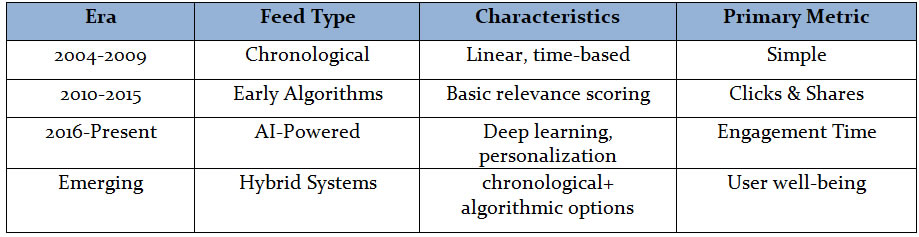
Sources: Compiled by the author from various sources
Importantly, algorithms often prioritise engagement and relevance over accuracy, social value, or ethical impact. Their primary objective is optimisation. Research consistently shows that content which is emotionally charged, sensational, or controversial is more likely to be promoted as it attracts attention and interaction. As a result, algorithms often amplify extreme viewpoints, disinformation, and polarising narratives.
The personalisation created by algorithms has transformed how individuals experience reality online. Users are increasingly exposed to content that aligns with their existing beliefs and matches their interests. This can contribute to the phenomenon referred to as “filter bubbles” or “echo chambers although these are not produced by algorithms alone.
Users also reinforce these spaces by choosing like-minded accounts, engaging with like-minded communities, and avoiding content that challenges their views.
Key findings indicate that algorithmic feeds increase user engagement by roughly 15-30%, but reduce content diversity and elevate polarising material. The following table illustrates changes in user engagement between the pre-algorithmic and algorithm-driven eras.
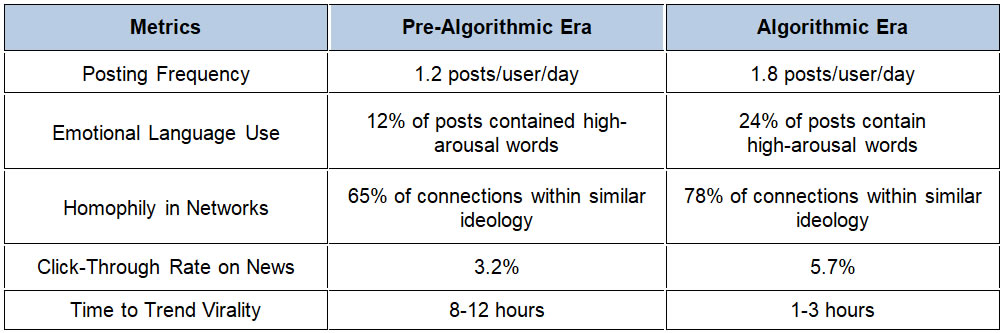
Sources: Compiled by the author from various sources
At the same time, algorithms shape public agendas by determining which trends on social media often spill into traditional media and political debate. In this sense, they act as gatekeepers, similar to editors, but without transparency or public accountability.
Importantly, these algorithms do not operate neutrally; they function selectively, reflecting the strategic interests and policy priorities of the actors or states that influence them. This becomes evident in practices such as selectively banning certain platforms in specific countries while allowing them to operate freely in others, as well as in the uneven enforcement of restrictions across platforms. For instance, during the Sudanese civil war, the UAE-backed Rapid Support Forces (RSF) used X and Telegram to circulate propaganda and atrocity videos. These posts were algorithmically amplified due to high engagement. By contrast, content from the Russian-backed Wagner Group in the Central African Republic depicting similar violence was throttled or removed under “violent content” policies following US and EU sanctions on Wagner.
Similarly, the politicisation of social media varies by region, with narratives amplified or suppressed depending on strategic alignments. For instance, X activated a crisis misinformation policy for the 2020 US election and the Russia-Ukraine war, but did not activate the same level of moderation protocols for the India-Pakistan border escalation in 2025 or the Myanmar coup in 2021, despite comparable levels of misinformation. This suggests that uneven enforcement was not produced by the algorithm alone. Rather, they emerged from the interaction between ordinary algorithmic amplification and selective policy interventions.
The algorithm thus operated “neutrally” in technical terms as using the same ranking logic across countries by prioritising engagement signals such as likes, comments, reposts, and watch time, but non-neutrally in practical effect as the policy enforcement was geopolitically selective. These practical effects can differ when the platform applies stronger crisis moderation in some contexts but not in others. This selective Geo-blocking can also be seen in the platform's compliance rate with government removal requests, as it varies across the countries shown in the table below.
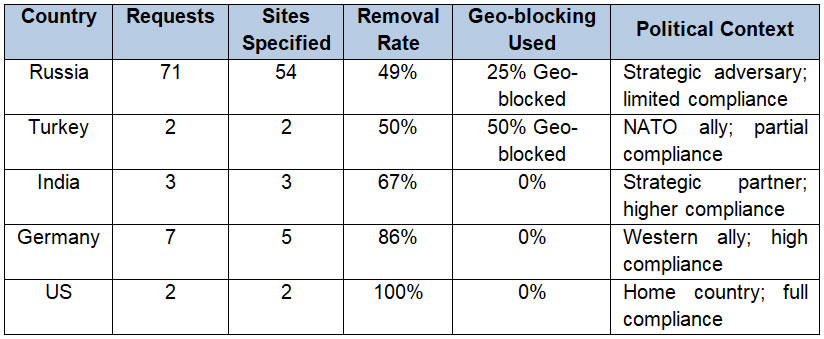
Sources: Automatic Transparency Report, July–December 2025
Together, these patterns suggest that algorithmic governance is not uniform but selectively applied, reinforcing political interests and shaping information environments in ways that can directly affect national security. Given these implications, regulation becomes a central policy question for countries. At one end, full control allows states to tightly manage content flows, platform behaviour, and algorithmic operations to reduce security risks.
At the other end, a spectrum of regulation provides a more balanced approach, combining targeted restrictions, transparency requirements, and accountability mechanisms while preserving openness and innovation.
Globally, Countries have adopted different strategies to address this regulation concern & a key trend across all models is the Evolving role of regulators. Across the world, existing regulators are expanding their mandates, and in many cases, specialised regulatory institutions are being developed specifically to deal with algorithmic influence. This reflects a broader move towards a state-based governance system.
For instance, the United States (US) largely relies on a market-driven model. Largely shielded by ‘’Section 230 of the Communications Decency Act, which protects platforms from liability for user-generated content. However, growing political pressure from both the left and right over issues of privacy (e.g., the Cambridge Analytica scandal), misinformation, and alleged political bias is leading to reconsideration, with proposed bills like the “Filter Bubble Transparency Act” seeking to mandate algorithmic choice. Recently, regulators are actively using legal action to hold platforms accountable. For example, Meta Platforms in the US has faced recent lawsuits in 2026 over concerns that its platforms harm users, especially minors, through addictive design and weak safety controls, alongside ongoing antitrust scrutiny by the Federal Trade Commission.
Conversely, the European Union (EU) has taken a more interventionist stance. The EU has positioned itself as the global standard-bearer for digital rights. The General Data Protection Regulation (GDPR) limits how user data can be harvested. More recently, the Digital Services Act (DSA) and Digital Markets Act (DMA) directly target algorithmic transparency. The DSA mandates that very large online platforms must conduct risk assessments of their algorithmic systems and provide users with the option to have a feed not based on profiling (a non-algorithmic, chronological feed).
On the other hand, China represents a contrasting model that is a closed, state-controlled digital ecosystem. The state exercises direct control over algorithmic systems, requiring platforms to align with national priorities and social norms. Its “Great Firewall” blocks foreign competitors, while domestic platforms like WeChat and Douyin (the Chinese version of TikTok) operate under strict censorship rules. Their algorithms are heavily controlled by the state to shape public opinion.
However, the creation and control of these powerful algorithms have become another central battleground between the large global tech companies that build them and the state governance systems that seek to manage them. This conflict is driven by a fundamental asymmetry, as for companies like Meta (Facebook, Instagram, Threads), TikTok, and X (Twitter), the algorithm is the engine of their business model. The following table depicts the major Social Media Platform revenues from Algorithmic Feeds.
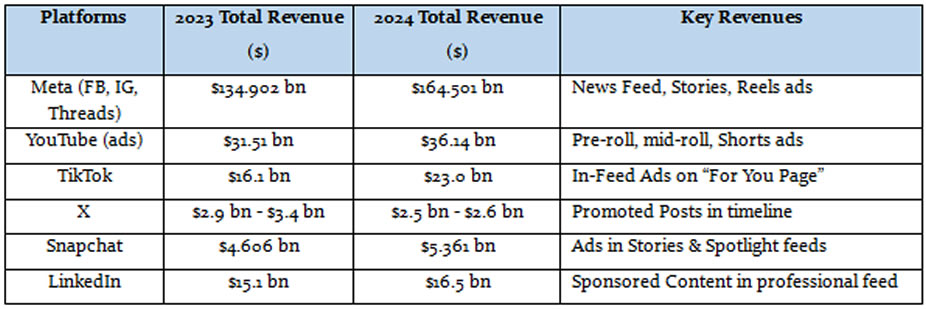
Sources: Meta Reports Fourth Quarter, SEC YouTube filings 2024, Bloomberg X statistics 2023-2024, LinkedIn Microsoft’s FY23-24, TikTok Revenue and Usage Statistics, Macro trends Snap Chat Revenue 2030-2024
The data illustrates that the Meta Platforms annual revenue for 2024 was $164.501B, a 21.94% increase from 2023 that must be protected as a trade secret. Any mandated change (e.g, to reduce polarisation) that could reduce engagement by even 1-2% threatens billions in revenue. For States like the EU and the US, they are trying to regulate digital platforms whose revenues exceed the economic capacity of many countries.
In this regard, the economic asymmetry of Pakistan is overwhelming, as Pakistan's entire federal budget (2023-2024) was $51 billion smaller than what Meta Platforms earns in a year. This illustrates the extreme disparity in resources in any negotiation over algorithmic governance as states seek sovereignty over information spaces, while companies protect proprietary algorithms as commercial assets.
For countries like Pakistan, one of the largest and fastest-growing digital markets with about 116 million internet users (the 10th largest in the world), including 71 million who actively engage with major social media networks (SMNs), yet its engagement with algorithmic governance remains limited. SMNs in Pakistan are primarily controlled and regulated by Pakistan Telecommunication Authority (PTA), which operates under the section 37 of Prevention of Electronic Crimes Act (PECA) 2016. As of March 2026, the government has formally activated a new regulatory body, the Social Media Protection and Regulatory Authority (SMPRA) to handle fast-track content regulation, complaints about misinformation, and ensuring platforms comply with registration, data localization, and content removal within 24–48 hours.
Therefore, a key challenge in Pakistan is the limited regulatory capacity. Institutions such as PTA & SMPRA are limited in their ability to influence platform behaviour, as they cannot control algorithms directly or enforce compliance beyond extreme measures, such as blocking excessive content and content removal. This results in a governance approach that is largely issue-driven or reactive, often leading to high economic and social costs.
Another issue is data sovereignty and control, as the majority of Pakistan’s digital public sphere operates on foreign-owned platforms such as Facebook, Instagram, and WhatsApp, all controlled by Meta Platforms. Thus, decisions about content ranking, visibility, and moderation are made outside Pakistan’s legal and cultural framework.
Public awareness of algorithms in Pakistan is also very low. Many users perceive their social media feeds as neutral reflections of reality, rather than curated outputs shaped by engagement-driven algorithms. This limited awareness is compounded by the underdevelopment of academic research, institutional capacity, and policy expertise on algorithmic governance. As a result, the politicisation of digital spaces becomes more pronounced, where algorithms amplify polarising content that facilitates the spread of misinformation and shapes public opinion in ways that may not align with national interests.
Pakistan faces a policy dilemma between ensuring national security and protecting freedom of expression. Strict regulation may limit harmful content but can also lead to censorship, and reduced digital freedom. Balancing these competing priorities remains one of the biggest challenges in governing algorithms effectively.
Therefore, a fundamental shift is required to understand how Pakistan conceptualises and engages with global tech firms. These platforms must be treated not merely as commercial entities but as transnational power centres. Thus, policy engagement with them should move beyond a regulator to company approach and adopt a state-to-state or state-to-global actor framework, recognising their geopolitical significance.
In a nutshell, given the growing challenges of algorithmic governance and its implications for national security, the core lesson for Pakistan lies in shifting its regulatory focus from reactive content control to proactive governance. The path forward requires a whole-of-government approach, strengthening institutional capacity to engage with platforms on issues of transparency on algorithmic impact, and improving public awareness of how content is curated and amplified. By addressing the effects of algorithms rather than attempting to manage their internal design, Pakistan can better protect its information space.