
Since gaining independence in 1960, ethnic fragmentation, weak governance and the politicisation of its immense natural wealth have hindered the Democratic Republic of Congo’s (DRC) path toward prosperity. This insight explores why, despite decades of peacekeeping efforts and international support, instability endures in Africa’s most resource-rich nation—a paradox that may itself hold the answer.
DRC’s persistent instability and conflict are best understood as a long-term structural problem. At the heart of this crisis is its mineral wealth—estimated at US$24 trillion, and includes cobalt, copper, coltan, gold, diamonds, and lithium—which attracts external actors who profit from disorder.
Figure 1: Map of the Democratic Republic of Congo
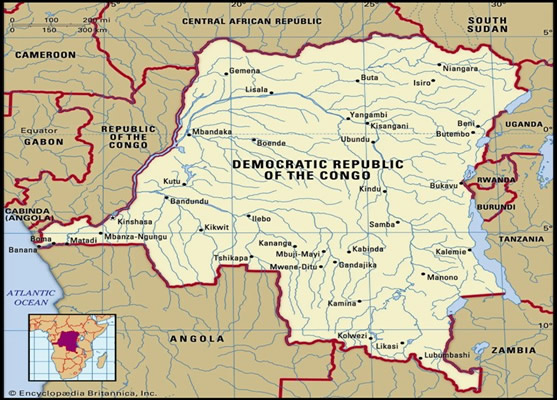
Source: Encyclopedia Britannica
Nestled at the heart of Africa, the Democratic Republic of the Congo (DRC), commonly referred to as the DRC to distinguish it from the Republic of the Congo, is the largest country in Sub-Saharan Africa and the second-largest in Africa.
Largely landlocked, it has a narrow 40-kilometre coastline along the Atlantic Ocean. It shares borders with nine African countries-Angola, Burundi, the Central African Republic, the Republic of Congo, Rwanda, South Sudan, Tanzania, Uganda, and Zambia. Home to more than 200 ethnic groups, the DRC is also the largest Francophone nation in the world.
The DRC’s fragility stems from its exploitative colonial past, coupled with a weak post-independence institutional framework and the presence of vast critical minerals. In a microcosm, its history can be divided into four periods: Colonial Legacy and the Congo Crisis (1885-1965), Mobutu’s Rule and State Decay (1965-1997), Africa’s World War (1996-2003), and the transition phase (2003 to date). The timeline below gives a glimpse of the happenings from 1885 till date.
Figure 2: DRC Events Timeline (1885-2025)
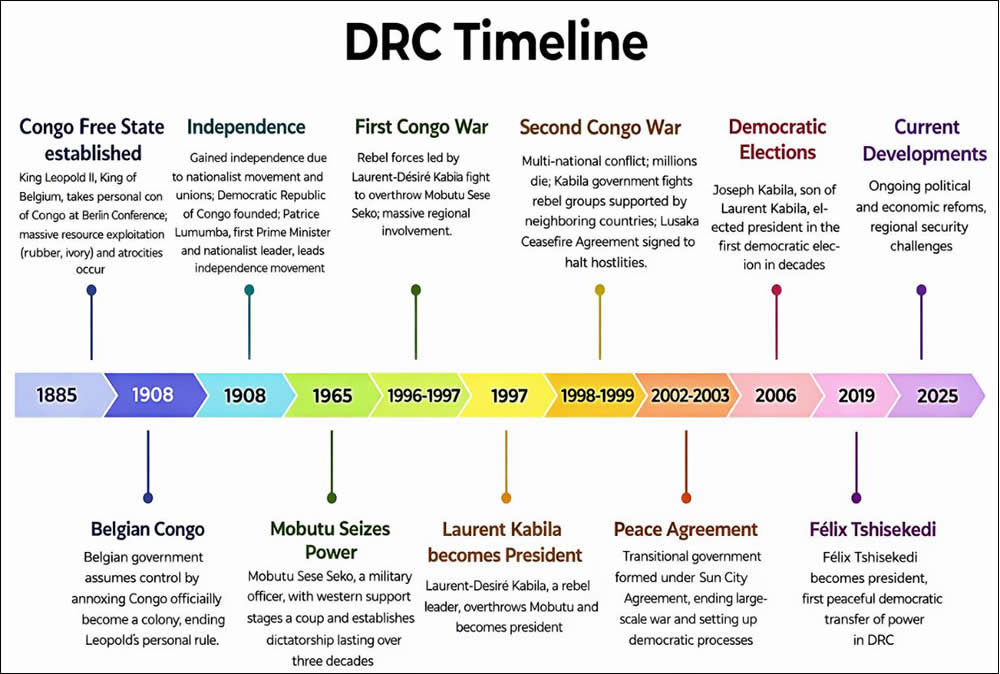
Source: Self-Compiled
The original architecture of fragility in the DRC was created by the Belgian rule (1885-1960), first as Leopold II’s personal domain and later under Belgian administration, by governing the territory as an extractive enterprise rather than a political community. Nevertheless, nationalist movements, civil unrest, and international pressure led to the DRC’s independence in 1960. However, at the time of independence, an institutionally hollow state was born.
This fragility was rapidly exploited during the Cold War, as the United States (US) and Belgium supported the installation of Mobutu Sese Seko , whose 32-year kleptocracy entrenched the country in economic collapse. This collapse, combined with political instability, was exploited by Laurent Kabila, ultimately leading to Mobuto’s ouster in 1997. Meanwhile, the spill-over of the 1994 Rwandan genocide, coupled with persistent political instability, set off “Africa’s World War” (1996–2003), as regional interventions and successive Congo wars displaced governance with a mineral-driven war economy and unending violence, leading to the assassination of Laurent Kabila in 2001.
A transitional government was formed under the 2002-2003 Sun City Peace Agreement, bringing his son, Joseph Kabila, to power.
Ever since, the DRC has experienced only a partial transition to peace with a constitutional semi-presidential system in place and regular elections; however, persistent violence in the eastern provinces underscores the limits of post-conflict consolidation.
United Nations (UN) peacekeeping has been both indispensable and insufficient. It has preserved the territorial integrity, yet it has remained limited in stabilising the conflict and curtailing violence. According to the UNHRC (2025), around 120 armed groups, including the most dominant March 23 Movement (M23), operate in the eastern provinces, exploiting minerals, driving violence, entrenched instability and regional insecurity.
Figure 3: UN Peacekeeping Missions in DRC
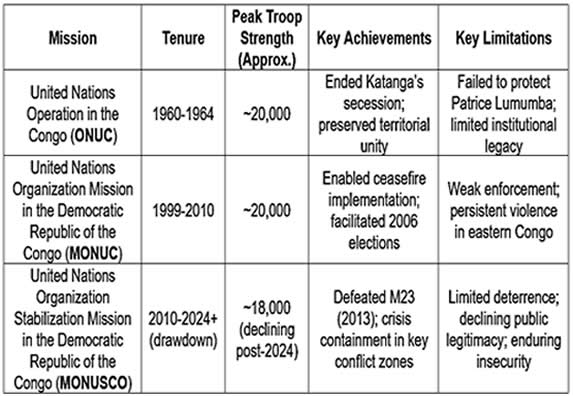
Source: Self-Compiled
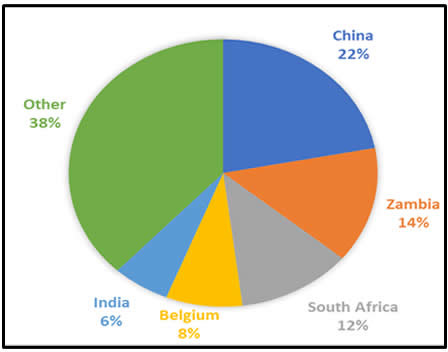
China is the DRC’s primary trade and investment partner, controlling much of the extraction and downstream processing through state-linked firms, giving Beijing a structural advantage across mineral value chains. The UAE, India, and Spain are key export partners, while imports come largely from China, South Africa, and Zambia.
Figure 4: Top Exporting partners of DRC
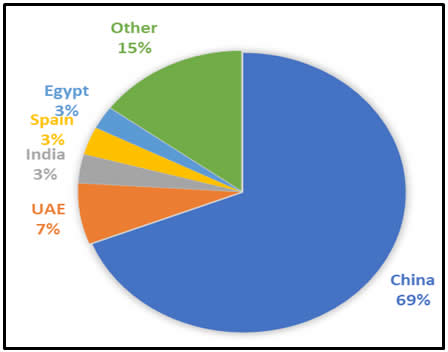
Source: Self-Compiled
Figure 5: Top Importing partners of DRC
Source: Self-Compiled
Regional countries like Rwanda act as an indirect power broker in eastern Congo, leveraging proxy forces and mineral networks to benefit from instability while avoiding occupation. Its diplomatic balancing between Western partners and China limits external pressure, enabling sustained influence as long as eastern Congo remains weakly governed and resource-rich.
DRC’s situation has always been shaped by great-power politics rather than by sovereignty. During the Cold War, it was a staunch US ally. Post-Cold War, the DRC’s centrality due to critical minerals has made it a focal point of US-China strategic competition.
Figure 6: US-DRC-China Trade Data
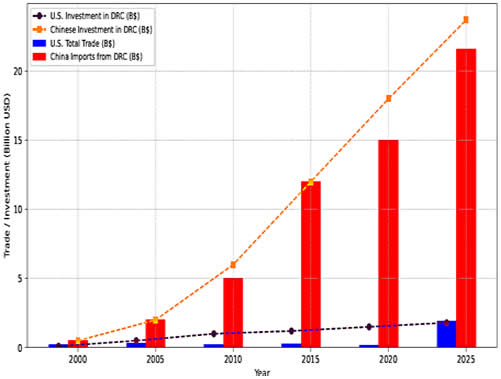
China retains structural dominance in mining and processing, rooted in long-standing infrastructure-linked extraction models. This has the risk of a repeat of access-over-reform engagement.
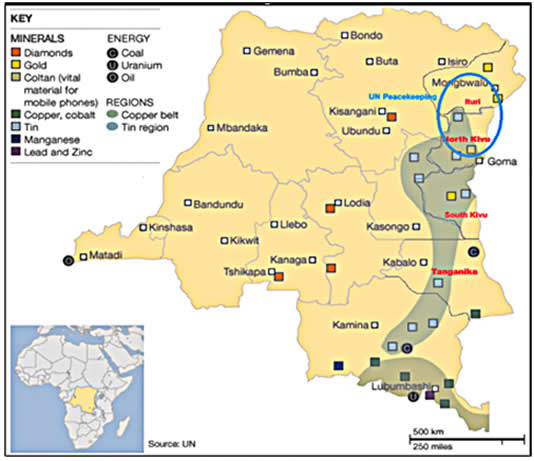
DRC produces about 80% of global cobalt, with Chinese state-owned enterprises controlling the bulk of the output. Nine of the world’s ten largest cobalt mines are in the DRC, about half Chinese-owned, while Chinese refineries process 60-90 % of global cobalt. Beijing’s position was cemented by the 2008 Sicomines deal, which exchanged infrastructure promises for access to cobalt and copper.
Figure 7: Critical Minerals in DRC
Source: Edited Map from BBC
Against this backdrop, recent engagements between Kinshasa and Washington—most notably, the US-DRC critical mineral pact (2025)—reflect a growing American effort to counterbalance China’s dominance by securing alternative supply chains and promoting responsible sourcing. The limits of US influence are further shaped by the DRC’s domestic institutional weaknesses, which dilute the geopolitical leverage of external partners.
The US brokered DRC-Rwanda peace agreement signed in June 2025 underscores Washington’s attempt to stabilise a strategically vital mineral corridor, yet it prioritises diplomatic signalling over addressing the political economy that sustains conflict.
By excluding the M23 and relying on vague withdrawal provisions, the agreement leaves intact the mineral-based war economy, thereby preserving conditions that continue to benefit entrenched actors.
In this context, US diplomatic and economic initiatives have yet to translate into a decisive strategic realignment, reinforcing the reality that China’s position in the DRC remains resilient despite rising American engagement.
The DRC thus embodies a stark paradox: vast potential alongside chronic fragility. From colonial extraction to proxy wars and prolonged UN peacekeeping, each phase has exposed the limits of external intervention in the absence of internal reform. As global demand for critical minerals intensifies, the DRC faces both heightened risk and a rare opportunity to convert abundance into sovereignty and resilience. DRC now stands at a crossroads—either reproducing extractive cycles under new geopolitical alignments or pursuing genuine sovereignty through institutional reform and inclusive development.