
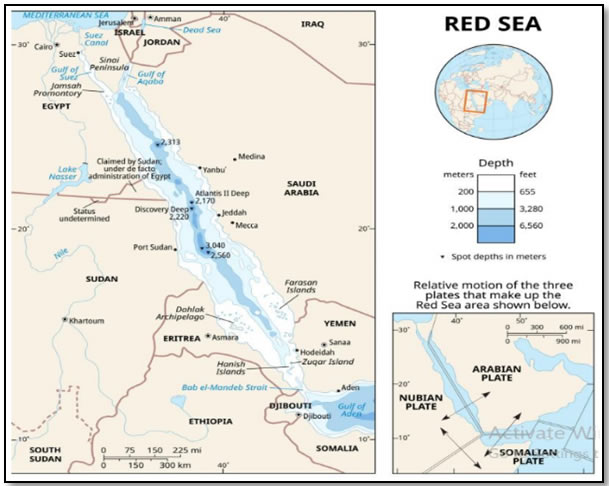
The Red Sea is a key waterway (1200 miles) that connects the Indian Ocean with the Mediterranean Sea through the Suez Canal (north) and the Bab el-Mandeb Strait (south). Bordered by eight littoral states: Egypt, Sudan, Eritrea, Djibouti, Saudi Arabia, Yemen, Jordan, and Israel, the Red Sea anchors the global energy trade across Asia, Europe, and Africa.
Figure 1: Strategic Location of the Red Sea
Source: Britannica
Over the years, the Red Sea has become a contentious maritime route due to the intensification of great-power competition, particularly between the United States (US) and China, as well as rising rivalry among regional powers. This insight analyses the Red Sea crisis not as an isolated maritime disruption but as a structural manifestation of intertwined global and regional power competition within a fragile regional order.
The significance of the Red Sea cannot be overstated. The combined GDP of the Red Sea’s littoral states and the Gulf of Aden (RSGA) currently stands at $1.2 trillion, which is projected to reach $5.6 trillion by 2050. Over the same period, the trade volume is likely to increase from $1 trillion to $4.5 trillion.
In recent years, the Red Sea maritime insecurity has escalated, with Yemen’s Houthis targeting commercial vessels after the Gaza war in November 2023. Since then, over 100 commercial vessels and over 170 US warships have been attacked, forcing ships to reroute via the Cape of Good Hope despite longer distances, higher fuel prices, and delays.
Figure 2: Operational Cost of Red Sea Vs Cape of Good Hope
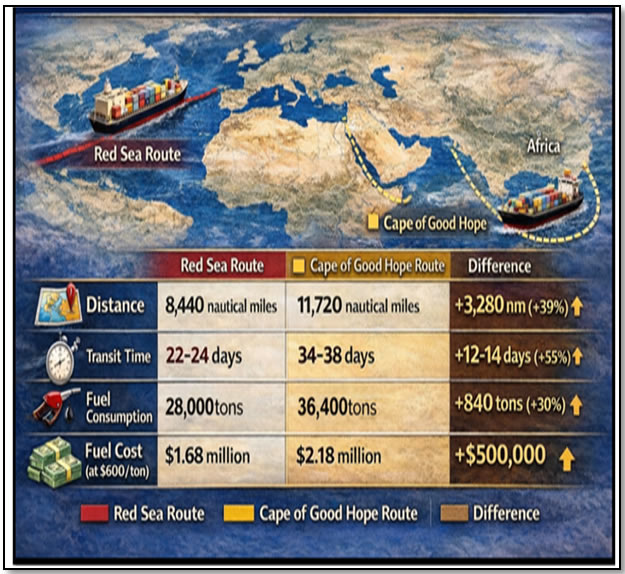
Image generated via AI, based on data input by the author
Source: U.S. Energy Information Administration 2024
Between 2015 and 2023, the Red Sea maritime traffic increased by 51%. However, following the Houthis' attacks on commercial ships in November 2023, the Red Sea trade volume declined by nearly 50%, and the Cape of Good Hope emerged as an alternative trade route.
Figure 3: Number of Ships Using the Red Sea and Cape Routes
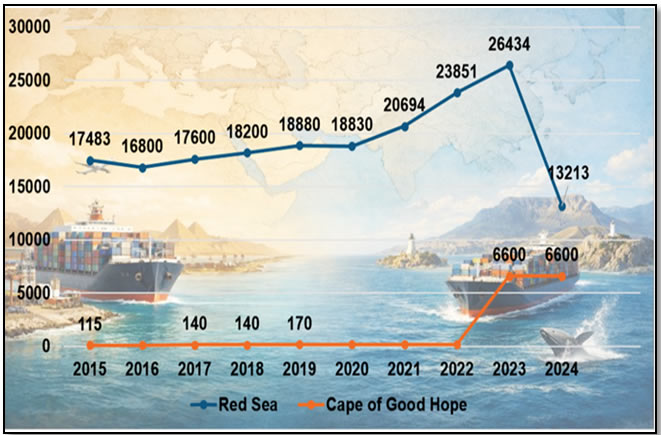
Image generated via AI, based on data input by the author
Source: SIS. Gov 2025
About 40% of trade between Asia and Europe transits through the Red Sea. Almost 30% of EU trade with the Middle East and North Africa (MENA) region, which fulfills 18% of its crude oil and 12.4% of its natural gas needs, transits through the Red Sea. At the peak of the Red Sea Crisis (December 2023-April 2024), EU inflation jumped to 3.4%, revealing its vulnerability to maritime disruptions.
Figure 4: Significance of the Red Sea
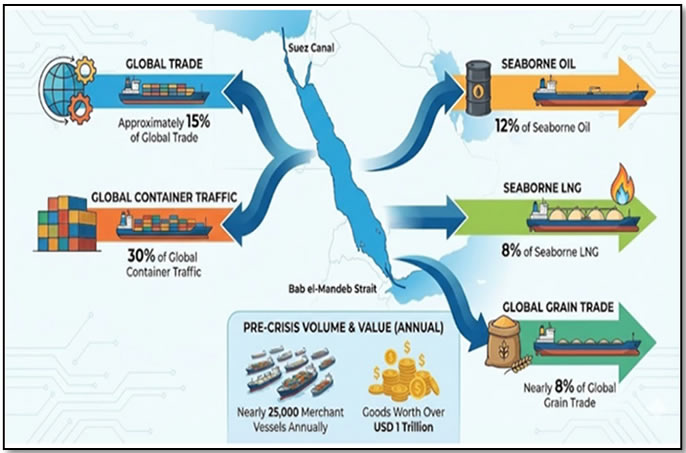
Image generated via AI, based on data input by the author
Source: Congressional Research Service-Daily Observer (2024) and the White House (2025)
The Red Sea is a vital commercial lifeline for East African and Gulf states. Egypt is highly reliant on the Suez Canal for revenue generation. In 2019-2024, approximately 121,902 ships transited via the Suez Canal, generating $39.92 billion in revenue. In 2023, revenue reached $10.25 billion but sharply declined to $3.99 billion in 2024.
Figure 5: The Red Sea Significance for East African States
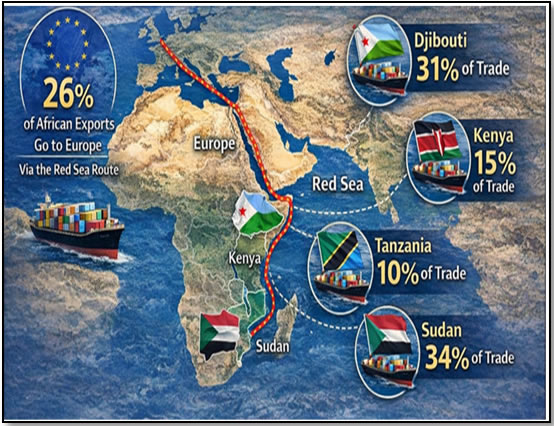
Image generated via AI, based on data input by the author
Source: UNCTAD (2024)
Notably, 47% of the Kingdom of Saudi Arabia's (KSA) trade transits through the Red Sea, and it has invested nearly $15.6 billion across East Africa. However, the Red Sea crisis led to a decline in maritime traffic at Jeddah Islamic Port (figure 6).
Figure 6: Maritime Traffic (Million TEUs) at Jeddah Islamic Port, KSA
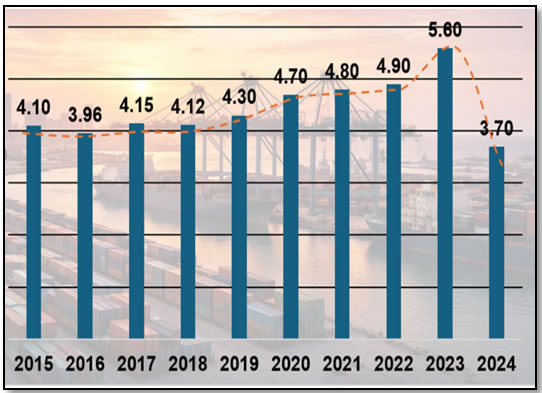
Image generated via AI, based on data input by the author
Source: Eurostat (2026)
Since 2008, the United Arab Emirates (UAE) has invested $47 billion in port infrastructure, energy, and mining sectors across East African countries. Similarly, Qatar invested $7.2 billion in port infrastructure development in Somalia and Sudan since 2019. From 2005 onwards, Turkiye also invested over $6 billion in infrastructure projects across East African states.
The Red Sea is vital to China's 21st-Century Maritime Silk Road linking Asia, Africa, and Europe. China is highly dependent on the Red Sea, with approximately $120 billion in imports and $160 billion in exports transiting through it annually. In Egypt, Beijing has 20% stake in Port Said, a $375 million commitment at Ain Sokhna terminal (Egypt), and a $140 million investment in Jeddah Port. Therefore, any trade disruption in the Red Sea extends beyond regional instability, directly affecting the Chinese and European trade.
Although only 3% of US trade passes through the Red Sea route, this corridor holds strategic significance for the US. The US National Security Strategy (2025) emphasizes the freedom of navigation in key chokepoints, linking the Red Sea’s stability with the economic viability of key regional partners of the US.
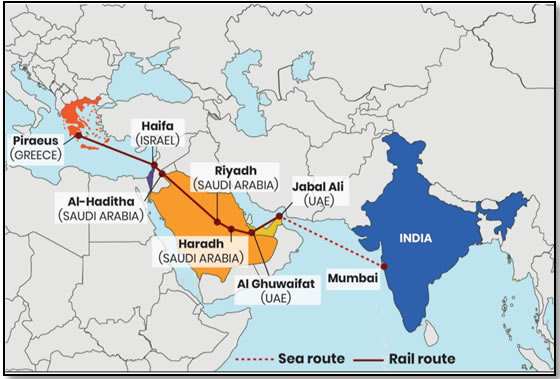
India-Middle East-Europe Economic Corridor (IMEC), backed by the US, is a strategic corridor aimed at mitigating Red Sea turmoil. If implemented, IMEC could reduce transportation costs by nearly 40% and logistical costs by around 30% compared to the Red Sea route.
Figure 7: India-Middle East-Europe Corridor (IMEC)
Source: IMEC. International (2023)
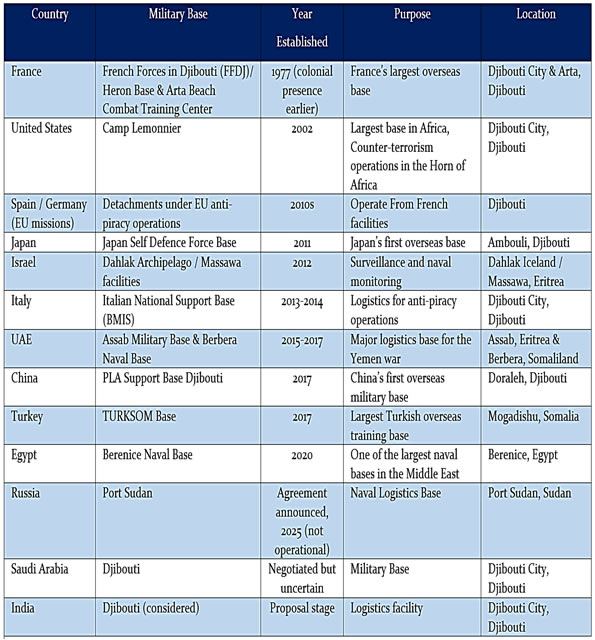
Given its strategic location, the Red Sea has become highly militarized. Djibouti has emerged as a strategic hub. It hosts several military bases due to its proximity to critical maritime trade routes.
Table 1: Foreign Military Bases in the Red Sea Region
Source: Self Compiled
In 2021, Eritrea became a part of the BRI and declared a strategic alliance with China. Moreover, Eritrea strengthened its ties with Russia through diplomatic activities and engaging in joint naval exercises. In 2024, Ethiopia's formal accession to BRICS further intensified the regional security dynamics.
The Red Sea crisis is no longer a limited maritime disruption. It has become a geopolitical battleground where global powers, the US and China, along with regional powers, are competing for influence. These efforts for control and influence are causing growing instability in the region. This continued instability can harm global trade, which is not in the interest of any stakeholder, especially China and Europe.
The solution to the Red Sea crisis depends on cooperation and mutual understanding among the stakeholders. Although this maritime trade corridor is critical for all the regional and global stakeholders, the ongoing great power rivalry is limiting the space for cooperation. The recent conflict between the US-Israel and Iran and the consequent disruption of another critical maritime chokepoint, the Strait of Hormuz, choking off approximately 20% of global oil supply, is threatening energy inflation and has led to a sharp spike in oil prices worldwide.
The rising tension in the Middle East has already led to a near blockade of the Strait of Hormuz, and any disruption in the Bab el Mandeb Strait could trigger a severe global energy crisis since the 1970s.
Maritime disruption across both these chokepoints would ripple through global supply chains and disproportionately impact energy-dependent economies, such as China and Europe, likely triggering a global recession. This evolving multi-chokepoint crisis highlights the systemic vulnerability of global trade and energy networks, as well as an uncertain future for the global economy.