Pakistan approved a National Social Protection Strategy (NSPS) in 2007, which was a government roadmap to move the country’s social protection system from a set of ad-hoc, overlapping programmes to a more integrated and transparent safety net. The NSPS seeks to reduce poverty and vulnerability by expanding access to economic opportunities, protecting households from income shocks and ensuring basic income support for the poor, while emphasising improved targeting, coordination, and monitoring through a unified national framework. This insight explores the landscape of Pakistan’s social protection sector.
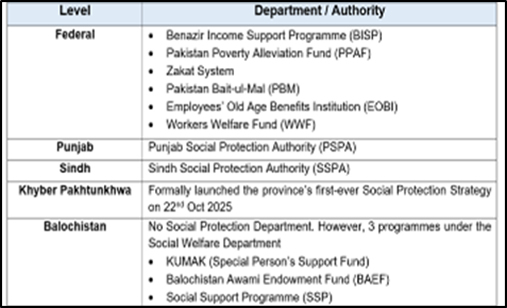
Table 1: Institutional Landscape of Social Protection
Source: Self-Extracted
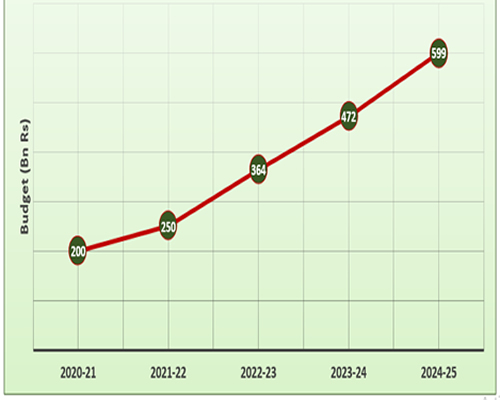
Benazir Income Support Programme (BISP) is the country’s flagship social protection initiative, administered by the Ministry of Poverty Alleviation and Social Safety. Over the years, BISP’s budget has increased considerably. For FY 2024-25, Rs 598.7 billion was allocated. However, total budgeted expenditure rose to Rs 716 billion by November 2025, reflecting a strong fiscal commitment to social development.
BISP has also expanded its scope through initiatives such as Benazir Kafalat, Taleemi Wazaif, and Nashonuma, focusing on women’s empowerment, child education, and nutrition.
Figure 1: BISP Budget Allocation (2020-25)
Source: BISP
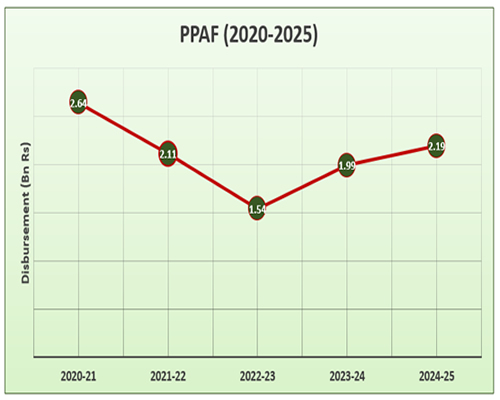
The Pakistan Poverty Alleviation Fund (PPAF) recognises poverty as a multidimensional issue, shaped by unemployment, poor access to education and healthcare, and climate-related challenges, which guides its programmatic priorities and funding allocations.
Figure 2: PPAF Disbursement
Source: PPAF
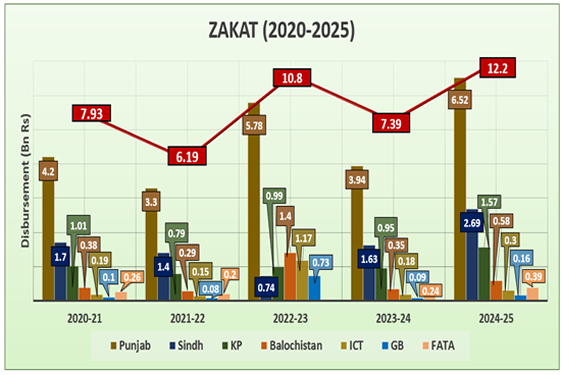
The Zakat System remains an essential mechanism for equitable wealth redistribution and poverty prevention. Figure 3 shows an overall upward trajectory of disbursements with periodic fluctuations across provinces.
Figure 3: Zakat System Disbursement
Source: Economic Surveys of Pakistan (2020-2025)
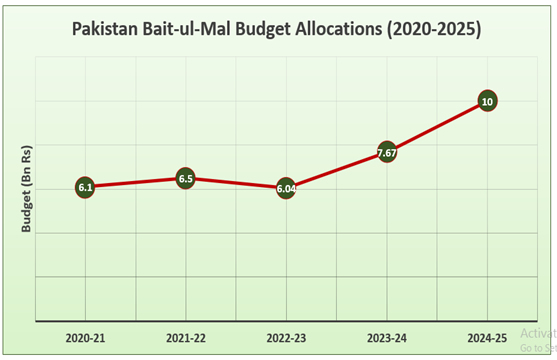
Pakistan Bait-ul-Mal (PBM) assists vulnerable groups, including widows, orphans, persons with disabilities, and the poor, by providing food, clothing, education, and health care.
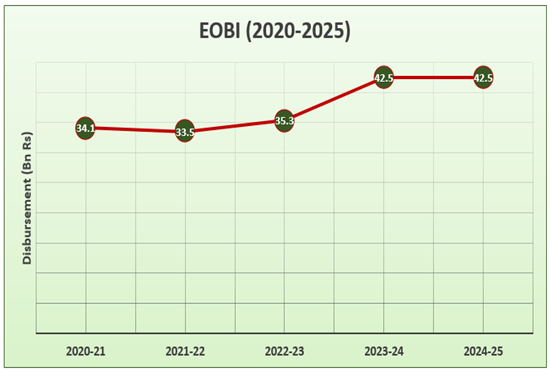
Employees’ Old Age Benefits Institution (EOBI) is Pakistan’s only national pension scheme for industrial and commercial workers.
Figure 4: PBM Budget Allocation
Source: PBM
It provides retirement, survivor, and invalidity pensions, playing a critical role in social protection. As of 2024-25, 11.46 million employees have been registered, with 155,189 total registered employers.
Figure 5: EOBI Disbursement
Source: Economic Surveys of Pakistan (2020-2025)
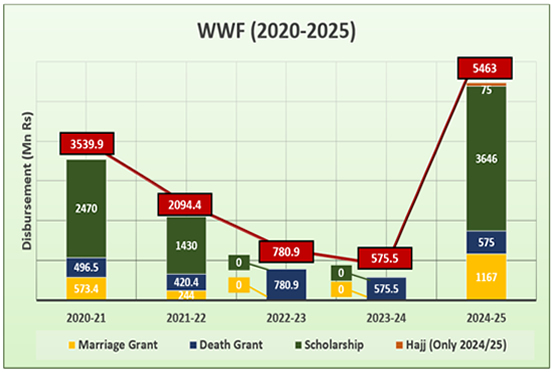
The Workers Welfare Fund (WWF), managed under the Ministry of Overseas Pakistanis and Human Resource Development, provides financial assistance in cases of workplace incidents. Figure 6 shows the amount disbursed under different cases from 2020-2025.
Figure 6: WWF Disbursement
Source: Economic Surveys of Pakistan (2020-2025)
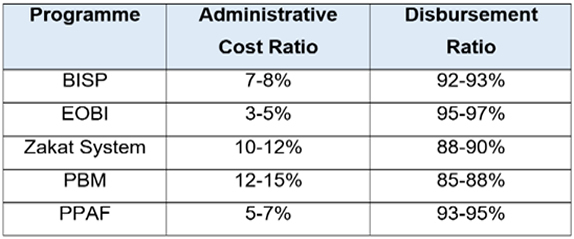
The administrative efficiency of federal social protection programmes varies according to their mandates, delivery models, and institutional structures. However, publicly available data show that most federal programmes maintain relatively low administrative costs compared to the volume of benefits delivered. A summary of administrative and disbursement ratios across major federal programmes is provided below.
Table 2: Administrative Cost vs. Disbursement Ratios of Federal Social Protection Programmes
Source: Self-Extracted
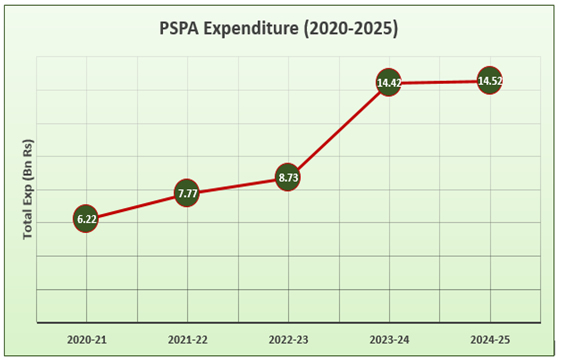
The Punjab Social Protection Authority (PSPA) was established to design, coordinate, and implement social protection programs in Punjab under the Punjab Social Protection Policy Framework. The key programmes include Khidmat Card, Sila-e-Fun, Massawat, Ba-Himmat Buzurg, Zewar-e-Taleem, Graduation and Income Generation Scheme for People with Disabilities, Nayee Zindagi, Aaghosh, Khud Muktar, and Bunyad.
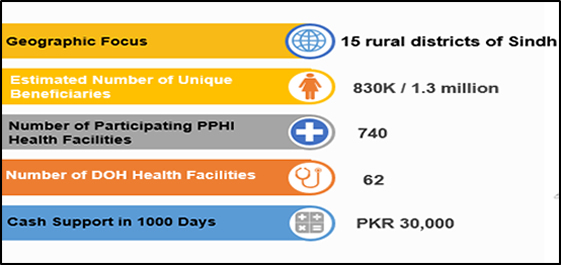
The Sindh Social Protection Authority's (SSPA) flagship programme is MAMTA, which has been in effect since 10 January 2023, and the duration is 60 months (Jan 2023-Dec 2027).
Figure 7: PSPA’s Total Expenditure for all Programmes
Source: PSPA
The total estimated budget for 5 years is Rs. 48,300 million. The scope is to strengthen and increase the scale of cash transfers to pregnant women and mothers of children under 2 years old, and to encourage them to utilise maternal, newborn, and child healthcare services. As of October 2025, a total of 830,000 pregnant and lactating women are registered, and SSPA has disbursed Rs 6.7 billion to these women.
Figure 8: MAMTA Programme
Source: SSPA
Khyber Pakhtunkhwa (KP) lacks a dedicated social protection department. On 22nd Oct 2025, the KP government launched its first-ever Social Protection Strategy to reduce poverty, promote gender equality, and enhance disaster response.
The strategy introduces a unified data system and modern technologies to enhance transparency and effectiveness. However, no specific budget allocation has been made public yet.
A draft act to establish a Social Protection Department in Balochistan was proposed in 2019, with an allocation of Rs 1 billion; however, it remains non-operational. In the interim period, the Social Welfare Department implements social protection initiatives, including KUMAK (Special Persons’ Support Fund), Balochistan Awami Endowment Fund (BAEF), and the Social Support Programme (SSP). KUMAK has a seed capital of Rs 2 billion, and BAEF holds Rs 7 billion, both invested by the Finance Department, with profits used to fund programme expenditures. The SSP is directly financed through Rs 100 million from the non-development budget, distributed to Deputy Commissioners under their administrative allocations.
NADRA maintains the National Socio-Economic Registry (NSER), the central database for federal social protection programmes. As of 2025, it covers around 82-84% of Pakistan’s population (203.5 million people or 41.4 million families). However, most provincial programmes are not fully integrated, causing duplication and preventing a unified, interoperable system for real-time data sharing across all government levels.
The federal and provincial social protection programmes are gradually adopting a hybrid payment system that combines digital and cash-based channels, though this varies by region. The policy is shifting toward digital payments to improve efficiency, transparency, and financial inclusion. For instance, BISP links cash payments to bank accounts and mobile wallets, while Punjab and Sindh are introducing bank-linked and RAAST-compatible payments integrated with NADRA verification, but the coverage is not yet uniform across all regions.
Pakistan’s social protection landscape comprises multiple overlapping programmes established at different times to address specific vulnerabilities. Over time, these programmes expanded vertically rather than horizontally, resulting in parallel structures rather than consolidation, leading to fragmentation and duplication.
Despite the 18th Amendment devolving social protection to provinces, federal programmes continue to function to maintain national coordination, equitable coverage, and fiscal stability. However, merging these programmes is politically sensitive and administratively complex, as each functions under separate legal mandates, staffing structures, and governance frameworks. Consolidation would require aligning laws, transferring personnel, redesigning payment systems, and negotiating financial responsibilities between the federation and provinces, making a complete institutional merger highly challenging. Since federal programmes serve different populations and have distinct policy objectives, merging them could dilute their core functions, reinforcing the need for stronger coordination and data integration rather than structural unification.
To strengthen evidence-based policymaking and improve coordination between federal and provincial programmes, the NSER should be expanded into a unified national registry encompassing all social protection programmes. This integration would help eliminate duplication across programmes and ensure that no vulnerable family is left out.
Lastly, to promote transparency and public accountability, all social protection departments should make their data on annual budgets and disbursements publicly available. Assessable and reliable financial data would enable citizens, researchers, and policy makers to assess performance, identify inefficiencies, and build greater trust in the system.