
Pakistan–Bangladesh relations have historically fluctuated, with periods of cordial engagement and diplomatic strain since the creation of Bangladesh in 1971. However, changing regional dynamics, economic interests, and shifting geopolitical alignments in South Asia are creating new opportunities for both countries to reassess their relationship.
This insight provides an overview of Pakistan–Bangladesh relations in both historical and recent years across key sectors, including trade, diplomacy, and connectivity. It argues that recent developments represent a strategic reset, indicating the potential for closer bilateral cooperation and regional engagement.
Bangladesh has long maintained cordial relations with India, particularly under the leadership of former Prime Minister Sheikh Hasina. However, in August 2024, a student-led movement culminated in her ouster from premiership, and Muhammad Yunus assumed charge as a caretaker leader ahead of the 2026 general elections. The current government is now headed by Prime Minister Tarique Rahman, who has adopted a more pragmatic, multi-vector foreign policy, including recalibrating relations with Pakistan as part of broader regional diplomacy.
In 2025, high-level diplomatic engagement resumed between the two countries, with Pakistan’s foreign minister, Ishaq Dar, visiting Dhaka after a 13-year gap. Both sides discussed trade normalisation, visa facilitation, cultural exchanges, and institutional cooperation. Six memoranda of understanding (MOUs) were signed on 24 August, 2025 in Dhaka to strengthen ties in various sectors. (Figure 1).
Figure 1
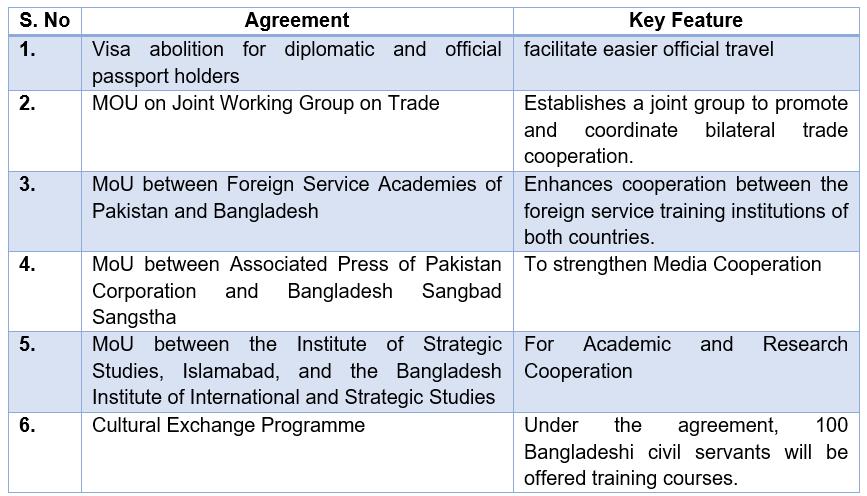
Sources: Compiled by the author via The News Pakistan
In addition, Islamabad and Dhaka agreed to revive the long-dormant Joint Economic Commission (JEC) in August 2025, last convened in 2005, as a step toward strengthening trade and investment ties. Therefore, trade, in particular, has emerged as a practical way to expand mutually and serve as a significant empirical indicator of the developing relationship (Figure 2).
Figure 2
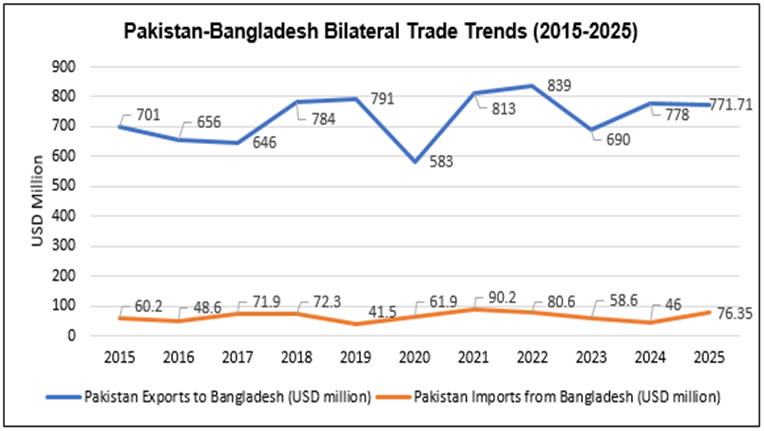
Sources: Compiled by the author via Trading Economics
The successful Karachi–Chittagong maritime trade in 2024 proved that direct routes can cut transit times by more than 50%. Previously, trade between Karachi and Chittagong largely relied on transshipment through Colombo, where cargo containers were unloaded and transferred onto another vessel before reaching their final destination. In contrast, the newly established direct trade route enabled uninterrupted cargo movement between the two ports. Consequently, shipment time has reportedly decreased to nearly 11 days, significantly improving trade efficiency, reducing logistics costs, and strengthening economic connectivity between Bangladesh and Pakistan (Figure 3).
This route also supports China’s BRI logistics corridors, connecting Gwadar Port to Chittagong and integrating South Asia with ASEAN countries, providing access to markets worth $3.5 trillion across ASEAN and the Middle East.
Figure 3
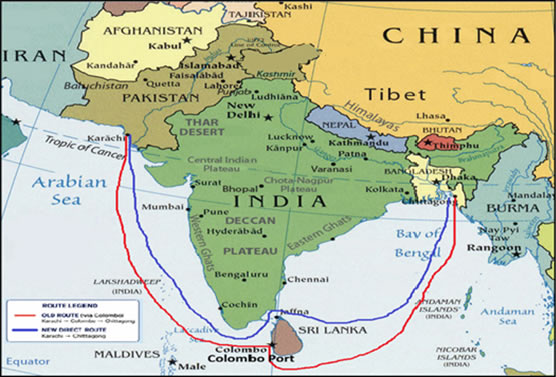
Sources: Press Books
Lines drawn by the author are subject to variations
Both countries are also improving their defence relations; a notable example is Bangladesh’s participation in Pakistan’s Multinational Maritime Exercise “AMAN-2025” (February 2025). Previously, Bangladesh also participated in the 2007, 2009, and 2013 AMAN Series. Bangladesh also attended as an observer in the Pakistan Air Force's Indus Shield 2024 air exercise. The potential acquisition of Pakistan’s JF-17 Thunder fighter jets under Bangladesh’s Forces Goal 2030 military modernisation plan represents another decisive turn. Bangladesh has sent pilots and technicians to the Pakistan Air Force Academy for professional military training.
Educational exchanges are significant, as over 400 Bangladeshi students are currently studying in Pakistan through OIC and COMSTECH scholarships. The Pakistan–Bangladesh Knowledge Corridor, a $500 million initiative launched in 2025, will offer 500 scholarships over five years to strengthen academic ties and foster long-term relationships.
Climate Cooperation is another area that needs attention, as both states are highly vulnerable to climate change and experience major flooding every 3-4 years, resulting in significant human and economic losses (Figure 4). From 2010 to 2024, Pakistan’s annual climate-related losses reached about US$3.2 billion, and Bangladesh's losses were approximately US$2.8 billion.
Figure 4
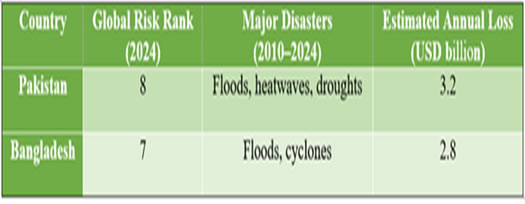
Sources: World Risk Report
The Pakistan-Bangladesh strategic reset is driven by evolving regional and global geopolitical realities. Since the political transition, Dhaka has renewed its engagement with Islamabad, pursuing a more diverse foreign policy, and the geopolitical implications of this rapprochement extend beyond bilateral relations.
For India, closer ties between Pakistan and Bangladesh diminish New Delhi's previously dominant influence in Dhaka and create new strategic uncertainties along its eastern frontier. China benefits by expanding its Belt and Road connectivity efforts through increased engagement with both Pakistan and Bangladesh, thereby enhancing its regional presence.
For the US, Bangladesh remains an important Indo-Pacific partner, and Dhaka's efforts to maintain strong relations with Washington while simultaneously engaging Beijing and Islamabad illustrate a hedging strategy rather than exclusive alignment with any single power, reshaping South Asia's geopolitical landscape.
While bilateral engagement has entered a new phase of diplomatic and economic engagement, historical legacies and socio-political issues, such as the presence of a large Bengali diaspora in Pakistan, estimated at 1.6 to 2 million people, and the unresolved status of Urdu-speaking Biharis (Stranded Pakistanis) in Bangladesh, roughly 300,000 to 500,000, continue to shape public discourse and bilateral sensitivities.
A forward-thinking reset should therefore prioritise economic cooperation, connectivity, and people-to-people contact. By separating historical grievances from contemporary strategic interests, both states can transform into a functional partnership grounded in regional interdependence rather than past contestation. In this context, historical sensitivities must be addressed through scholarly dialogue, promoting mutual acknowledgment of shared suffering and avoiding blame-centric narratives or unilateral expectations.