
From the First Gulf War to the conflicts of 2026, space-based infrastructure has moved beyond merely supporting military operations to becoming deeply embedded within the military conduct. During Operation Desert Storm in 1991, described as the first “space war”, United States (US)-led coalition forces used the then-emerging Global Positioning System (GPS) for navigation, troop positioning, and precision bombing against Iraqi soldiers. Three decades later, this dependence extends beyond state-owned military satellites to privately operated Commercial Satellite Constellations (CSCs): large, coordinated networks of satellites providing broadband connectivity, remote sensing, and geospatial data.
This insight examines when CSCs lose their civilian protection under International Humanitarian Law (IHL), the legality of targeting them, and the practical feasibility of conducting military operations against them in space.
CSCs are prima facie civilian objects and perform an important range of civilian functions. They provide broadband connectivity, enable weather forecasting, support disaster response, and supply geospatial data used in agriculture, infrastructure planning, and scientific research.
Current and Planned Mega-Constellations
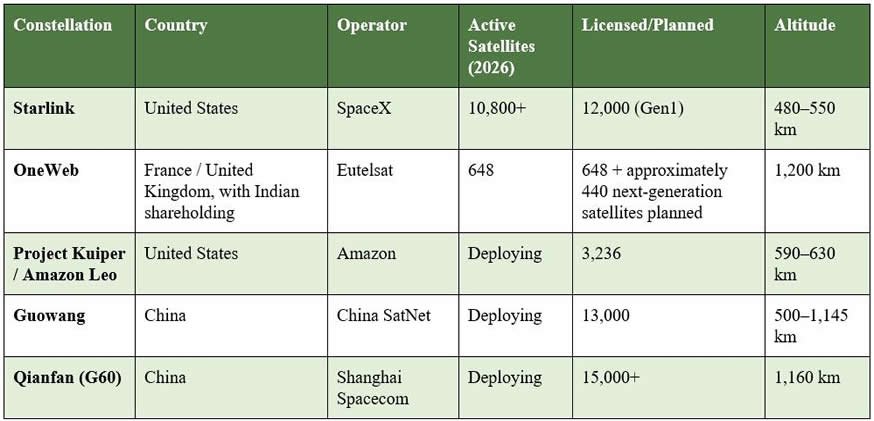
Sources: Orbital Radar(orbitalradar.com)
Yet the predominantly civilian character of CSCs has not insulated them from the battlefield. Two primary examples illustrate this shift: the Russo-Ukraine War in 2022 and US-Israel War against Iran in 2026. In Ukraine, forces relied extensively on connectivity provided by the US-based Starlink constellation to facilitate reconnaissance operations, stream live drone feeds, and maintain command-and-control capabilities. CSCs thus, in the words of the Ukrainian Minister of Digital Information, became the “blood of the entire Ukrainian communication infrastructure”.
A similar development emerged during the US-Israel War against Iran. The US integrated Starlink-supported systems into the deployment of its Low-cost Uncrewed Combat Attack System (LUCAS)—a loitering munition platform developed to counter the Iranian Shahed-136 architecture. These LUCAS networks were then deployed by Task Force Scorpion in a heavily contested electronic-warfare environment to target the Iranian positions.
These instances highlight the growing conflation between civilian and military uses of commercial satellite infrastructure, and the dilemma pertaining to their targetability under IHL. This dual-use character necessitates an analysis of Article 52(2) of Additional Protocol I (AP I) to the Geneva Conventions, which sets out the circumstances in which a civilian object loses its protection and becomes a lawful military objective.
As per the test, an object is a lawful military target only if its “nature, location, purpose, or use makes an effective contribution to military action”, and its “destruction or neutralisation offers a definite military advantage.” The International Committee of the Red Cross’ (ICRC) commentary further elucidates that a “definite military advantage” must be offered in “circumstances ruling at the time”, meaning that it could be neither “potential” nor “indeterminate” in nature.
With CSCs the application of this rule creates several hurdles. First, communications satellites are rarely split into separate military and civilian components. Most CSCs function as one unit and project geospatial intelligence data to a live broadcast which is then purchased by a third-party for real-time assessment. This data can then be employed for both civilian and military purposes depending upon the buyer. For instance, the US-based Maxar technology famously provided intelligence on a 40 km-long advancing Russian column near Kyiv. Yet, simultaneously, the very same Maxar nodes provided humanitarian agencies with invaluable information regarding the movement of refugees and geospatial human tracking.
Moreover, designating the exact targetable satellite within a larger constellation becomes a near impossibility. By virtue of this, a CSC functions as an amalgamation of thousands of satellites constantly moving around Earth at a blistering speed of 17000 miles per hour. Pinpointing the exact satellite, targeting which offers a definite military advantage, becomes a logistical cul-de-sac. The alternative – deployment of a space-based nuclear weapon capable of destroying thousands of satellites in a single go or destruction of a terrestrial ground station – fails the proportionality and distinction standards under IHL.
Second, space law, juris spatialis, also falls short of defining the targetability parameters for such a constellation. While the 1967 Outer Space Treaty (OST) does place a prohibition on using nuclear weapons and other weapons of mass destruction (WMDs) in Earth’s orbit and/or celestial bodies, it does not lay down the contours of deploying Anti-Satellite (ASAT) weaponry against CSCs. Although Womera Manual on International Law of Military Space Operation aims to bridge this gap by applying pre-existing IHL standards to space, criticism of such by states such as Russia further weakens its persuasive power.
Third, if a state nevertheless decides to target a satellite constellation through ASAT weaponry, the consequences are dire. A hypervelocity collision fragments a target into thousands of pieces, many too small to even monitor, which continue to circle the planets for decades. A primary example of this was the 2019 Indian ASAT test, which created over 400 pieces of trackable space debris in Earth’s lower orbit.
Countries with Demonstrated ASAT Capabilities
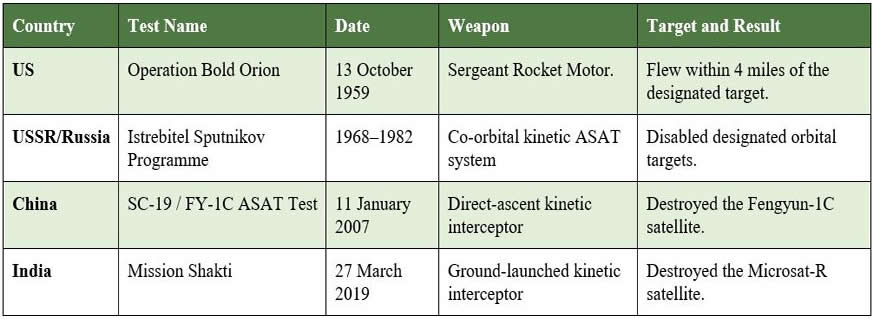
Sources: aerospace.csis.org
Taken together, these issues demonstrate the legal conundrum pertaining to the targetability of CSCs in space and the practical challenges of conducting a strike against them. Resolving this issue, however, requires navigating a geopolitical split over the very application of IHL in space.
While a Western bloc led by the US has advocated for the applicability of IHL in space, Russia actively opposes formalising these frameworks, claiming that drafting 'rules of the road' for orbital combat would legitimise space warfare.
This division leaves states fragmented between two lobbies: a Western push for orbital IHL applicability, and a Sino-Russian demand for hardware-focused treaties like the Prevention of the Placement of Weapons in Outer Space (PPWT), which advocates for imposing a blanket ban on space-based weaponry.
This issue is further exacerbated by the failure of private entities to clearly demarcate between the civilian and military components of their CSCs. While recent developments showcase that Starlink might be operationalizing such a distinction, a complete segregation still remains technically challenging due to the unification of Starlink’s main server system.
The urgent task thus, for both state actors and private entities, lies in not only bridging the chasm between existing IHL rules and their applicability in space, but also operationalising a hardware-focused treaty which explicitly lays down the rules of engagement in the extra-terrestrial.
Without such guardrails, targeting a single military-supporting satellite runs the risk of disrupting entire civilian networks, triggering never-ceasing debris collisions, and inflicting long-term damage on orbital networks upon which both civilian societies and armed forces increasingly depend.