
Pakistan’s counterterrorism challenge is increasingly moving into digital domain, where proscribed organisations use social media for propaganda, recruitment, and the glorification of violence. The core problem is not only that extremist content appears online, but that once such content is reported by the state, platform responses often remain uneven, delayed, or shaped by company policies that may not align with Pakistan’s security concerns. This creates an enforcement gap in which terrorist networks can adapt, migrate across services, and rebuild their digital presence faster than regulators can respond.
Through data received from PTA on reported online activity linked to the Tehrik-e-Taliban Pakistan (TTP), Balochistan Liberation Army (BLA), and Daesh or Islamic State Khorasan Province (ISKP) over the past five years for trends related to Facebook, Instagram, TikTok, X, and YouTube, this Insight examines how gaps in platform cooperation create national security risks for Pakistan and argues that lawful cooperation in counterterrorism contexts should become measurable, enforceable, and subject to clear accountability safeguards.
The TTP, BLA, and ISKP are all recognised terrorist entities by Pakistan as well as by the UN, the UK, and the US. Pakistani authorities have repeatedly highlighted that these groups use Social Media Platforms (SMPs) such as X, Facebook, WhatsApp, Instagram, Telegram, YouTube, and TikTok for propaganda and recruitment.
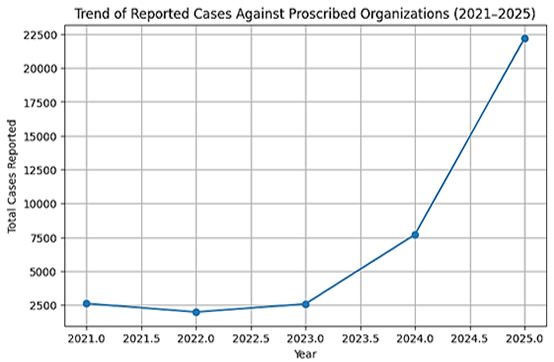
The data from 2021-2025 shows that in the ‘Proscribed/Terrorist’ category, specifically for the three proscribed organisations, reported content rose from 2627 cases in 2021 to 22186 in 2025 (an increase of 745%), while the compliance rate of SMPs dropped from 99.66% to 88.8%. This suggests that more content is being identified, but compliance is not keeping pace. This is best read as a system-level warning sign of rising volume combined with growing friction in platform response.
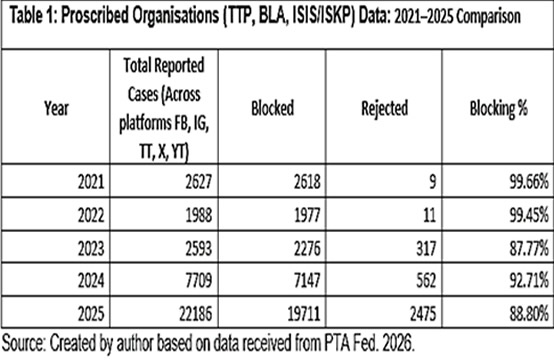
The platforms reportedly require 24-48 hours to comply with the flagged content; however, delays can be longer where cases are contested or subject to review. It should be noted here that these are not routine content complaints: the dataset concerns accounts and material linked to internationally designated terrorist organisations (not just proscribed in Pakistan), so priority handling and stronger cooperation from the platforms is expected—yet the trend indicates declining responsiveness.
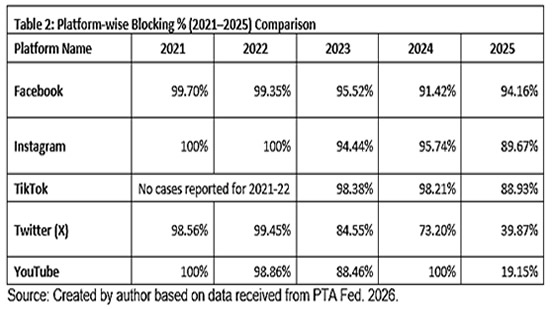
The platform-level picture presented in the table below is equally revealing. According to the data, Facebook and TikTok appear to show comparatively stronger cooperation in compliance, whereas X and YouTube appear weaker in several areas, with more cases either rejected or left under review. Extremist networks do not require uniform permissiveness across the digital ecosystem; they benefit from uneven enforcement. Slower response, inconsistent moderation, and delayed review create openings that allow content to persist, migrate, and reappear.
What the available data shows more clearly is not a fixed platform preference, but a broader pattern of rising flagged activity and uneven platform cooperation. The issue is not simply that extremist content appears online, but the deeper national security concern is that responses to state reporting remain inconsistent across platforms and are often too slow for Pakistan’s threat environment. The data also reveals a second vulnerability: the enforcement chain begins not with platforms, but with Pakistan's own ability to identify and flag content accurately and at scale.
At present, reporting and flagging often depend heavily on manual processes and on the willingness of foreign platforms to act. Locally trained AI models, especially those capable of handling Pakistani languages and local threat patterns, could assist in improving detection, support prioritised reporting, and help verify whether removed content quickly reappears elsewhere. Such tools should support, not replace, lawful human review. But without this technical layer, enforcement will remain overly dependent on slow manual processes and on external platform discretion, a dependency that is ultimately structural, since the content itself lives on platforms Pakistan neither hosts nor controls.
Proactive detection by platforms is already standard. The Global Internet Forum to Counter Terrorism (GIFCT) operates a hash-sharing database, and the European Union enforces a one-hour removal rule. Such measures, if applied correctly, directly relate to Pakistan's volume and speed gap. The weakness for Pakistan lies not in legal authority but in enforceable compliance, especially where major international media platforms lack local presence or maintain slow response channels.
This dependency is also geographic: the platforms most relevant to Pakistan administer their operations not from Pakistan but from outside, mainly Singapore (Meta, Google/YouTube, X, and TikTok all run Asia-Pacific operations there), with Telegram based in Dubai. Decisions affecting Pakistani content are therefore taken under regulatory and commercial incentives set elsewhere, reinforcing the structural gap between Pakistan’s lawful authority and its practical leverage. In Pakistan, the domestic legal architecture for countering such content is already in place. The Prevention of Electronic Crimes Act (PECA) 2016 criminalises, among other things, the online glorification of terrorism and activities linked to proscribed organisations.
Section 37 empowers the PTA to block or direct the removal of unlawful online content on specified grounds, including security-related concerns. The 2021 Removal and Blocking of Unlawful Online Content Rules were intended to operationalise this framework. International experience shows what a more disciplined approach can achieve.
In 2024, Brazil’s Supreme Court suspended X over disinformation and non-compliance with court orders until it complied with court orders, paid fines, and appointed a local legal representative.
Turkiye used a different route, relying on escalating penalties under its social media law over content regulation and local representation requirements to pressure platforms into establishing local accountability structures. Pakistan should therefore move from episodic requests to a tiered compliance architecture.
This should include local legal representation for high-risk large platforms; graduated penalties for non-compliance with lawful orders; platform-specific compliance scorecards; AI-enabled monitoring and verification (using locally trained models) to improve detection, prioritised reporting, and tracking of mirror-account recurrence and content reappearance; transparency reporting on proactive and automated removals (including error and reinstatement rates); and stronger moderation capacity in Urdu and regional languages.
Independent oversight should ensure that national security enforcement remains lawful, targeted, and reviewable. The objective is not censorship by default. It is jurisdictional accountability–the straightforward expectation that platforms operating in Pakistan respect local law when national security is at stake. But, as data proves, SMPs apply their own standards and act on Pakistani requests mainly where those requests align with their norms.
For Pakistan, the fuller remedy is sovereign platforms of the kind China and Russia have built, but that demands sustained investment and capacity. However, Pakistan does not need to copy their model to learn the lesson: the goal is reduced dependency, not state control of speech. Until that capacity exists, Pakistan will remain dependent on platforms it neither hosts nor controls, and its national security will rest on the discretion of companies answering to other jurisdictions.