
Inland waterways (IWs) are globally recognised as one of the most cost-effective and environmentally sustainable modes of transportation. Historically, the Indus River system served as a major transportation artery during the colonial period. Pakistan has a vast network of rivers and canals; however, the modal split is heavily imbalanced, and the waterways remain untapped despite their cost-efficiency. This insight argues that Pakistan’s untapped inland waterways could serve as a complementary third corridor for cost-effective transportation in the long term, besides roads and rails. Pakistan's modal split is heavily imbalanced, with roads carrying over 96% of inland freight, rail carrying only 4%, and waterways carrying 0%. It increases logistics costs and puts pressure on road infrastructure. Pakistan consumes 58.8 million litres of petroleum products per day. The import of these products accounts for 67% of the trade deficit.
The volatile energy prices make freight efficiency a strategic economic concern. Growing environmental commitments require cleaner and more sustainable logistics solutions. These challenges highlight the need to explore inland waterways. Pakistan’s geographic potential for inland navigation is anchored in the Indus River system, which has five major tributaries and 10 smaller rivers. It also includes 19 barrages and headworks, including the six main barrages and a total of 56 canals. (Figure 1) This hydrological network stretches over 30,000km across the Indus basin. The inland water transport (IWT) in Pakistan remains untapped. The 18th Amendment makes the waterways a domain of provincial authority.
Yet there is no assigned ministry or federal regulatory authority to coordinate IWT across provinces due to an unresolved jurisdictional debate between federal and provincial stakeholders. However, there are existing colonial laws on IWT, like the Canal and Drainage Act of 1873 and the Inland Steam-vessels Act of 1917, which could be amended for use.
In 2014, under the public-private partnership policy, the Punjab government established the Inland Water Transport Development Company (IWTDC) as a pilot project. Although it proved the feasibility of a 220 km stretch between Daud Khel and Attock, the pilot project was shelved in 2018 due to the absence of a legal and regulatory framework and a lack of clear financial viability for the provincial budget.
The National Freight and Logistics Policy of Pakistan 2020, issued by the Ministry of Communications, proposed a three-phase development of IWT. Phase 1 included further work on the pilot project under IWTDC, including the development of an integrated terminal at Daud Khel. Phase 2 included its extension from Daud Khel to Tunsa, and Phase 3 would extend it from Tunsa to Sukkur.
Figure - 1
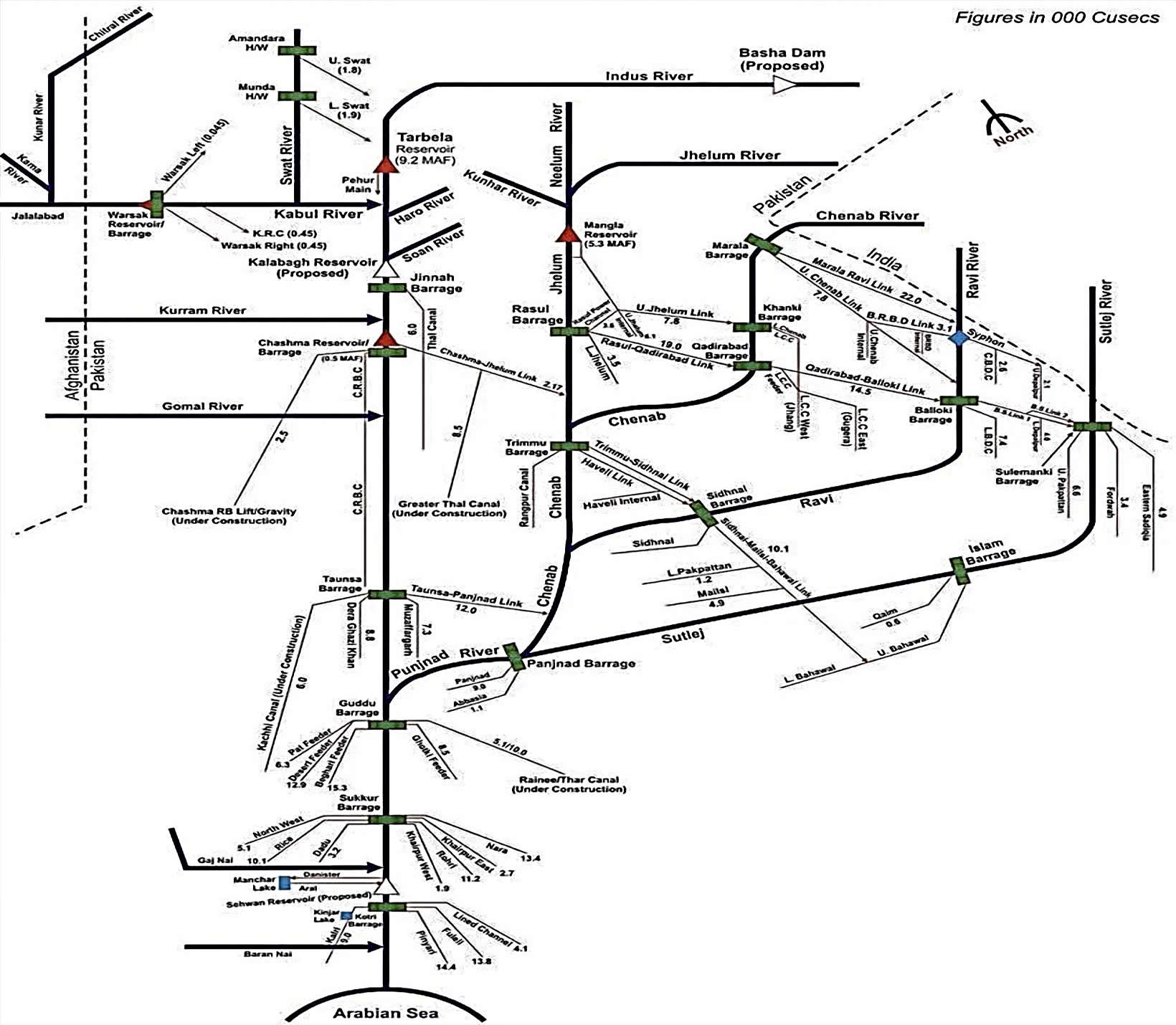
Sources: Research gate https://www.researchgate.net/figure/Schematic-map-of-the-irrigation-canal-network-of-Pakistan-Source-Stewart-et-al-179_fig1_354424748
In 2022, the World Bank's report on IWT suggested extending the waterways from Sukkur to Kotri, Gharo Creek, and to Port Qasim. Four primary economic efficiencies could drive the adoption of IWs as a third corridor. Firstly, IWs are the most fuel-efficient mode of bulk transport compared to roads and rail.
To move 1,500 tons over 200 km, a single waterborne barge consumes only 1,600 litres of fuel, compared to 4,200 litres for three trains and 15,000 litres for 60 trucks. More precisely, Barges use 8 to 10 times less fuel than cargo trucks and 3 to 4 times less than railways. (Figure 2)
Figure - 2
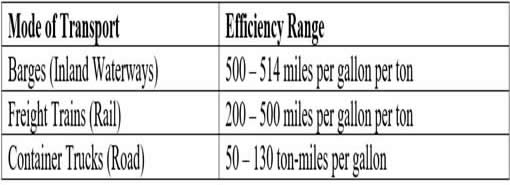
Sources: RSI Logistics https://www.rsilogistics.com/blog/is-rail-better-for-the-environment-than-trucks/
Secondly, a comparative study of the operational costs of the Punjab IWT pilot project shows that IWT's operating costs are also lower than those of road and rail transport. However, it also shows that the IWT offers a lower profit margin than road transport. (Figure 3)
Figure - 3
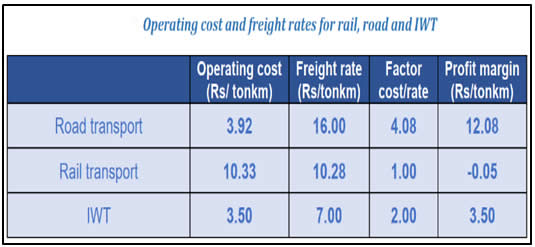
Sources: Punjab Inland Waterways Transport Pilot Project https://documents1.worldbank.org/curated/en/767691635863022447/pdf/An-Implementable-Vision-for-Revival-and-Development.pdf
In addition, the cost of establishing waterways is also less than that of roads and rails. For instance, the IWT project in Punjab costs Rs 270 million/km, and maintenance costs are estimated at 2.5% of the investment cost. In comparison, the cost of the 1726 km ML1 Railway project and a dry port in Havalian is Rs.1.89 trillion ($6.68 bn), i.e., Rs.1075 million/km, while the cost of highway roads ranges from Rs 175 to 600 million. (Figure 4)
Figure - 4
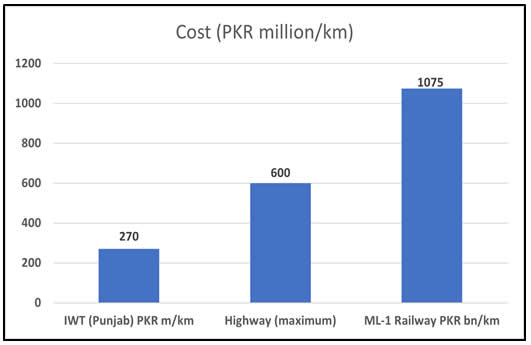
Sources: Global science review. https://www.gssrjournal.com/article/inland-water-transport-in-pakistan-limits-and-prospects Dawn news report. https://www.dawn.com/news/1667854
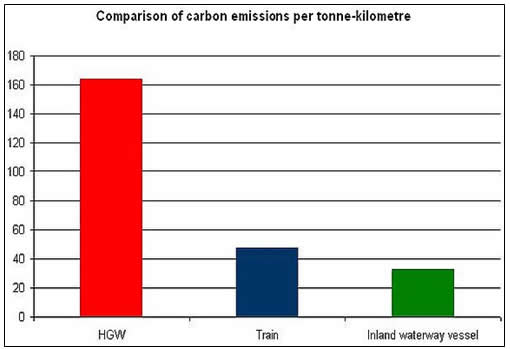
Environmental performance provides another advantage. Inland water vessels emit significantly less carbon dioxide per ton-kilometre than road transport. A heavy goods vehicle (HGV) emits 164 grams of CO2 per tonne-kilometre and a train 48.1 grams, whereas an inland waterway vessel only emits 33.4 grams (Figure 5).
Figure - 5
Sources: Moselkommission https://moselkommission.org/
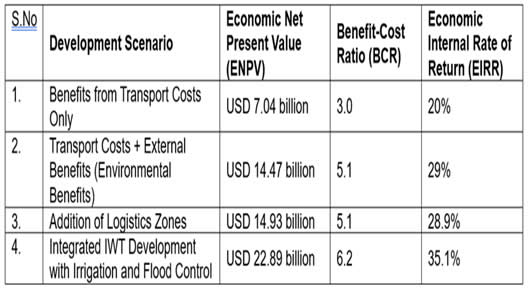
Overall, the cost-benefit analysis indicates that the IWs as a third corridor is an economically viable option. The primary benefit arises from reduced transport and logistics costs. Economic viability improves when additional benefits, such as environmental externalities, the development of logistics zones, irrigation efficiency, and flood control measures, are included (Figure 6).
Figure - 6
Sources: World Bank report 2022. https://documents1.worldbank.org/curated/en/767691635863022447/pdf/An-Implementable-Vision-for-Revival-and-Development.pdf
Several challenges make the implementation of integrated IWT at the national level non-viable in the short term. Some barrages (Jinnah, Chashma, Guddu, and Kotri) were already built with navigational locks, but upgrading them may cost Rs. 6.9 billion each.
Some barrages, like the Sukkur Barrage, lack navigational locks because they were built primarily for irrigation and flood control. There is also a lack of purpose-built terminals, and building one would cost Rs.180 million. Dams, on the other hand, also block waterways. There is also a lack of standardised vessels and accessibility to Karachi Port and Port Qasim.
Climate change is another major challenge. During winter, reduced river and canal flows hinder navigation. Climate modelling using Long Short-Term Memory (LSTM) networks projects a 17% to 25.6% increase in summer streamflow, potentially increasing the risk of catastrophic flooding and infrastructure damage.
Standard navigability for medium-sized craft requires a channel depth of 6 to 10 feet, which is available in many perennial stretches. However, in some waterways, physical obstructions, such as outcropping rocks and sandbars (between Attock Khurd and Khushal Garh), narrow the channel.
Sediment buildup has reduced flood-handling capacity by 17.75% over 24 years. These challenges require proper dredging to make waterways viable and sustainable during flood seasons under a “room for river” strategy.
IWs are viable and cost-effective in the long term if pursued gradually through phased pilot projects on commercially viable stretches, drawing a lesson from Indian policy. However, it would have limited utility due to the existing modal split, infrastructure, and geographical factors. Pakistan needs a unified national transport framework that integrates waterways with roads, railways, aviation, and maritime transport under a unified Ministry of Transport and Communication.
They could be used to transport commodities like containerised cargo, agricultural commodities, cement, coal, minerals and ores, and Industrial raw materials. IWs are not merely a transport alternative but a macroeconomic necessity. The national freight and logistics policy is a step in the right direction. The increasing energy costs, economic potential, and environmental needs necessitate its continuation.