
In recent decades, Indonesia has emerged as a resilient democracy and vibrant economy in Southeast Asia. This Insight explores Indonesia’s trajectory of success, consolidating its geostrategic importance and achieving economic stability in a multipolar world order.
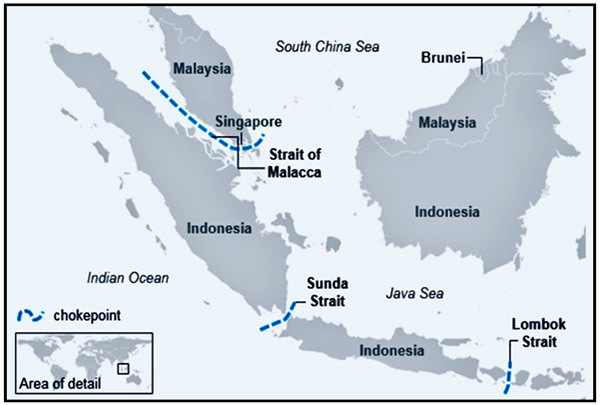
Indonesia, being the world’s largest archipelagic state, is strategically located at key maritime chokepoints, i.e., the Lombok, the Malacca, and the Sunda Straits. It is the geopolitical and economic centre of the Asia-Pacific region, as nearly 50% of global oil shipments and trade pass through these routes.
Figure 1: Map showing the geo-strategic location of Indonesia
Source: Self-Compiled
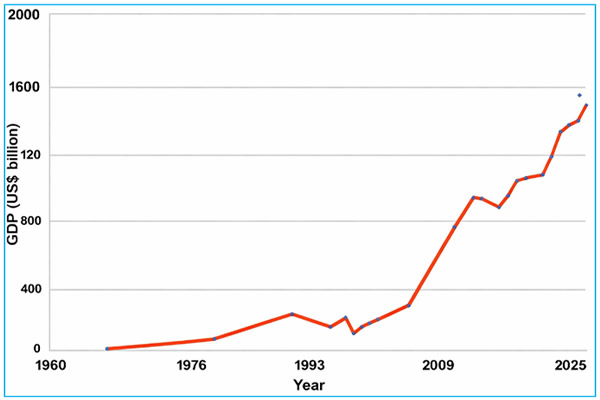
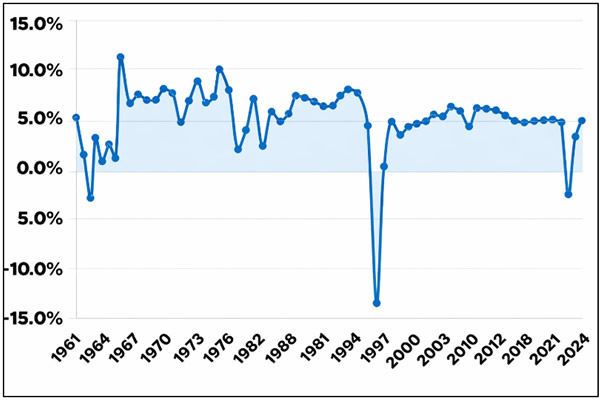
Indonesia ranks as the world’s sixth-largest economy, and its GDP has expanded from US$5.7 billion (1967) to US$1.5 trillion (2025), maintaining an average annual growth rate of 5-6%.
Figure 2: Indonesia’s GDP Growth (1967-2025)
Source: World Bank
Figure 3: Graph showing Indonesia’s average GDP Rate 1961–2024
Source: World Bank
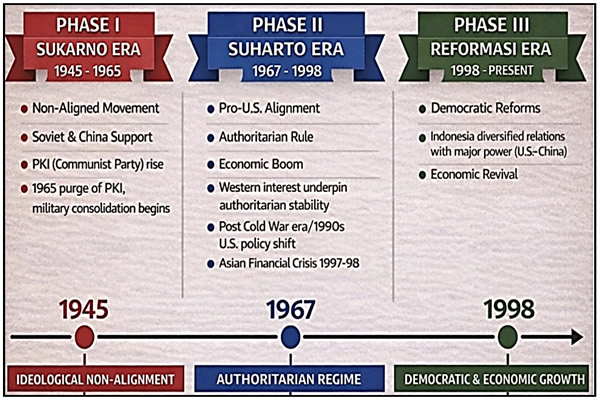
Since its independence in 1945, Indonesia’s development has been shaped by both Cold and post-Cold War dynamics characterised by great-power rivalry. Indonesia's transformation, therefore, can be understood by considering three distinct phases of its history.
Under President Sukarno’s regime (1949-1965), Indonesia led the Non-Aligned Movement (NAM-1961), yet it leaned towards the Soviet Union. Indonesia-USSR trade was limited and largely aid-driven. i.e., US$1.3 billion (1958-1963); however, during this period, the Soviet Union was delivering large quantities of weapons and defence equipment to Indonesia. By 1962, Indonesia was the biggest non-communist recipient of Soviet bloc military aid. This anti-Western stance, coupled with domestic economic and political challenges, spiralled into the mid-1960s crisis, which paved the way for the military takeover under President Suharto.
With President Suharto’s New Order (1967–1998), Indonesia inclined towards the U.S.-led Western bloc as a strategic defence against communism. The resultant U.S. support and influx of foreign investment helped achieve socio-economic progress; however, these did not result in robust institutional capacity-building and long-term stability.
The post–Cold War global shift in the 1990s, marked by the U.S. emergence as the sole superpower and Washington’s changing attitudes toward authoritarian regimes, reduced tolerance for Indonesia's political instability and signalled a shift in U.S. policy in the region.
Figure 4: Indonesia Transformation (1945-Present)
Source: Self-Compiled
The 1997-98 Asian Financial Crisis acted as a trigger, revealing underlying structural vulnerabilities and domestic governance issues. The U.S. was instrumental in sponsoring a US$43 billion IMF bailout package for Indonesia; however, it was conditioned on massive structural economic and political reforms, indirectly leading to the resignation of President Suharto and a shift in domestic political policies. In the aftermath, Indonesia 'Reformasi' movement (1998) enhanced its commitment to inclusive governance, human-capital development, and civil-military reform.
In the ensuing years, Indonesia witnessed an immense political transition leading to the independence of East Timor in 2002 and autonomy for Aceh in 2005. Washington predominantly facilitated both these outcomes in line with its transformed post-Cold War strategic objectives in the region. These Western-sponsored political reforms hence aimed to enhance Indonesia’s resilience and regional legitimacy, sustaining Western influence across the Asia-Pacific.
Washington further consolidated its relations with Indonesia through the Indo-Pacific Strategy (2022), which promotes a rule-based regional order. The Comprehensive Strategic Partnership (CSP-2023) institutionalised cooperation across multiple domains, such as Garuda Shield joint exercises, enhancing regional deterrence in maritime security collaboration.
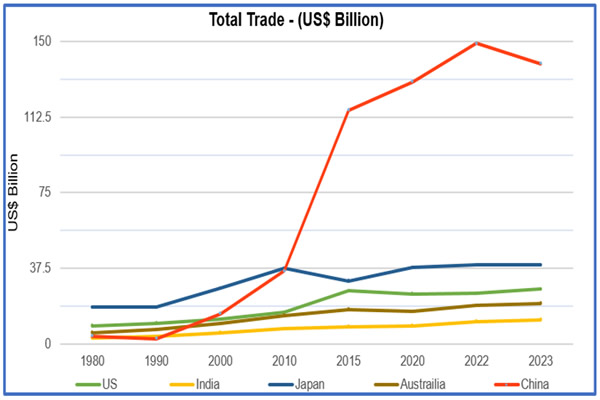
Parallel to its engagement with the U.S., Indonesia rapidly deepened economic cooperation with China after achieving democratic stability in 2004. Its net exports-imports have increased from $ 3.8 billion (2003) to $ 135 billion (2024) through the Comprehensive Strategic Partnership (CSP) under the Belt and Road Initiative (BRI-2013).
Since 2013, China has emerged as Indonesia's largest trading partner and second-largest investor. The ASEAN-China Free Trade Agreement (FTA) and the Regional Comprehensive Economic Partnership (RCEP) further boosted their bilateral trade. As of 2024, Indonesia implemented a zero‑tariff policy on approximately 65.1% of Chinese-origin products, and China reciprocated for 67.9 % of Indonesian-origin products under RCEP, facilitating free trade.
This cooperation is not limited to trade: under frameworks such as the BRI and Indonesia’s Global Maritime Fulcrum vision, infrastructure-heavy projects have improved regional connectivity. By 2023, Indonesia had signed BRI projects worth $8.6 billion, including trade, infrastructure, defence, and technology cooperation. China has been involved in 81 investments during 2022-2024, with Jakarta-Bandung High-Speed Rail (HSR) and Morowali Industrial Park among the prominent ones.
Figure 5: Indonesia’s Major Trade Partners (1980-2023)
Source: Self-Compiled
Both states are also collaborating in energy efficiency projects. As of 2023, they are cooperating on nickel and the EV battery industry, where China dominates nearly 47% of its refining capacity. Indonesia is also collaborating with China in a 6.9 GWh battery plant and is expected to reach 15 GWh by 2026. This reveals the national approach of Jakarta to enhance value chains through technology transfers, local processing, and attracting FDI. It would help the country to gain economic and strategic position in the global EV and battery market.
Overall, Indonesia's development course is characterised by multifaceted factors. At the external level, Indonesia has been able to balance its relationships with both the U.S. and China amid strategic competition in the Asia-Pacific. It has attracted China-driven BRI and RCEP economic and technological gains, while maintaining U.S.-influenced defence cooperation through forums such as the Indo-Pacific Economic Framework (IPEF-2022) and the CSP (2023). At the same time, it maintains ASEAN centrality in the form of ASEAN Outlook on Indo-Pacific (AOIP), which promotes an inclusive order without aligning with any great power. This reflects Jakarta’s strategic objective based on the principle of Bebas Aktif (Free and Active) that represents diversified diplomacy in maintaining national sovereignty and economic development.
To conclude, the analysis indicates that Indonesia has consistently secured great power attention since its independence, despite adopting a non-alignment policy during the Cold War. In the post-Cold War period, Indonesia’s size, resources, strategic location and geographical proximity to China drew sustained U.S. engagement. This has positioned Jakarta as a key regional actor capable of counteracting Beijing’s influence in Southeast Asia. Indonesia’s transition from Cold War alignments to reform-driven geoeconomics in the turbulent Asia-Pacific region, therefore, offers a pathway for countries like Pakistan towards stability and growth amid great-power rivalry.