
Since the establishment of the People’s Republic of China (PRC) in 1949, one of the significant dimensions in Sino-US relations has been the issue of Taiwan. For China, it is a matter of sovereignty and territorial integrity, while the US treats it as a geostrategic issue to counter China's rise. This insight examines how US policy toward Taiwan influences Sino-US relations.
Historically, the Taiwan issue is rooted in the Chinese Civil War (1927-1949). After the civil war ended, the then-ruling party in China, the Kuomintang (KMT), fled to Taiwan following its defeat by the Communist Party of China (CPC). The KMT, under Chiang Kai-shek, established its government in Taiwan, forming the Republic of China (ROC). In contrast, the CPC, under Mao Zedong, established the communist government in Beijing. In 1971, the PRC was admitted to the UN, and Taiwan was expelled, but the US upheld Taiwan as the legitimate government until 1979. In 1979, the US formally recognised China but maintained unofficial relations with Taiwan under the KMT by potentially breaching the One-China policy agreed under the Three Joint Communiqués between China and the US.
China considers the long-standing Taiwan issue an internal political matter of sovereignty and an integral part of the “great rejuvenation of the Chinese nation,” which cannot be achieved without the unification of Taiwan. China opposes defense, economic, political, and diplomatic relations between Taiwan and the rest of the world.
However, the US continues to maintain strong relations with Taiwan. - Taiwan relies mostly on US security support and weapon supplies, even though there is no formal security treaty between them. The US is neither authorising military intervention nor clearly assuring China that military intervention will not occur in the event of a conflict between China and Taiwan.
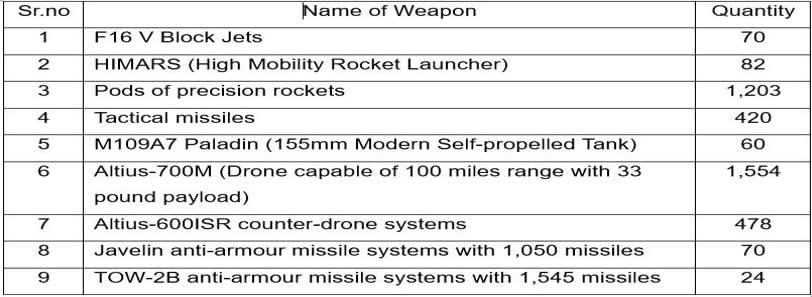
Despite the 1982 US-China joint Communiqué to reduce US arms sales to Taiwan, Washington continues to increase arms sales, with $39.6 billion worth of weapons scheduled for 2026 (Table 1), and to increase the number of US trainers for Taiwanese forces from 500 to 1,000 in 2026.
Table 1: Weapons to be Purchased by Taiwan from the US in 2026
Sources: Focus Taiwan
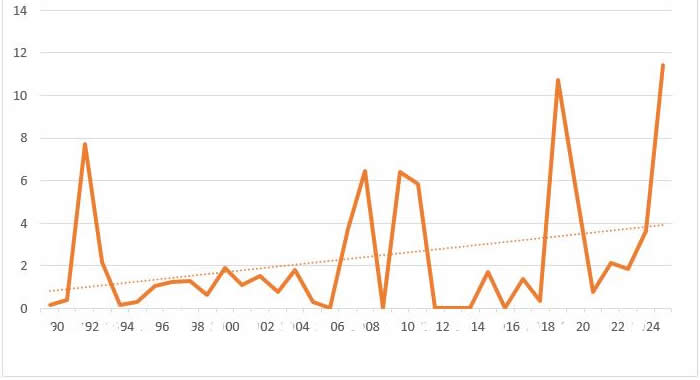
The US arms sales to Taiwan are among the most controversial issues in US-China relations. Since 1990, US arms sales to Taiwan have grown at an average of $2.41 billion per year (Figure 1). As China considers Taiwan an internal matter, any arms sales are considered as an interference in China’s internal affairs.
Figure 1: Year-Wise US Arms Sales to Taiwan from 1990 to 2025 in $Billion
Sources: https://www.us-taiwan.org/resources/ustbc-comments-on-eight-arms-sales-to-taiwan-valued-at-over-us-11-1-billion/
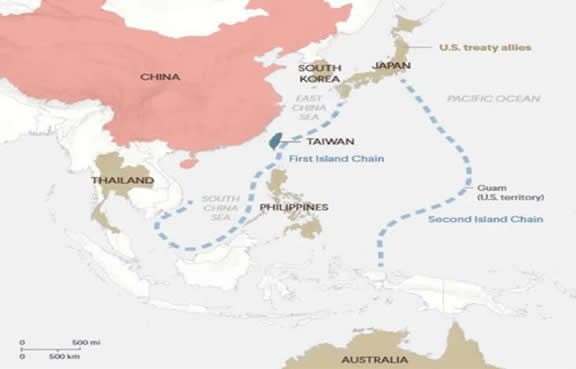
Taiwan's geostrategic location is of critical importance to both China and the US. Located along critical sea lines of communication in the Western Pacific, the island is central to regional security and global trade, and any military confrontation in the Taiwan Strait could severely disrupt international commerce and maritime traffic (Figure 2). Continued regional instability due to China-Taiwan tension benefits the ‘US Strategy of Disruption against China’.
Figure 2
Sources: https://www.cfr.org/task-force-reports/us-taiwan-relations-in-a-new-era
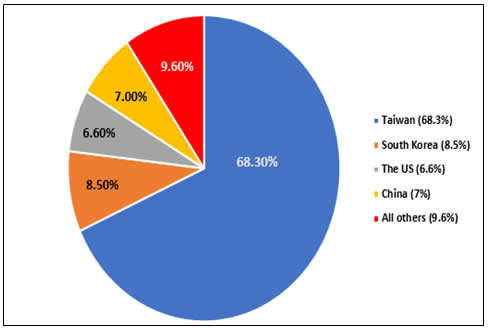
Taiwan also plays a significant role in the US-China semiconductor rivalry. Taiwan produces 68.3% of the world’s semiconductors (Figure 3), of which 2% are exported directly to the US. In addition, in January 2026, the US and Taiwan signed a $500 billion Chips Deal that included plans to build semiconductor industrial parks in Arizona.
Figure 3: Semiconductor Market Share (%)
Sources: International Trade Administration, Washington, DC, (2025)
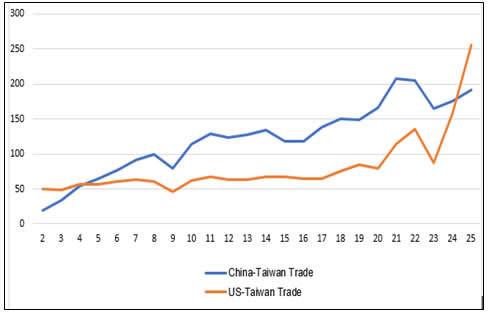
The US is also Taiwan’s largest trade partner, reaching a trade volume of $256 billion in 2025 (Figure 4). The growing US-Taiwan trade increases Washington's influence in Taipei, reduces economic dependence on China, and enhances Taiwan's international legitimacy, complicating peaceful unification.
Figure 4: US-Taiwan vs China-Taiwan Trade Relations from 2002 to 2025 (In Billion USD)
Sources: Statesta 2025, CEIC Data, and the US Census Bureau 2026
Reunification of Taiwan has always been central to Beijing's long-standing goal of achieving national rejuvenation by 2049. To ensure peaceful reunification, China is using various political, economic, and diplomatic tools. In China’s strategic communication, there is also an increasing reference to specific historical documents, such as the 1943 Cairo Declaration and the 1945 Potsdam Proclamation, which call for Chinese control over all territories that Japan seized during World War II.
From China's perspective, the increasing political divisions within Taiwan over relations with the US present an opportunity to weaken domestic consensus and improve the chances for a political settlement on terms more favorable to Beijing. The current two main opposition political parties, the KMT since 2005 and the Taiwan People's Party (TPP) since 2019, have adopted a pro-engagement stance with China and have become strong opponents of the pro-sovereignty ruling Democratic Progressive Party (DPP).
The KMT and TPP oppose increasing the defense budget and blocked the US-Taiwan joint weapons development plan (2026-2034), labeling it as making the Taiwan Strait a “powder keg.” In the near future, the Taiwan issue is likely to remain one of the most important factors shaping Sino–US relations. The US may continue supporting Taiwan while maintaining its long-standing policy of strategic ambiguity. China, on the other hand, is most likely to use a mix of peaceful political means, economic incentives, along with long-term political, economic, and social pressures to ensure reunification.
Concurrently, the “One Country, Two Systems” formula continues to represent a potential framework through which China seeks to reconcile its objective of reunification. Looking ahead, the stability of the Taiwan Strait will depend on how effectively both powers manage their strategic competition and communication.