“It should not have been there, but they forced us… This time, it must be decided whether Afghanistan wants to live peacefully or not.”
— Prime Minister Shehbaz Sharif, on the Pak-Afghan trade blockade
Since the withdrawal of US and NATO forces from Afghanistan in August 2021, terrorism inside Pakistan has surged, with independent trackers recording a 66% rise in violence in 2024 alone, concentrated in Khyber Pakhtunkhwa (KP). Pakistan's initial bet on a friendly Taliban curbing the TTP collapsed after Kabul released hundreds of TTP fighters, including senior commanders, from Afghan jails.
Dialogue gave way to force through 2025-26: border clashes in October 2025 triggered a Qatar/Türkiye-mediated Doha ceasefire, followed by failed Istanbul talks, a full trade suspension from mid-October 2025 that halted roughly $1.6 billion in annual cross-border commerce, and February 2026 airstrikes on Nangarhar and Paktika that Islamabad now frames as strikes on an “Afghan regime” rather than a government. Yet by mid-2026 the violence had not declined; even as Chinese mediation continued.
Islamabad's official position is that the Taliban are unwilling, not merely unable to act, and that most attacks originate from Afghan soil Pakistan has separately accused India's RAW of financing the TTP and BLA, presenting the “irrefutable evidence” to the UN, OIC and P5 states.
A competing hypothesis holds that the Taliban lack both the will and the capacity to fight the TTP, fearing that pressured fighters could defect to the rival ISKP, and that both the TTP and BLA draw covert external support, to keep Pakistan destabilised, from the Western and Indian intelligence agencies.
Three documented facts feed this suspicion. First, the roughly $7.1 billion in US-supplied equipment abandoned in Afghanistan in 2021 has demonstrably reached the TTP; a 2025 SIGAR report and Pakistani military statements both confirm American arms recovered from militants. Second, several senior Taliban figures—including Foreign Minister Amir Khan Muttaqi, Khairullah Khairkhwa, Abdul Haq Wasiq and Mohammad Fazl—are former Guantánamo Bay detainees released in a 2014 prisoner exchange, thus questioning their independence. Third, a planned Muttaqi visit to Pakistan in August 2025 was scuttled after Washington withheld the required UN sanctions-travel waiver, while a UNSC exemption for a visit to India was approved weeks later for October 9-16, 2025.
Mediation has managed rather than resolved the crisis: Qatari and Turkish-brokered talks collapsed twice in late 2025, and a Chinese-led track since has kept channels open without securing verifiable Taliban action.
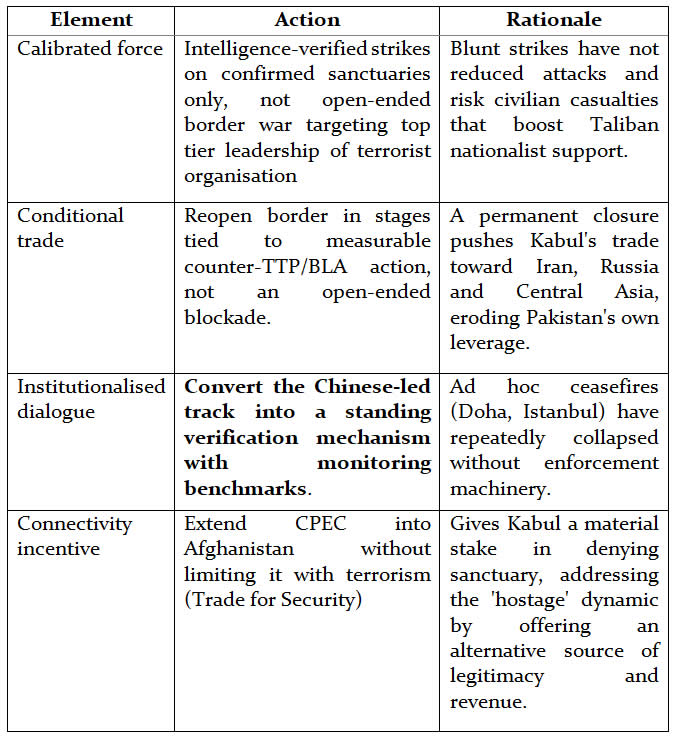
Afghanistan's isolation persists—Russia alone has formally recognised the Afghan Regime—leaving Pakistan's ambition to become South, Central and West Asia's connectivity hub, via CPEC's proposed extension into Afghanistan, agreed in principle at a May 2025 Beijing trilateral, hostage to an unresolved security relationship. Four years of dialogue and roughly a year of kinetic pressure have both failed to reduce attacks, suggesting neither, pursued alone, is sufficient. A more sustainable course would combine four elements.
Calibrated force, sustained economic leverage, and a revived bilateral process anchored in shared connectivity interests together offer a more durable path for peace with Afghanistan than either kinetic pressure or dialogue pursued in isolation—both of which have already been tried since 2021 without reducing the threat. Absent that combination, the strategic dividend of regional economic integration that Pakistan seeks will likely remain, as it has since 2021, hostage to a border neither talks nor bombs have yet secured.