Economic growth is often framed under two broad models: the resource-dependent model and the knowledge-driven model. The former relies on the extraction of natural resources, while the latter sustains itself through innovation. Research and Development (R&D) anchors this transition from a finite-resource-driven model to long-term, knowledge-based growth.
Pakistan has largely remained a resource-driven economy, with less than 30% contribution from knowledge sectors, unlike leading economies where these sectors account for 70–80%. Ranked 99th out of 139 in the Global Innovation Index (GII), Pakistan’s R&D landscape reflects both potential and constraints. This insight explores the existing landscape of R&D in Pakistan and analyses its readiness for transitioning towards a knowledge economy.
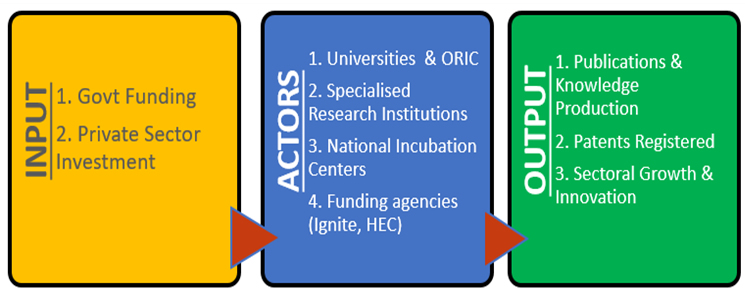
Figure 1: Pillars of R&D
Source: Created by Author
Pakistan’s R&D sector rests on three interconnected pillars: input, actors and output (Fig. 1). Input comprises the spending on R&D by government and private entities, which currently stands at 0.164% of GDP. The actors include a network of over 250 universities, numerous specialised research institutions working in eight major sectors, three dedicated funding agencies (Higher Education Commission (HEC), Ignite and Pakistan Science Fund (PSF)), eight National Incubation Centres (NICs) and nine Centres of Excellence (CoEs) across the country. The output of this R&D infrastructure is reflected in 3 domains: research publications, the number of patents registered and the overall innovative growth of the sector.
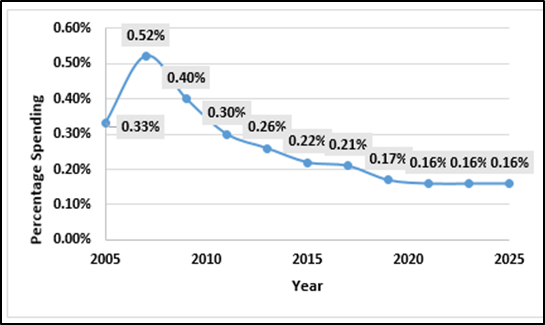
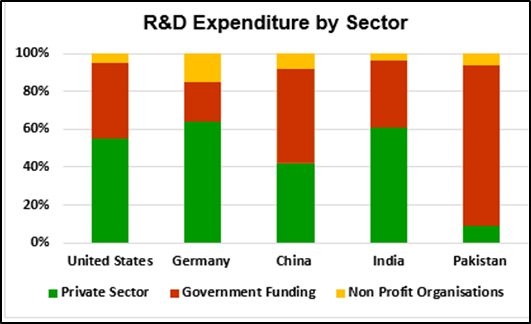
Pakistan’s R&D spending has declined from 0.22% of GDP in 2015 to 0.16% in 2025 (Graph 1). Most of this investment comes from public sector institutions, while contributions from private firms and non-profit organisations remain limited (Graph 2). In contrast, in advanced economies, the private sector drives innovation, accounting for nearly 50–60% of total R&D spending. Consequently, Pakistan’s R&D landscape presents a structurally imbalanced depiction.
Graph 1: Trajectory of Pakistans R&D Expenditure
Source: World Scorecard
Graph 2: R&D Share by Spending Sector
Source: Compiled by Author
Furthermore, this structural imbalance is aggravated by uneven R&D investment across sectors, where funding remains concentrated in mature sectors, with a broad production base and limited innovation potential.
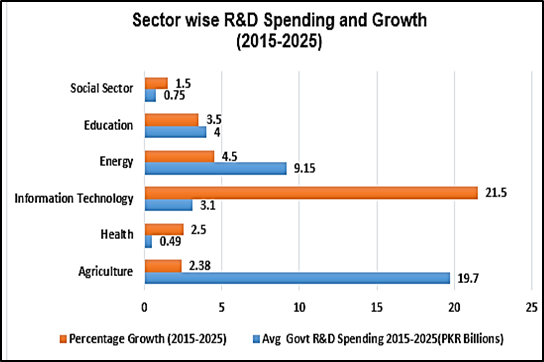
The agriculture sector, for instance, received an average of 19.7 billion PKR annually from 2015 to 2025 but displayed only 2.38% growth (Graph 3).
In contrast, the IT sector, with 3.1 billion PKR (1/6th of agriculture’s allocation), recorded nine times higher growth, while energy, education, health, and social sectors displayed incremental gains. This contrast shows that higher spending alone does not guarantee stronger outcomes; rather, it correlates with growth only in sectors with a higher innovation margin and expansion capacity.
Graph 3: Sector-Wise Spending and Growth 2015-2025
Source: Self-created by the author from the Yearly Economic Survey of Pakistan
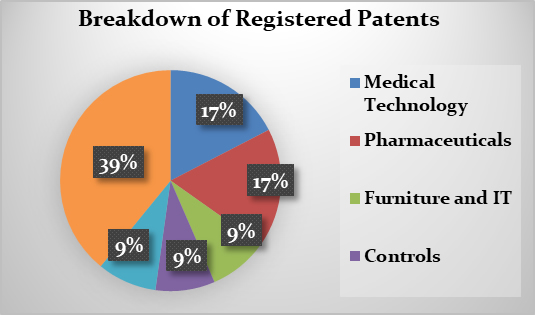
Another important metric to map the R&D sector in Pakistan is “innovation performance”, and this front presents a bleak picture. According to 2025 World Intellectual Property Organisation (WIPO) data, Pakistan is ranked 53rd out of 166 countries in global rank, with 963 patents filed, and 2112 active patents to date. The sectoral breakdown (Fig. 2) of these presents a handsome share of patents registered in medical and manufacturing fields; however, the largest portion, classified as ‘others’, reflects less defined patents, thereby highlighting a fragmented patent generation and narrowed growth prospects.
Figure 2: Sectoral Breakdown of Registered Patents
Source: WIPO Country Profile
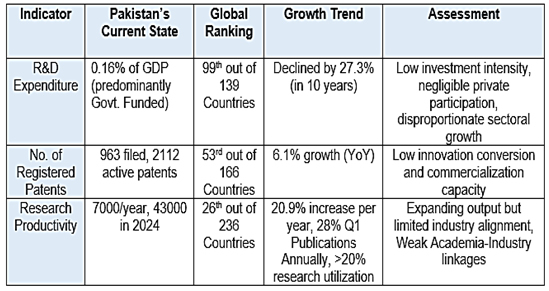
Moreover, Pakistan’s research output, though expanding, shows limited industrial integration. Academic institutions produce over 7,000 publications annually, with a growth rate of 20.9% per year. In 2024, the country ranked 26th among 236 nations in the Scimago Journal Ranking (SJR), with 28% Q1 publications. A comparison with leading research nations shows Pakistan’s strong research quality, despite the fact that less than 20% of the university-produced research is utilised by industry, reflecting a lack of applied research in universities and a distrust in industry regarding academic research.
Table 1: Snapshot of R&D in Pakistan
Source: Self-Extracted
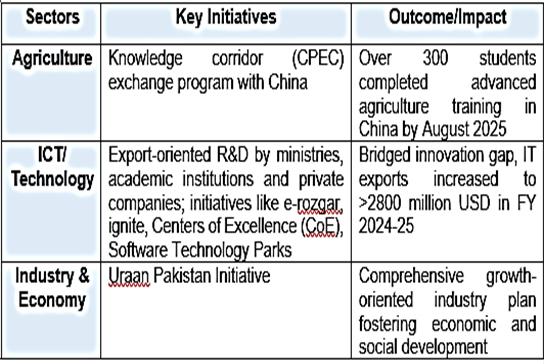
Within this broader landscape, the government of Pakistan has launched several targeted initiatives to strengthen the R&D ecosystem and boost sectoral export growth. As summarised in Table 2, these examples demonstrate that strategic, well-structured R&D programs can yield measurable positive outcomes.
However, despite these initiatives, overall R&D in Pakistan demonstrates limited materialisation in economic terms.
Table 2: Specialised Initiatives for R&D by the Government of Pakistan
Source: Self-Extracted
In light of the above landscape, three challenges emerge as the root causes of this imbalanced R&D structure: private-sector disengagement from R&D, a misaligned research base, and a lack of Public-Private innovation mechanisms.
The first and most critical challenge is the twofold disengagement of the private sector from R&D, characterised by a lack of investment and minimal innovation within firms. Structurally, the country’s R&D relies on public-sector spending, with the private sector contributing less than 10% of total investment. In addition, the First Industrial National Innovation Survey 2024 indicates that 93% of the firms do not conduct R&D, while the remaining 7% concentrate only on process optimisation. One of the prime reasons for this disengagement, reported by the private sector, is the higher cost of innovation projects.
To address similar concerns, developing countries are employing ‘R&D tax incentives’ as innovation support policy instrument, with level of support to a firm is determined by profitability, firm size and investment units in R&D. At present, 85% of the total Chinese R&D support for firms consists of this tax incentives, same goes for other countries: Iceland 74%, Norway 39%, and 48% in Türkiye.
Therefore, implementing a targeted tax incentive R&D framework could provide the necessary financial support to the private sector and significantly strengthen innovation-based economic growth.
Secondly, there is a misalignment of the research base in Pakistan. Globally, universities are considered the core of research and innovation, and developed economies conduct around 60% of research across all domains within higher education institutions, whereas in Pakistan, universities produce less than 20% of industry-utilised research. By comparison, universities in Germany, France and the UK receive approximately 50% of the total R&D funding and produce industrially applicable research. With over 250 universities in the country, Pakistan has the potential to establish a robust R&D ecosystem, where universities may position themselves as hubs of innovation and foster applied research and stronger academia–industry linkages. Finally, the lack of Public-Private coordination in the R&D ecosystem is impeding the intended growth.
Although there is no dearth of research productivity in the country, its commercialisation is weak.
The public sector dominates funding in the research phase, but the development and commercialisation phases require private-sector experience. Therefore, there is a need to enhance public-private collaborative funding in the R&D sector, where public-private sector investment share in the research phase should be 60%-10%, while 30% private funds may dominate the development and commercialisation phase. Such a framework will enhance research productivity and encourage new ventures.
In conclusion, Pakistan’s R&D ecosystem shows significant potential but remains constrained by structural imbalances. While research output is growing, there is a greater need to align research priorities and investment patterns with the sector’s growth dynamics. In this regard, targeted incentives, strengthened university–industry linkages, and collaborative funding models can be employed for transitioning towards a knowledge-driven economy.