
As the Cold War confrontation between the Western and Eastern European blocs ended, Europe sought to integrate Russia into a broader European framework through partnerships in trade, energy and security. Over time, a complex relationship developed characterized by growing economic interdependence alongside persistent strategic mistrust. While Russia became a leading energy supplier of Europe and mutual trade relations strengthened, NATO’s eastward expansion heightened geopolitical tensions. The 2014 Crimean Crisis and the Russia-Ukraine War since 2022 has forced Europe to diversify its trade and energy relations.
This insight examines Europe's trade, defense, and energy sectors in the context of the Russia-Ukraine conflict, showing that its strategic autonomy agenda has been largely rhetorical, and that its diversification efforts have instead deepened its reliance on a more demanding US.
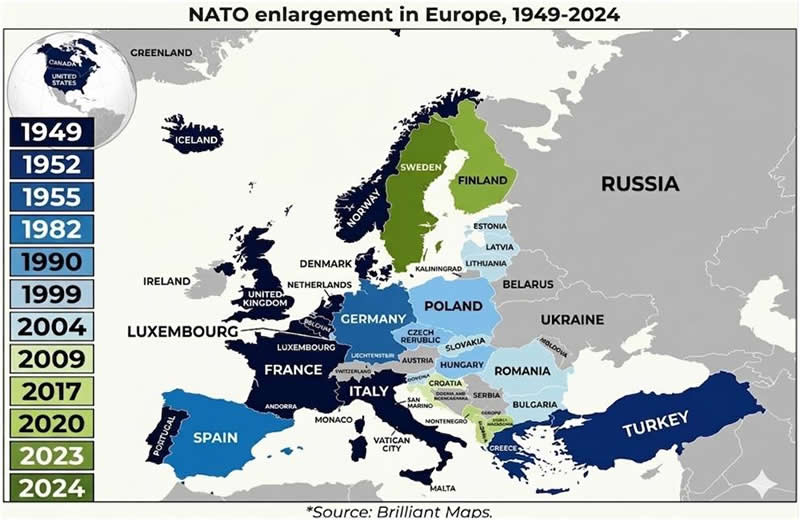
Russia perceives NATO and EU's post-Cold War expansion as eroding its security buffer with Western Europe. As the US pivots toward the Asia-Pacific and Middle East, it is pressurizing Europe to shoulder more of NATO's financial burden, buy more American-made arms against Russia, replace Russian energy with US supplies, and cede Denmark's ownership of Greenland, while imposing higher tariffs on European goods. US support for Europe has thus become increasingly conditional on compliance with these demands.
In early 2026, premiers of major European nations, Keir Starmer, Friedrich Merz, Emmanuel Macron, and Pedro Sánchez visited China, signaling efforts at diversification in their relations. Yet Macron and Merz later criticized China at Davos and Munich, signaling loyalty to the US instead, showing Europe's deepening dependence on Washington.
At the 2026 Munich Security Conference, Secretary of State Marco Rubio declared that Europe and America 'belong together' to save Western civilization through tighter migration and abandoning liberal policy 'delusions', warning the US would act alone if Europe failed to comply. Additionally, the US has raised tariffs on Europe, blaming its green energy initiatives for American economic losses (WEF, 2026).
This pressure was further echoed during the Strait of Hormuz Crisis, where Trump questioned the reliability of European NATO partners, and culminated at the 2026 NATO Summit, where Europe accepted US demands, committing $50 billion to new procurement, accelerating the 5% defense GDP target, and assuming primary responsibility for aiding Ukraine, as conditions for NATO's survival.
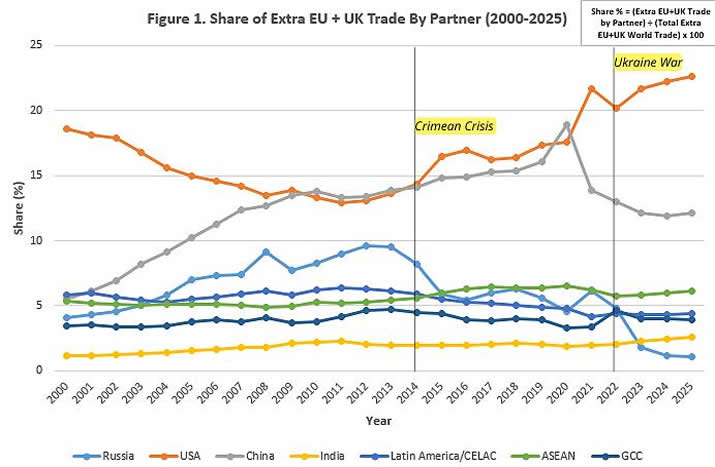
The US has traditionally been Europe’s largest external trade partner. Figure 1 shows that the US trade share with Europe was 18.6% in 2000, stayed around 14% from 2010 to 2014, began increasing after 2014, reaching 22.6% by 2025. (Note: Figures represent EU+UK share). China, Europe’s second-largest external trading partner, was at 5.5% share in 2000, reached 14% in 2014, and peaked at 18.9% in 2020. By 2025, it fell to about 12%.
Sources: Eurostal extra EU Trade database; European Commision DG Trade statistics & partner profiles; UK ONS trade statistics; HMRC UK Trade Info; UK Department for Business & Tade statistics; UN Comtrade; IMF DOTS; World Bank WDI; UNCTAD; ASEAN Statistics Yearbook & ADB Issues of Economist Intelligence Unit and Various other briefings.
Russia emerged as Europe’s third-largest external trading partner by 2010. Its share rose from 4.1% in 2000 to around 8% in 2010, began declining from 7% in 2014, and collapsed to 1.1% by 2025.
Association of Southeast Asian Nations’ (ASEAN) trade share with Europe was at 5.35% in 2000, stayed around 5% from 2014 until reaching 6.15% by 2025. Latin America was around 5% in 2000, stayed around 6% from 2010 to 2014, then gradually declined to 4.4% by 2025.
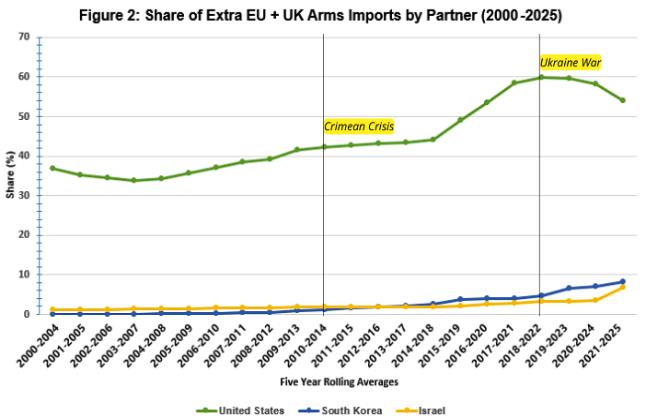
Gulf Cooperation Council (GCC) stayed around 3% from 2000 to 2010, reached 4.9% in 2014, and settled at 4% by 2025. India’s share was at 1.17% in 2000, stayed around 2% from 2010 to 2014, and reached 2.58% by 2025. Across the defense sector, the US has also remained Europe's dominant arms supplier. Figure 2 shows that the US share of Europe’s arms imports was 36.85% in 2000–2004 and reached 42% by 2010-2014 (Note: defense data are five-year rolling averages). Its share sharply increased from 44% in 2014-2018 period to 53.93% by 2025.
Sources: IISS, The Military Balance 2025; UK Ministry of Defence, strategic export controls & defence statistics; SIPRI, arms transfers database, sauces/methods, yearbook & Trends in International Arms Transfers 2025; US. DSCA, Historical Sales Book; UK Department for Business and Trade, defence and security export statistics; European Commission, EDIS monitoring non-EU dependencies; Global affairs Canada, military goods export report, UK Parliament, UK-Israel defence relationship; European Defence Review, South Korean arms in Europe.
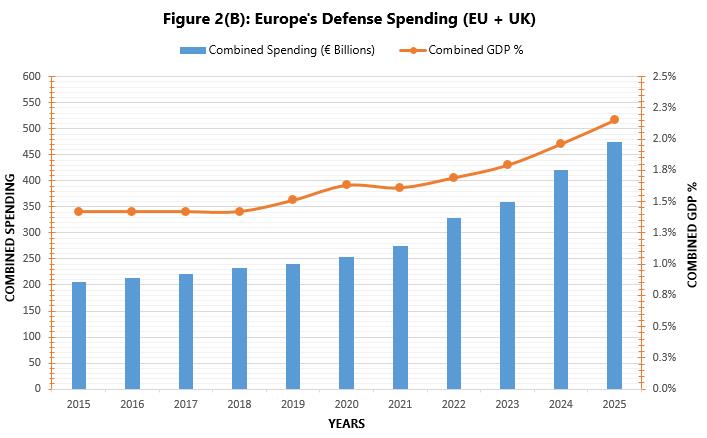
Among other arms suppliers, South Korea rose from near zero in 2000–2004, accelerating after 2014-2018 from 4% to 8.31% by 2021–2025. Israel’s share also increased from 1.15% in 2000–2004, accelerated after 2014-2018 from 2% to 6.79% in 2021–2025. Figure 2(B) shows that European defense expenditure has more than doubled since 2015. It has launched collective initiatives such as Readiness 2030 and the European Defense Fund (EDF), focused on “Buying European”. However, increased arms imports from the US indicate that much of this spending goes to the US.
Sources: NATO, Defence Expenditure of NATO Countries 2015-2025; European Defence Agency (EDA), Defence Data annual reports & 2025 key findings; SIPRI, Military Expenditure Database & Trends in World Military Expenditure 2025; IISS, The Military Balance 2025; European Commission, EDIS monitoring and EU defence budget analysis; Eurostat, government expenditure on defence (COFOG); Munich Security Report 2025.
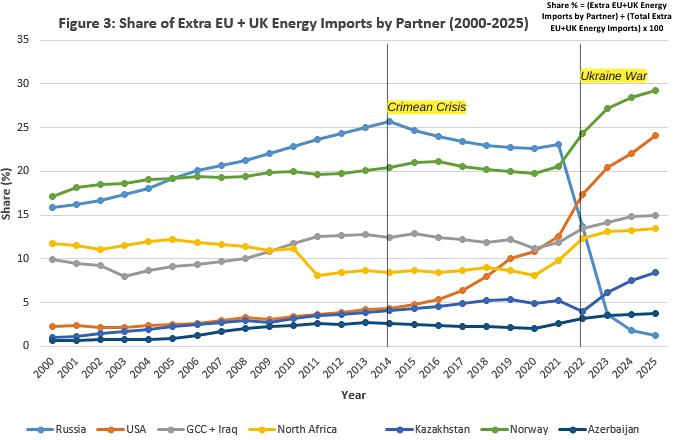
In terms of energy, Norway has been Europe’s most reliable supplier. Figure 3 shows that Norway’s share was higher than Russia's at 17% in 2000. In the mid-2010s, Norway’s share hovered around 20–21%. By 2006, Russia emerged as Europe’s largest energy supplier, peaking at 25.7% in 2014 before sliding to 22% by 2021 just before the Ukraine War. By 2025, Russia’s share of energy supply to Europe had collapsed to 1.2%, while Norway emerged as the dominant energy supplier, peaking at 29%.
Sources: DESNZ DUKES; DESNZ Energy Trends; IEA; ONS; UK Parliament; European Commission; Eurostat; UN Comtrade; World Bank WITS; HMRC; Energy Institute; EIA
The US, once a smaller energy partner, rose from 2.3% in 2000 to 4.3% by 2014. Its share increased after 2014 and surged after 2022 as LNG filled the gap left by Russia. By 2025, the US reached 24.1%, nearing Russia’s peak. Other energy suppliers also show notable shifts. The GCC and Iraq rose from 9–10% in the early 2000s to 15% by 2025.
North Africa supplied 11–12% of Europe’s energy but fell to 8% between 2011 and 2020, then recovered to 13.5% by 2025. Kazakhstan rose from 1% in 2000 to 5% in 2020 and 8.4% by 2025. Similarly, Azerbaijan grew from 1% in 2000 to around the 2–3% range after 2010, then increased to 3.8% by 2025.
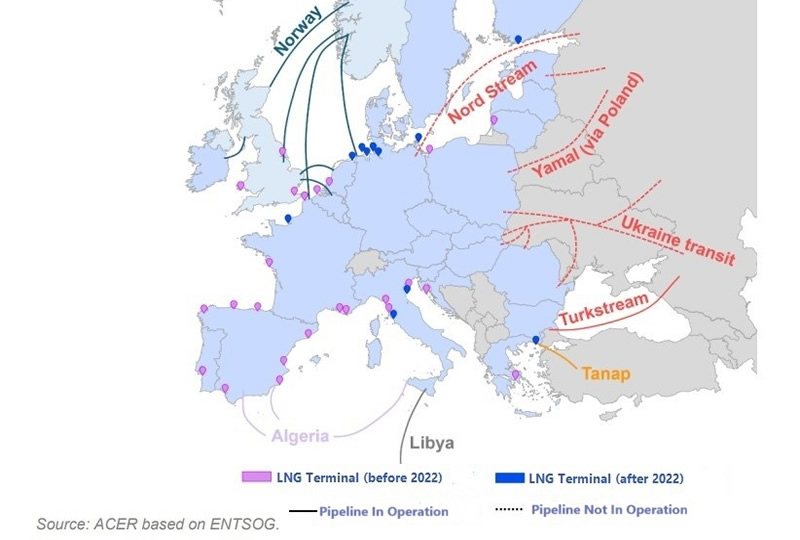
Figure 3(B) maps Europe’s pipeline shift since the Russia-Ukraine war began. It shows a pivot away from Russian pipelines in Eastern Europe and toward the North Sea (Norway), the Caspian corridor (Azerbaijan through Turkey), and the Mediterranean basin (Algeria & Libya). It also shows new LNG terminals, mainly supplying gas from the US and the Gulf region.
Figure 3(B): Status of Europe’s Key Energy Supply Routes
The data shows that Europe's dependency on the US in trade, defense, and energy has increased since the Russia-Ukraine conflict began in 2014, and especially after the 2022 war. The dependency has persisted even as European leaders have periodically gestured to reduce reliance on Washington.
In conclusion, Europe's rhetoric of strategic autonomy has not matched reality. The Ukraine conflict has only deepened its integration into the US-led security and economic framework. Genuine progress towards diversification and strategic autonomy would require radical reforms to domestic industry, a recalibration of ties with Russia and other partners, and a fundamental rethinking of energy and defense infrastructure. None of this seems likely in the short or medium term.
The views expressed in this Insight are of the author(s) alone and do not necessarily reflect the policy of ISSRA/NDU.