
China’s diplomatic relations with European states, such as the United Kingdom (UK), France, and Italy, began in the mid-1970s. The initial process led to the establishment of formal relations between China and the European Economic Community (EEC) in 1975, laying the foundation for broader Europe-China cooperation.
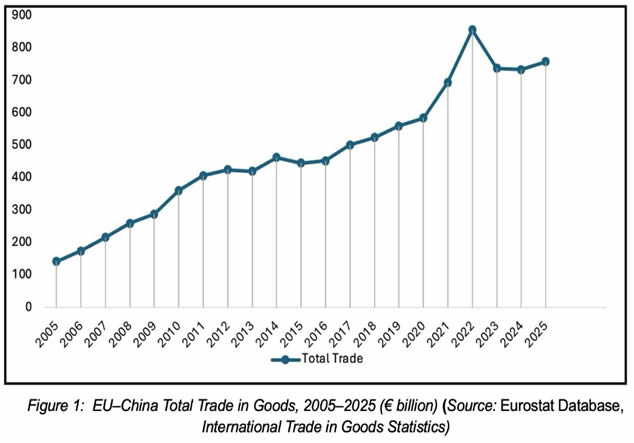
Between 2000 and 2014, relations between Europe and China expanded through growing trade, investment, and diplomatic engagement. Bilateral trade increased from €177 billion in 2004 to over €418 billion in 2014 (Figure 1). Political ties were also institutionalised through the Comprehensive Strategic Partnership in 2003.
The introduction of the Belt and Road Initiative (BRI) in 2013 deepened connectivity. The 17+1 mechanism was increasingly joined by countries from Central and Eastern Europe. By 2013, relations between Europe and China were moving on a positive trajectory.
A significant turning point in Sino-European relations emerged in 2014 due to the Crimean Conflict. This initiated European reassessment of geopolitical risk and strategic dependence, which intensified after the outbreak of the Russia-Ukraine war in 2022. The war altered Europe’s approach towards China, exposing vulnerabilities linked to strategic dependency and supply-chain resilience.
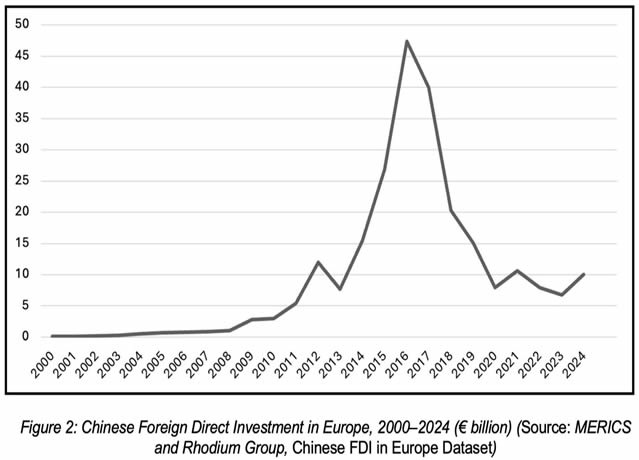
European governments began adopting a de-risking policy to reduce vulnerability in the energy, technology, and infrastructure sectors. This shift was most evident in the adoption of the European Economic Security Strategy of 2023 and the UK’s National Security and Investment Act, which introduced stricter investment screening mechanisms while diversifying trade and supply chain partnerships. These measures led to a decline of Chinese direct investment in Europe from its peak in 2016 at €47 billion to €11.6 billion in 2024 (Figure 2).
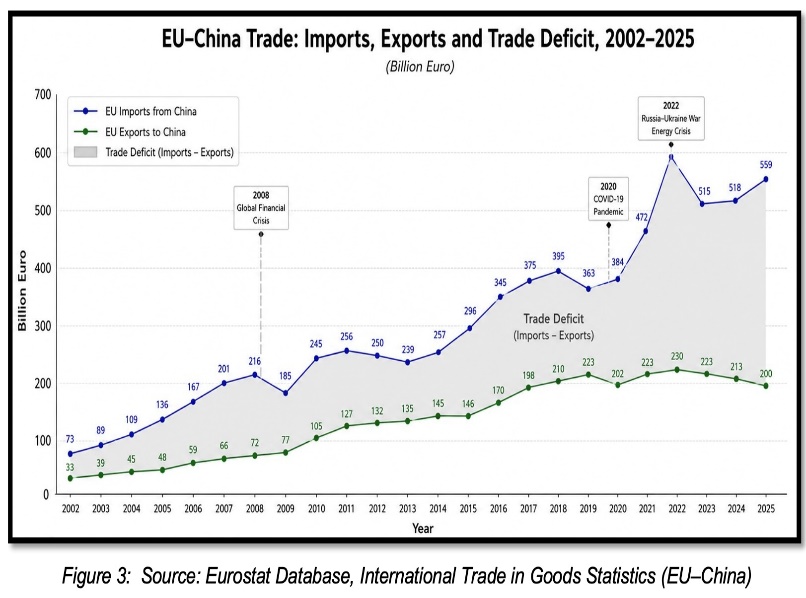
Trade volumes remained high but marked with imbalance. Europe’s trade deficit with China peaked at €397.3 billion in 2022, before narrowing to €360 billion in 2025. European exports to China grew until 2022 to €230 bn but declined to €199 bn in 2025 (Figure 3). This decrease reflects weakening demand in China for European goods and Europe's diversification into markets in the US, India, and Southeast Asia.
Despite de-risking efforts, stricter investment screening, and diversification of substantial economic interdependence between Europe and China persists, with bilateral trade exceeding €732 billion in 2024. UK-China trade also totalled nearly £99 billion in 2024, demonstrating the continued importance of this relationship.
Technology and security have remained an issue in Sino-European relations. In 2018, concerns initially emerged, linked to Huawei’s role in European 5G infrastructure. The Trump administration claimed that China’s links to Huawei posed it as a security risk to critical communication networks and pushed for its restriction. This led several countries, including the UK, Sweden, and Germany, to remove Huawei equipment from their 5G networks. However, by 2024, only 11 out of 27 European states had imposed restrictions on Huawei and ZTE in their 5G networks.
The Russia-Ukraine war reinforced technological concerns regarding Sino-European relations. Consequently, European states extended scrutiny of China’s role in telecommunications infrastructure, semiconductor supply chains, rare minerals, and clean energy technologies. To reduce vulnerabilities, European states introduced investment screening mechanisms and industrial policies to strengthen domestic capacity.
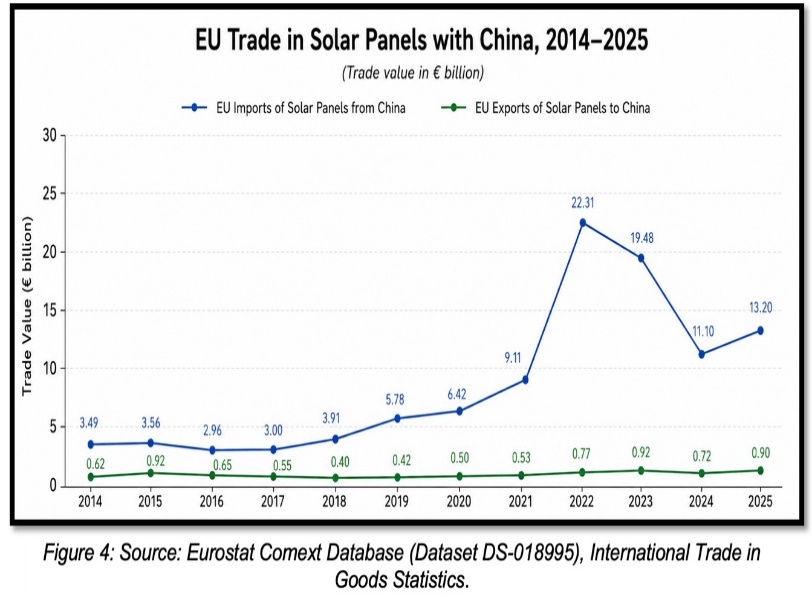
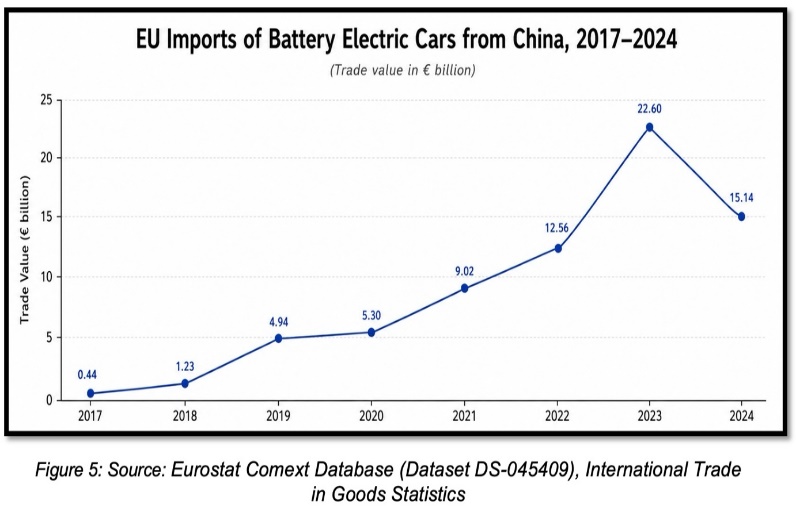
However, Europe remains dependent on Chinese technology to meet its sustainable energy and technology needs. In 2024, China accounted for 98% of Europe’s solar panels imports, 88% of lithium-ion battery imports, and 61% of solar inverters imports (Figure 4). Similarly, despite Europe introducing tariffs on Chinese EV imports, 650,000 units were still imported from China in 2025, with imports at €15.14 billion in 2024, remaining above 2022 levels. (Figure 5).
Diplomatically, from 2000 to 2013, China and Europe were cooperative. However, growing concerns about market reciprocity, industrial policy, and strategic dependency led to the European Commission’s 2019 Strategic Outlook describing China as a “Cooperation partner, economic competitor, and systemic rival”.
Europe-China relations became tense as China’s neutrality on the Russia-Ukraine war was concerning among European governments. This concern was evident through Italy’s exit from the BRI in 2023 and the exits of Lithuania (2021), Estonia, and Latvia (2022) from the 17+1 framework (Figure 6).
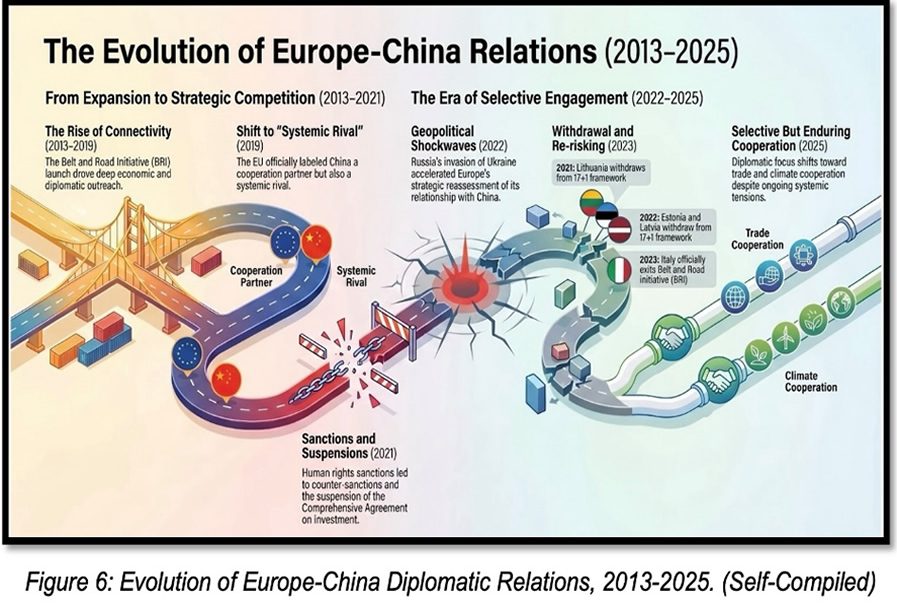
Nevertheless, diplomatic engagement has continued. The resumption of the EU-China Summit in 2023, the 25th EU-China Summit in 2025, marking the 50th anniversary of diplomatic relations between the two, visits by French Prime Minister Macron (2023), German Chancellor Scholz (2024), and UK Prime Minister Stramer (2026) demonstrate continued engagement.
Connectivity between Europe and China has also experienced recalibration. Maritime transport constitutes the principal mode of trade, accounting for 97% of trade volume, while rail accounts for around 1% and air transport 2% of trade volume between China and Europe. Transport by rail constitutes a small share of total trade but is integral for time-sensitive and higher-value goods.
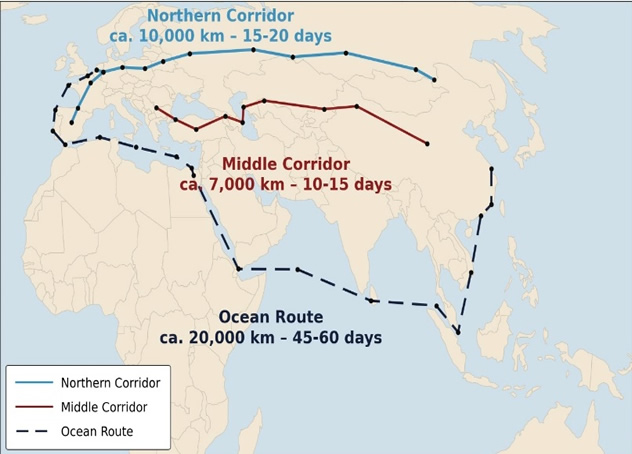
Figure 7: Comparative Eurasian Transit Corridors Linking China and Europe
Sources: Clingendeal Institute
The Northern Corridor was the dominant route used for transporting goods by rail. This route ran through Kazakhstan, Russia, and Belarus, with a transit time of 12-18 days and handled 86% of Europe-China rail freight transport (Figure 7). While the remaining 14% train transport was through the middle corridor. Following sanctions imposed on Russia, freight transport along the Northern Corridor dropped 50% and shifted to the Trans-Caspian Route (Middle Corridor). This route runs through Kazakhstan, the Caspian Sea, the South Caucasus, and Turkiye. Freight volumes along this corridor increased from 1.5 million tonnes in 2022 to 4.1 million tonnes by 2024.
The Russia-Ukraine war has contributed to the rebalancing of Europe-China Relations. While Europe has adopted de-risking policies to enhance economic security and reduce vulnerabilities in critical sectors, diplomatic engagement continues. The use of the alternative transport corridor (Middle Corridor) further demonstrates adaptation rather than disengagement.
Additionally, Europe-China relations may also be influenced by developments in the transatlantic relationship between the US and Europe. Recent behaviour of the US has led to reassessment by European governments and has brought strategic autonomy to the forefront.
Resultingly, Europe may proceed with its de-risking strategies while maintaining economic cooperation with China in domains of shared interests. Europe-China relations may develop along pragmatic lines, coexisting between cooperation and competition, amidst the increasing multipolar world.