China has a number of religions, and the government guarantees religious freedom through legal provisions. The West often portrays this as the suppression of religions. The Western narrative suggests that religious freedom is acknowledged only on paper but undermined in practice. Therefore, it is important to understand China’s approach to religious freedom beyond the lens of Western media. This insight examines how China, through a constitutional mechanism, manages religious freedom while protecting national security.
During the Cultural Revolution from 1966 to 1976, all religions were generally suppressed in China to eradicate outdated practices, but since “Opening Up” in 1978, a significant increase in religious freedom has been observed. Article 36 of the Constitution of China says, “Citizens enjoy freedom of religious belief. No state organ shall coerce citizens to believe in or not in any religion, nor shall they discriminate based on religion, and the state shall protect normal religious activities”.
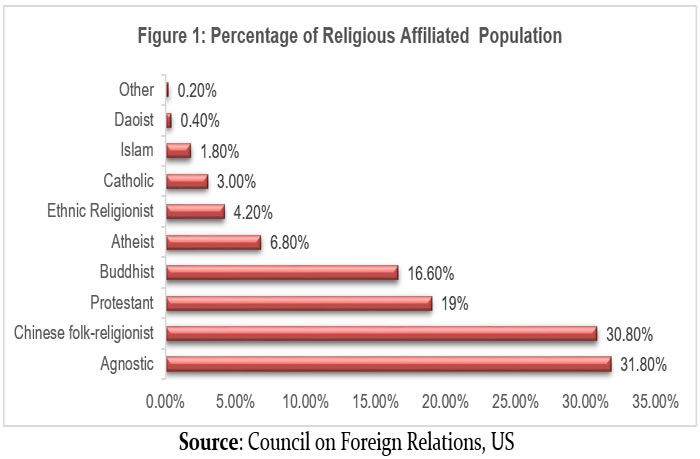
China officially recognises only five religions: Buddhism, Protestantism, Catholicism, Islam and Daoism—each administered by a state-authorised body— with a total of 200 million believers and 380,000 clerics. Islam is practised by 1.8% of China's total population, with an estimated 20 million adherents and 57,000 clerics (Figure 1). However, 66.8% of the population believes in religions that are not officially recognised, i.e., Ethnic Religionist, Chinese folk-religionist, and Agnostic, and 6.8% people are atheists.
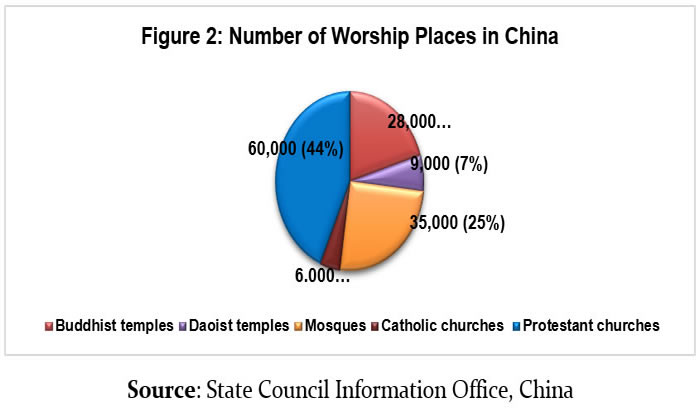
Likewise, there are about 138,000 registered places of worship (Figure 2), run by a state-affiliated institute. For example, the Chinese Islamic Association serves to ensure religious practices comply with state laws. Since 2007, it has also organised annual pilgrimages for 10,000 Chinese Muslims to Saudi Arabia.
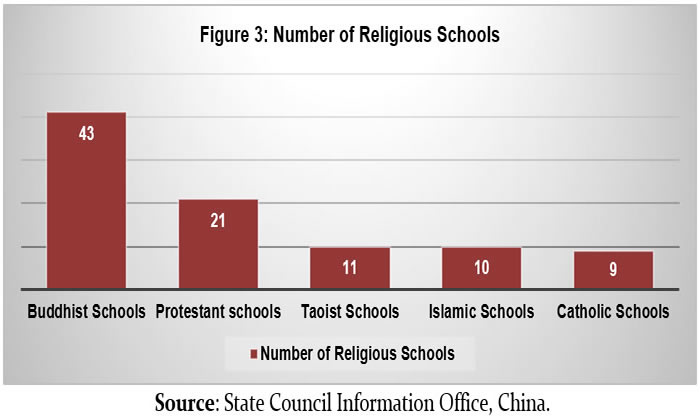
There are ninety-four religious schools in China: forty-three for Buddhism, twenty-one for Protestantism, eleven for Daoism, ten for Islam, and nine Catholic schools (Figure 3). According to 2018 statistics, around 10,000 students were enrolled in religious schools, with 47,000 having graduated.
The 2005 policy on Regulations on Religious Affairs requires all religious groups to be registered and managed by the authorities. The government censors the contents of religious sermons, publications and curriculum of the 94 religious schools to align them with national religious policies. Foreigners are also allowed to perform religious activities in accordance with state laws and protocols; however, they are not allowed to establish or run any religious institute or engage in missionary activities. Conditions of the worship places have been improved, including the assurance of public services, the continuous publication of religious literature, and even religious groups running websites.
Human Rights Organisations and Western media outlets question religious freedom in China, especially in Xinjiang, and regularly report crackdowns on religious institutions, most recently on branches of Zion Church or the crackdown on some mosques in Gansu and Ningxia regions. In fact, these institutions were unofficial and made unauthorised modifications in architectural structures. Under the ‘sinicisation of religion’ policy of China, aimed at integrating religion into Chinese culture, registration and regulation of religious institutions are necessary. At the 19th National Congress of the Communist Party, the policy of Sinicisation of religion was adopted to provide active guidance to religions so that they can adapt to a socialist society while upholding the basic principle of freedom.
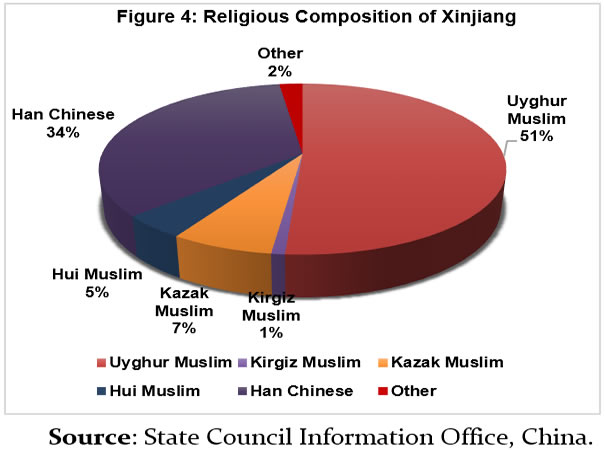
The often-cited case of religious restriction is the alleged suppression of Islam and Muslims in Xinjiang. Out of the 25.85 million people living in Xinjiang, 14.93 million are Muslims, while 10.9 million are members of the Han ethnic group (Figure 4).
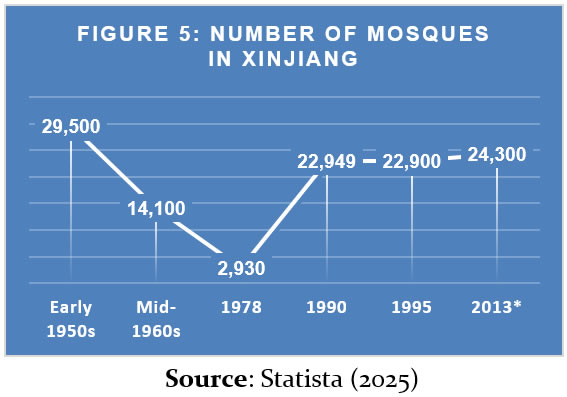
Since the 1980s, opening-up policies, under the goal of “harmonious society”, China has been tolerant of religious activities. In the 1980s, there were 2,930 mosques and 3,000 religious practitioners, whereas today there are 24,300 mosques and 28,000 religious practitioners (Figure 5). The increasing number of mosques and practising Muslims in Xinjiang indicates religious freedom, discarding the Western Media's claims of religious suppression. Moreover, since 2001, more than 1 million copies of religious books in the Uyghur language have been produced in Xinjiang, and over 4,000 people have been sent to study at Islamic institutions in Egypt and Pakistan. These figures illustrate China's dedication to protecting Muslims' right to religious freedom.
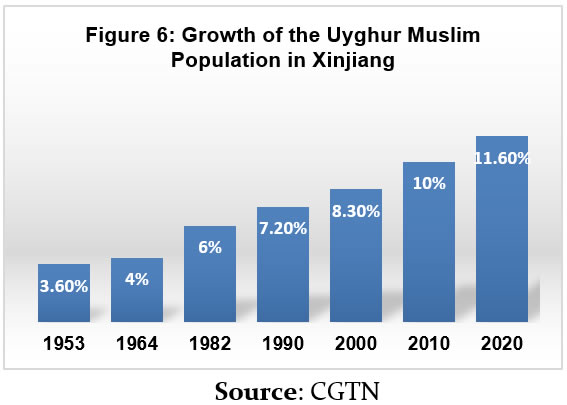
Evidence indicates that over the past seven decades, the number of Muslims in Xinjiang has increased significantly (Figure 6). As China links peace and stability to economic development, vocational training centres have been established in Xinjiang, where unemployed and unskilled people are learning new skills. These centres are often called mass internment camps by the Western Media. Such institutions aim to address the root causes of extremism and fundamentalism in less developed societies by providing skills to those without them.
Likewise, donations exceeding 100,000 Yuan are restricted; prior approval is required for the location and timing of religious festivals; online religious activities are monitored; and unregistered religious groups and institutions are not allowed to run any online or offline activities. All these are required to combat the misuse of religion for political objectives.
The government only allows religious activities in designated places. It does not mean that religion in China is state-controlled, but rather that it is managed by the state due to legitimate security concerns and the need for national cohesion in a multi-religious society.
Religious freedom in a multi-religious and multi-ethnic society needs regulations to prevent extremism and promote national unity. Other countries, like Pakistan, where tendencies of religious extremism and terrorism are found, can learn lessons from the Chinese experience, like institutional oversight over religious affairs, clearly defined boundaries of what is allowed and what is not, content management and regulations, synchronization of religious policy with national security to combat extremism and terrorism, and the use of surveillance technologies to prevent the spread of extremist ideologies and use of religion for political objectives.