
The global economy is experiencing a significant shift due to digitalisation in trade finance and innovation. In this context, cryptocurrency, a blockchain-based digital asset that operates in a decentralised manner and is outside government control, offers an alternative to traditional financial systems. In Pakistan, although cryptocurrency is not legalised, there is widespread public engagement in investments and transactions. This insight argues that Pakistan needs to capitalise on the growing cryptocurrency market and adopt a regulatory model that promotes responsible innovation in the sector to improve the country’s financial and economic conditions.
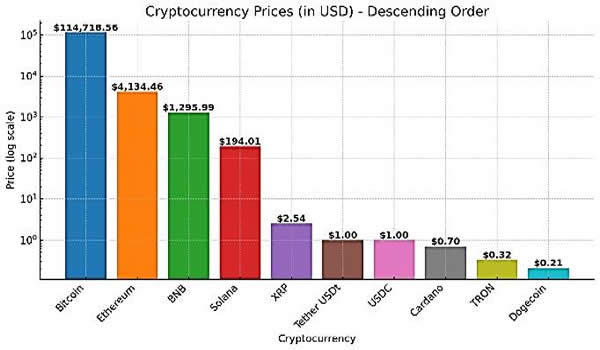
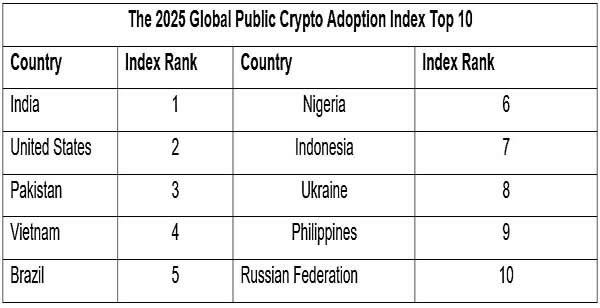
The global digital economy is expanding rapidly. As part of this transformation, Cryptocurrencies have seen increased adoption, with Bitcoin and Ethereum leading the way, as shown in Graph 1. Crypto users have surpassed 560 million in 2024 to 580 million in 2025 around the globe. The people in emerging economies have the highest adoption rates, as shown in Table 1.
Graph-1: Top 10 Cryptocurrencies in the world (2025)
Source: CoinMarketCap
Table-1: The 2025 Global Public Crypto Adoption Index Top 10)
Source: The Chainanalysis
Global adoption patterns demonstrate the diversity of approaches states have taken toward cryptocurrency, which reflects contrasting priorities between fostering innovation and maintaining financial stability.
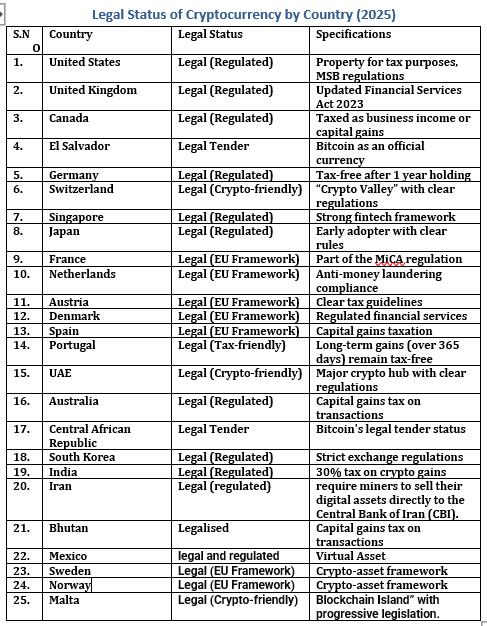
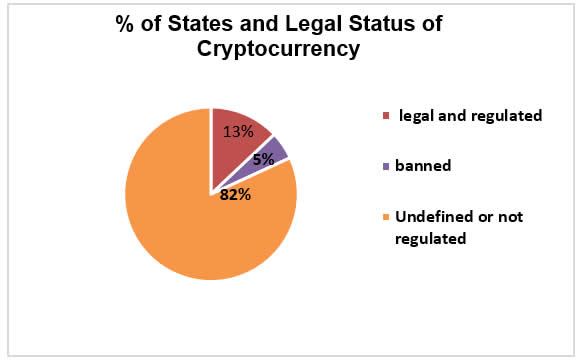
The Financial Action Task Force (FATF) has mandated that virtual asset service providers adhere to anti-money laundering and countering the financing of terrorism regulations. While international experiences vary, the global policy direction is shifting toward regulation rather than prohibition. Table 2 shows that 25 countries, mostly growing economies, have legalised cryptocurrency with various adaptation methods. While 10 countries have banned decentralised cryptocurrencies, most states have neither legalised nor banned them as of 2025. As shown in the Pie Chart.
Table-2: Legal Status of Cryptocurrency by Country (2025)
Source: demandsage.com
Source: Counts vary by methodology; figures based on Demand Sage (Oct–Nov 2025)
In the absence of a global governance mechanism, States have adopted various methods to regulate cryptocurrencies, primarily stablecoins. In the US, the government has classified cryptocurrencies as commodities or properties and has established strategic bitcoin reserves of seized bitcoins through a Presidential executive order in March 2025. The Guiding and Establishing National Innovation for U.S. Stablecoins Act (GENIUS Act), signed in July 2025, applies fragmented regulation to stablecoins. Registration with the Financial Crimes Enforcement Network (FinCEN) as a Money Services Business (MSB) is mandatory for those who operate crypto.
UAE has created a special economic zone for private crypto businesses under the authority of the Dubai Financial Services Authority (DFSA) in Dubai International Financial Centre (DIFC), and the Virtual Assets Regulatory Authority (VARA) issues licences through the government-operated licensing firm KIKLABB. India follows a hybrid approach, lifting its banking ban in 2022 but enforcing 1% TDS (Tax Deducted at Source) on sales and strict reporting obligations.
The European Union (EU) introduced the Markets in Crypto-Assets (MiCA) regulation in 2023, creating a comprehensive licensing and oversight framework; however, it has not required all states to legalise cryptocurrency. China has imposed a complete ban on trading and mining of decentralised cryptocurrencies, while advancing its digital yuan project, the largest Pilot project in the world.
Only two countries in the world, El Salvador and the Central African Republic (CAR), have adopted Bitcoin as legal tender. However, CAR later suspended it. It marked a bold but risky experiment, criticised by the International Monetary Fund (IMF) for fiscal vulnerabilities and governance issues.
In Pakistan, Cryptocurrency is not legalised and is prohibited. In 2018, the State Bank of Pakistan (SBP) prohibited banks and financial institutions from dealing with cryptocurrencies, citing risks of fraud and terrorism financing. Despite this, the market continued to thrive underground. Pakistan is ranked third in the global crypto adaptation market by public, as shown in Table 1. This informal growth and potential benefits in remittances, financial inclusion, and digital entrepreneurship prompted a reconsideration of policy in Pakistan.
In March 2025, the Pakistan Cryptocurrency Council (PCC) was established to regulate, foster, and integrate blockchain and cryptocurrency innovations into the country’s financial and economic framework. Established under the Virtual Assets Ordinance 2025, the Pakistan Virtual Asset Regulatory Authority (PVARA) is mandated to formalise and regulate virtual assets in line with international standards set by the FATF, IMF, and World Bank. It restricts cryptocurrencies to stablecoin-like tokens backed 100% by fiat (currency not backed by a commodity but is legal) or approved assets and imposes licensing and reserve requirements. In parallel, the SBP launched a Central Bank digital Currency (CBDC) pilot, signalling interest in state-backed digital finance.
Adopting cryptocurrency has both opportunities and risks for Pakistan. On the opportunity side, considering Pakistan’s human resources, crypto mining could be a significant source of GDP.
Regulated cryptocurrency could reduce the cost of remittances from 7% to under 2% per transaction, saving a considerable amount annually. Legalising cryptocurrency could also expand financial inclusion, as more than 100 million adults, including crypto owners, remain unbanked, and crypto wallets could provide them access to payments and savings. Startups in fintech and blockchain could attract investment, create employment opportunities, and enhance Pakistan’s economic status.
At the same time, risks remain considerable. According to the IMF, cryptocurrencies are notoriously volatile, posing risks to economic stability and investor protection. Fraud and scams have already cost Pakistani investors billions in recent years, as detected by the Federal Investigation Agency (FIA). Social risks are also pronounced, as only 26% of adults are financially literate according to the SBP, leaving many vulnerable to exploitation.
There is a misconception that, being decentralised, cryptocurrencies cannot be regulated and leave no trail of transactions. Hence, it could be used to finance terrorism and banned organisations. However, these transactions are visible and could be traced according to cryptocurrency experts like the CEO of PCC. However, the risk of terrorist financing cannot be neglected.
Pakistan can adopt the international community’s approach to cryptocurrency regulation as a model. However, it is not advisable to use it as a payment method by the government, considering the IMF’s reservations. Drawing lessons from countries leading in the cryptocurrency market, Pakistan should establish firms for the mining and trading of cryptocurrencies and allocate resources, such as excess electricity, for mining. However, Pakistan should sequence the reforms carefully to avoid a policy reversal like that in CAR. A unified strategy that integrates regulation, education, awareness, and technological robustness can enable Pakistan to capitalise on cryptocurrency opportunities while safeguarding its financial stability and national security.