
Adopted on 10th November 1975, the United Nations General Assembly (UNGA) Resolution 3379 declared Zionism to be a form of racism. The resolution emerged within a broader UN context influenced by decolonisation, Cold War politics, and opposition to racial segregation after the UN observation during South African Apartheid. This insight aims to explore the essence of UNGA resolution 3379 and its present relevance within the ever-evolving norms of the international community.
From the start of the 20th century, significant efforts had begun to combat racism. Such efforts were only heightened with the addition of multiple previously colonised countries to the UN, greatly increasing advocacy against colonialism and initiating a combined effort towards decolonisation and discriminatory practices. This movement had come to fruition through the initiation of Resolution 1514 in 1960, which proclaimed a need to put an end to all colonial practices, emphasising the importance of the territorial integrity of each state.
Simultaneously, parallels between Zionism and colonialism were closely examined, particularly their shared goal of territorial control through land occupation. Zionism was observed to require the effective removal of native Palestinians within Palestine to function, a sentiment mirrored by most colonialist practices, further cementing the comparisons. Such comparisons formed the basis upon which Resolution 3379 had been made.
The UNGA Resolution 3379, quoting Resolution 77 of the Organisation of African Unity, noted the commonality between the racist regime of South Africa and the racist regime in Palestine based on mutual imperialistic origins. It went on to quote UNGA resolution 3151 G, in which the General Assembly had condemned the ‘unholy alliance’ between South African Racism and Zionism. Resolution 3379, recalling the UNGA’s prior resolution aimed towards eliminating all forms of racisms, expressed its intention to ensure the fulfilment of such goals. In light of all such prior resolutions, the UNGA in resolution 3379 declared Zionism as a form of Racism.
The resolution was passed with 72 votes in favour, 35 against, and 32 abstentions. The opposition was led by Israel and the US, who called the comparisons baseless. Arab and African nations, and the Soviet bloc, however, supported the sentiment and voted in favour. Support by African and Arab states has been attributed to religious and cultural solidarity; however, the Soviet Bloc’s support was seen by many historians as an attempt to counter the rising influence of the US.
UN Resolution 3379 (XXX) Voting Trends
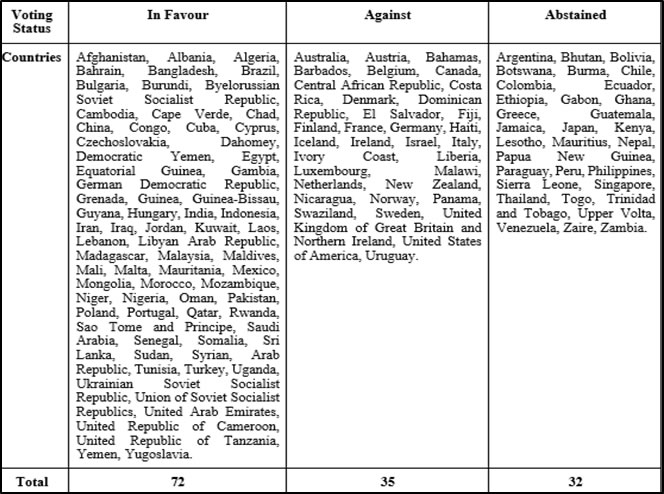
Note: Bahrain, Saudi Arabia, and South Africa (suspended due to apartheid) were absent from the vote on Resolution 3379.
16 years later, with the gradual end of the Cold War, the US began its ascent as the predominant global power, greatly weakening the Soviet bloc. Such shifts in power changed the geopolitical landscape of the UN, prompting its members to reevaluate their political affiliations. On 16th December 1991, Resolution 3379 was struck down in Resolution 46/86, which can be seen as a testament to such changing affiliations. The resolution stated the decision of the UNGA to revoke the earlier resolution, with no further elaboration as to the rationale behind such a decision. It was passed with a vote of 111 in favour, 25 against, and 13 abstentions, a testament to the changing loyalties within the UN.
UN Resolution 46/86 Voting Trends
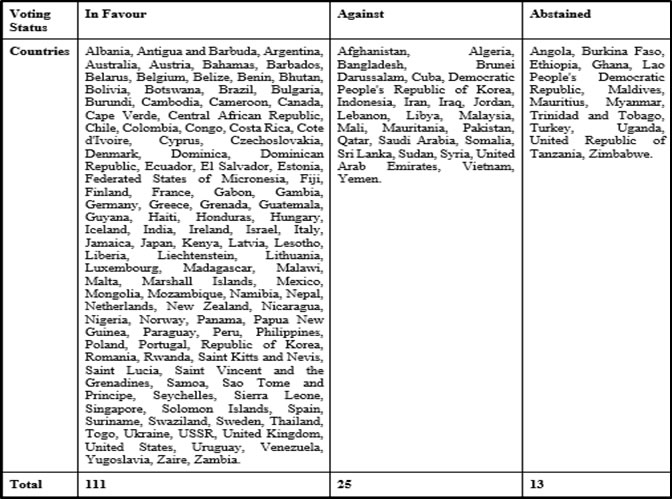
Note: Bahrain, Chad, China, Comoros, Djibouti, Egypt, Guinea, Guinea-Bissau, Kuwait, Morocco, Niger, Oman, Senegal, South Africa (suspended due to apartheid), Tunisia, and Vanuatu were absent from the voting on Resolution 46/86.
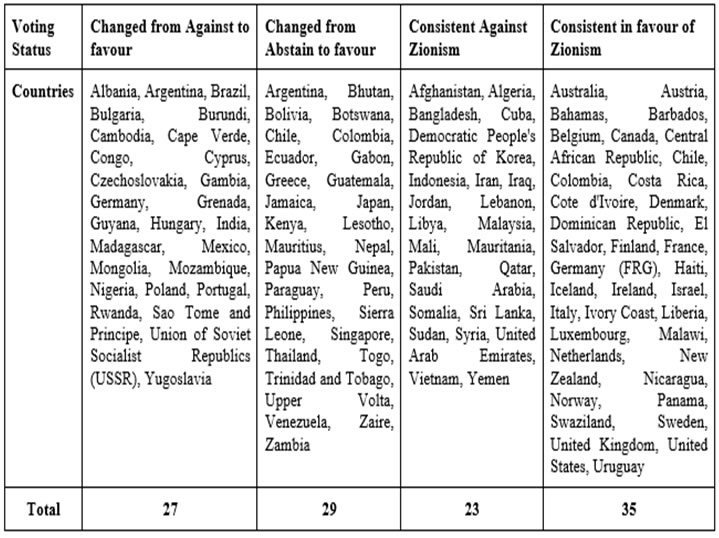
Changes in Voting Trends between 1976 and 1991
Such shifts in alignments had direct consequences as Israel’s conduct, under the shield of Zionism, continued to heighten hostilities in the region. The 1996 shelling of a UN compound in Qana, Lebanon, further exemplifies the use of security narrative to justify disproportionate use of force by the Israeli forces, leading to the deaths of over 100 civilians. The 2006 Israel-Lebanon war also gives testament to this cycle of violence, in which the UN observed the attacks by Israel to have caused harm to civilian life and objects. During the war, the Israeli Defence Forces (IDF) were reported to have acted in a manner that qualified as a temporary occupation of multiple Lebanese towns and villages. Such spikes in violence continue to persist, leading to a patterned use of temporary occupation as a war tactic by IDF soldiers, increasing concerns as to the legal basis of such operations.
The control exercised by Israel in the Palestinian territory further showcases the consistent hostilities within the region, with many attributing such conflicts to the colonialist intent and potential genocidal nature of Zionism. From 7th October 2023 onwards, such conflicts have reached unprecedented levels with significant harm to the civilian population in Gaza. As the conflict continues unhindered, such actions are met with continued condemnations by the UN and numerous Human Rights Organizations. Such condemnation and ever-growing violence within Gaza bring into question the intent and nature of Zionism, highlighting the resolve expressed under Resolution 3379.
Simultaneously, the global order continues to transition towards multi-polarity, weakening U.S dominance over International legal discourse. The rise of China and Russia as competing powers to the US, alongside changing political alignments, diverges from the unipolar era of the 1991 Resolution. Additionally, with many European countries recognising Palestine's status of statehood, the discrimination towards Palestinians as a result of Zionism is highlighted, further showcasing the relevance of resolution 3379 in the present day. This importance is most prominent with the growing need to prevent the emergence of similar discriminatory ideologies which perpetuate an exclusionary concept of statehood, such as already seen by Hindutva in India.
South Africa’s proceedings against Israel and the interest from European countries such as Ireland and Belgium within such proceedings demonstrate a collective disapproval of such practices. Consolidating this momentum may enable the formation of a united front for the rejuvenation of the 1975 resolution, forming ideal grounds for its rekindling. By connecting the African, Muslim, and European blocs, a prevalent policy can be formed to once more highlight the concerns raised in resolution 3379.
The convergence of Zionism and emerging discriminatory ideologies, such as Hindutva, underscores the persistence of discriminatory frameworks. Such alignments increasingly extend beyond geostrategic or geoeconomic considerations, falling within a geopolitical framework grounded in shared ideological underpinnings. Shifting geopolitical conditions, particularly the increasing multipolarity and renewed scrutiny of perceived colonial legacies, have reopened such discussions. While the reconsideration of resolution 3379 depends on complex and multifaceted legal and political challenges, the emergence of such discourse gives way to potential avenues for its implementation.