According to IQAir's World Air Quality Report 2025, Pakistan recorded the worst air quality among 143 monitored countries, with an annual average PM 2.5 concentration more than 13 times the WHO guideline. The Pakistan Economic Survey 2025-26 also confirms that around 22,000 deaths each year are linked to air pollution. Four of the ten most polluted cities in the world are in Pakistan, with Lahore being the worst, followed by Faisalabad, Multan and Peshawar.
This insight argues that Pakistan's urban air pollution crisis primarily stems from local factors, with transport being the largest contributor. It suggests that long-term improvements will come from consistent, city-specific reforms rather than temporary emergency measures that tend to reemerge each smog season.
Pakistan’s National Clean Air Policy, approved by the Federal Cabinet in March 2023, attributes 235,000 premature deaths annually to air pollution exposure. A study by Aga Khan University, sampling in central Karachi, recorded a 30 to 40 percent rise in daily hospital admissions and emergency visits for respiratory illness following short-term exposure to PM2.5. Similarly, the University of Chicago's Air Quality Life Index suggests that complying with the WHO guideline could extend the average life expectancy by 3.3 years, and by more than five years in Lahore and Peshawar.
Figure 1 below illustrates average PM2.5 concentrations across Pakistan’s major cities.
Figure - 1
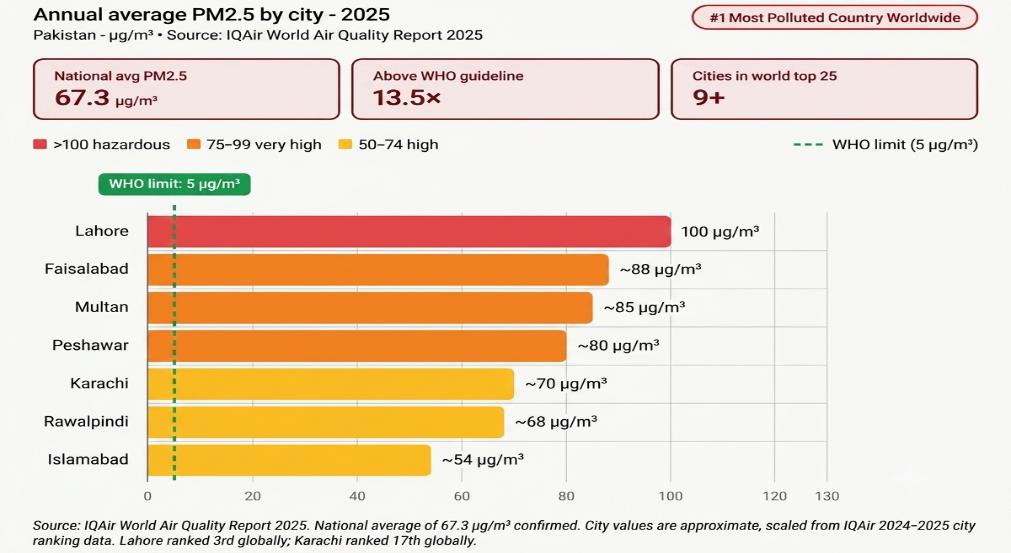
Sources: IQAir, World Air Quality Report 2025; Pakistan Economic Survey 2025-26.
The 2024 season truly highlighted the impact of these averages in real-life situations. Punjab took the serious step of declaring a health emergency. At the same time, provincial records showed nearly 1.93 million respiratory cases in just one month, and UNICEF warned that 11 million children under 5 are breathing dangerous air each day.
The Pakistan Air Quality Initiative's national landscape report from December 2025, which is the country's first comprehensive inventory that looked at each city individually rather than nationwide, helps clear up a lot of the confusion. In Lahore, transport makes up 35 % of PM2.5 levels. Rawalpindi-Islamabad sees transport as the main source at 53%, while Peshawar is similar at 51%, and Karachi stands out as being predominantly industrial, with 49%from industry and port operations. Since each city faces different pollution sources, each situation calls for its own tailored solution. Figure 2 below shows the share of urban PM2.5 across Pakistan's major cities.
Figure - 2
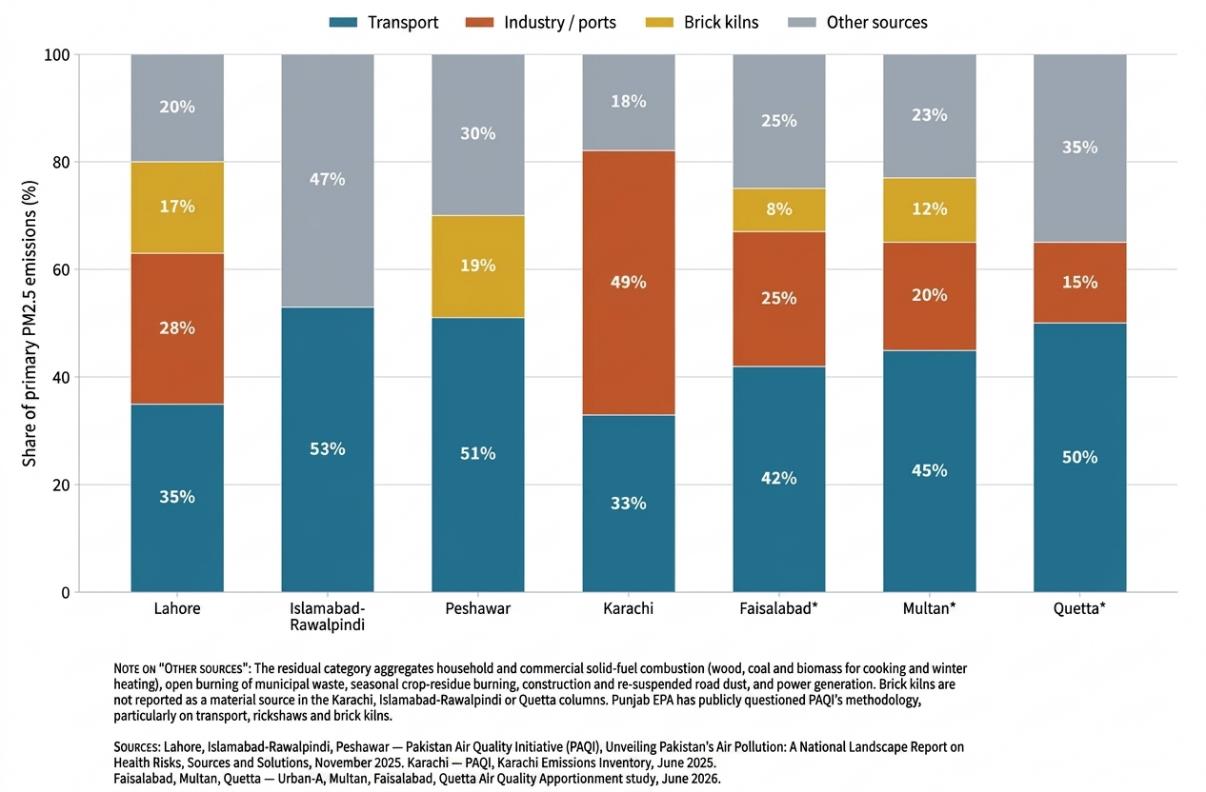
Source: Pakistan Air Quality Initiative, Unveiling Pakistan’s Air Pollution, December 2025.
Transport has become the top urban issue mainly because of the country's heavy reliance on roads. Figure 3 provides an overview of Urban Traffic Load in Pakistan’s major cities.
Figure - 3
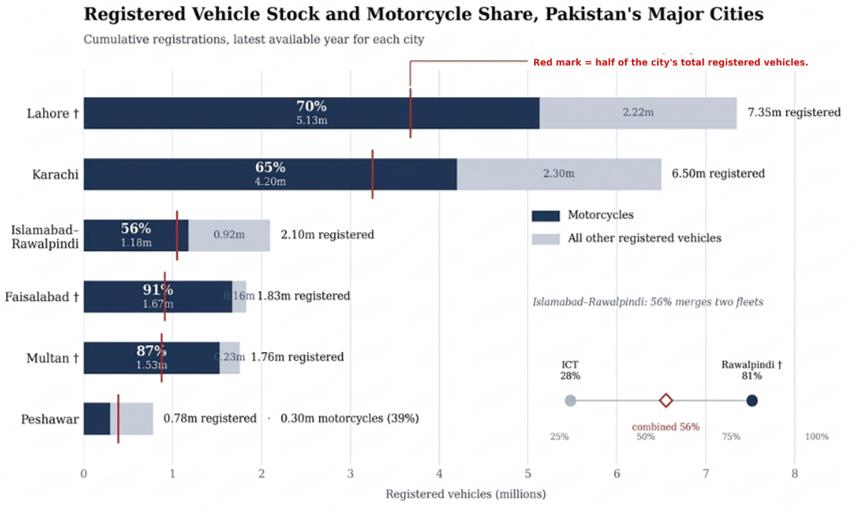
Source: JICA/PMA transport studies; Punjab Excise & Taxation; PAQI 2025
Two-wheelers are more significant than their size suggests. In Lahore, studies link about 36% of fine-particle pollution to diesel and two-stroke exhaust, with two- and three-wheelers being particularly high emitters. A two-stroke engine produces much more particulate matter per litre than a modern car. Peshawar's problem is compounded by more than 50,000 unregistered two-stroke engine rickshaws, a vehicle class that emits more particulate matter per kilometre than any other on the road.
The number of two-wheeler vehicles is rapidly increasing. After the decline caused by the 2022 floods, sales bounced back in 2024, making Pakistan one of the fastest-growing two-wheeler markets globally. Every new vehicle adds to the challenge, as shown in the Two-wheeler data over the past ten years in Figure 4.
Figure - 4
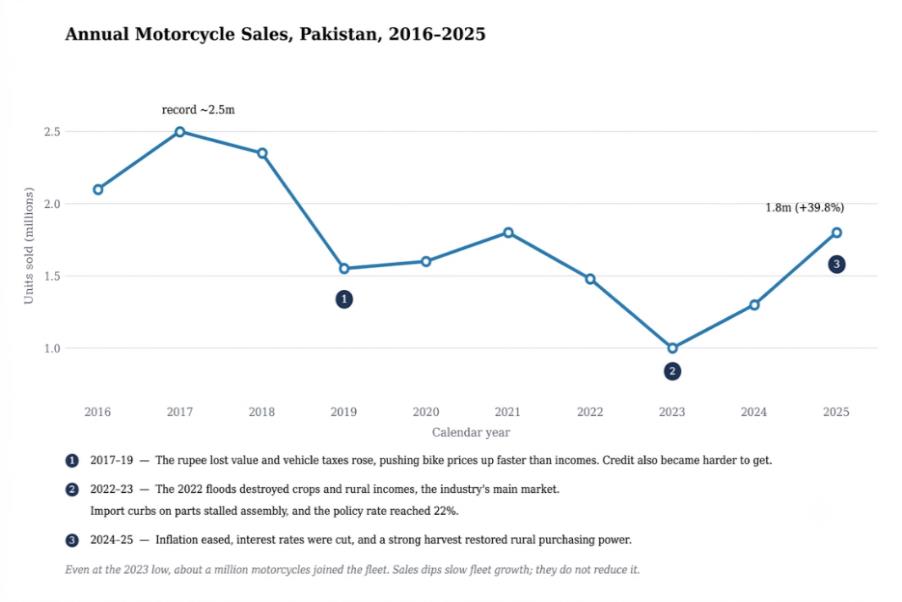
Source: PAMA; Motorcycles Data, Pakistan Motorcycles – Facts & Data 2026
Many cities have faced similar choices between making long-term structural changes and applying temporary solutions. Significant reduction in PM2.5 levels has been witnessed depending upon the intervention type. Examples of cities that faced pollution comparable to major Pakistani cities, from most successful structural to least effective seasonal/ emergency, are given below in Figure 5.
Figure - 5
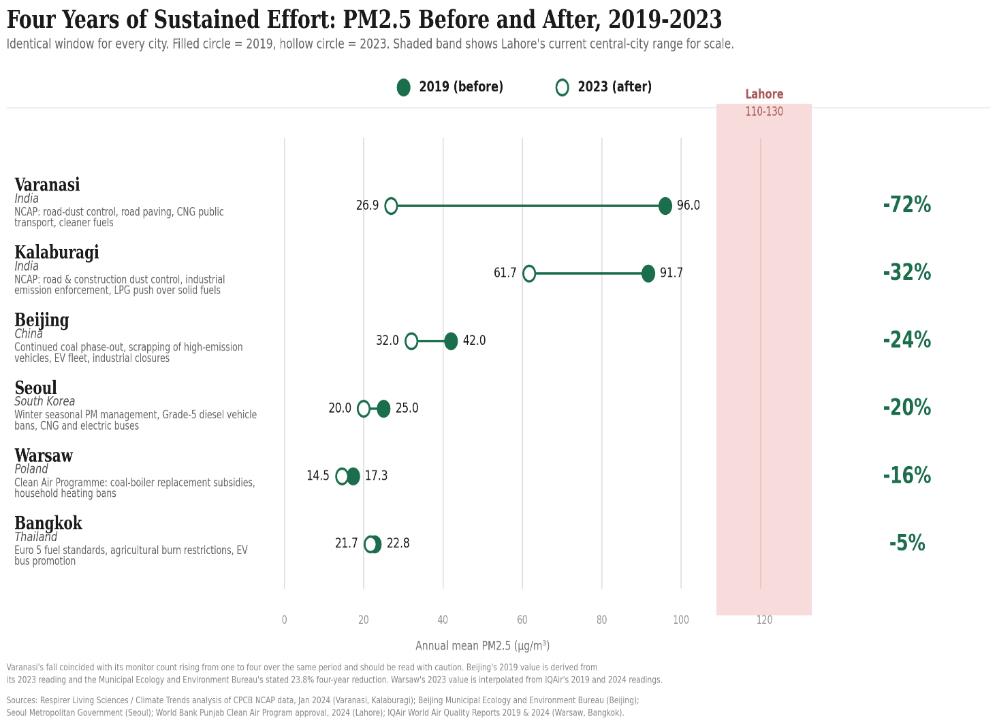
Source: UNEP; Beijing Municipal Ecology & Environment Bureau’ EPIC/University of Chicago; IIT Delhi.
Peshawar's Trans Peshawar bus rapid transit (BRT) system, which uses hybrid-electric buses, moves over 345,000 passengers daily—making it the busiest BRT in the country. Meanwhile, Lahore's Metrobus and Orange Line together transport more than 250,000 people each day, and a 2024 report highlights that the Metrobus alone helps reduce CO₂ emissions by approximately 15,000 tonnes per year. The Rawalpindi-Islamabad Metrobus system serves around 135,000 commuters daily, now supported by 160 electric buses imported from China. Expanding and linking these systems is a powerful step forward, offering the greatest benefits. Table 1 below provides an analysis of the key advantages of Pakistan’s major mass transit projects.
Table 1: Operating mass -Transit systems: annual CO2-e avoided
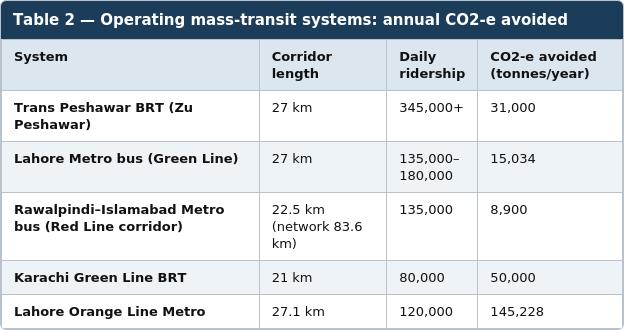
Source: Trans Peshawar; Punjab Mass Transit Authority
Cleaner fuel is most effective when paired with cleaner engines. Pakistan is now providing Euro-5 fuel nationwide and aims to reach Euro-6 standards by 2030. However, the impact is limited because there is no strict enforcement of vehicle-emission standards; for example, Punjab has only 32 inspection stations to serve over 24 million vehicles. Implementing mandatory emission testing and fitness certification could be a simple yet powerful step forward.
Rail should be considered a valuable part of the transportation mix. Improving rail freight and the ML-1 corridor can help reduce heavy diesel trucking on urban roads, which in turn can help lower city pollution. That’s a great reason to support the Railways' goal of increasing its passenger modal share from around 4 to 20%.
Renewing the fleet is the next positive step forward. Punjab's smog roadmap already bans vehicles without fitness certificates and has introduced the country's first environmental traffic squads. A trustworthy scrappage scheme for the oldest and most polluting vehicles would be a natural and effective follow-up. Electrification then directly tackles the most harmful segment. The National Electric Vehicle Policy 2025-30 aims for 30% of new vehicle sales to be electric by 2030, supported by over Rs100 billion in incentives. Early subsidies have already helped more than 116,000 e-motorcycles and 3,000 e-rickshaws get on the road, with Punjab planning to distribute 100,000 e-motorcycles in its second phase.
Focusing on two- and three-wheelers offers the fastest path to cleaner air in cities. The response should match the problem: a city-specific programme built on mass transit, cleaner fuels and fleet electrification. Paid parking to discourage private vehicle use, organised parking facilities, and a congestion charge in the major urban centres would reduce traffic and increase demand for mass transit. Development of public transport infrastructure should be prioritised over the construction of new flyovers and underpasses. Clean air is a standing strategic priority rather than a seasonal concern.