
Pluralism and multiculturalism were once core principles of European society. However, the tide is now shifting. There is a notable rise in anti-immigrant sentiment among Europeans, leaving Europe at a crossroads: to be an inclusive society or an exclusive community. This insight examines the evolving sentiment towards immigrants in Europe, exploring the causes, policy changes and potential consequences.
Figure 1: Total Immigrants entering Europe
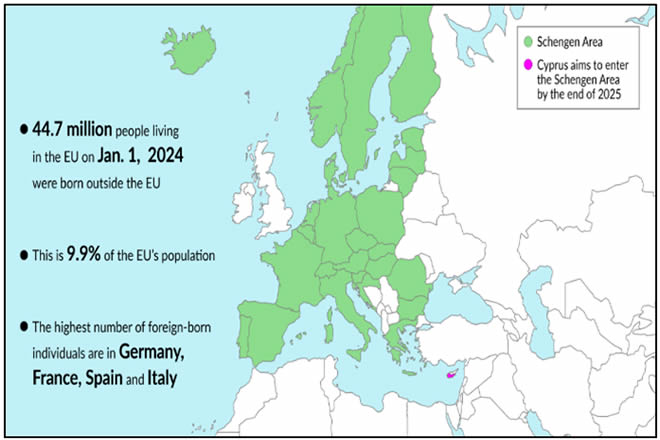
Source: IOM
Within the European context, immigrants and refugees are distinctly different, but these categories are often blurred in public discourse. According to the EU laws, which are followed by most European states, immigrants are people who have legally resided in the territory of an EU member state for at least 12 months. Refugee refers to persons granted refugee status, or authorisation to stay under national laws concerning international protection. An illegal refugee is a person who enters Europe and remains without the required permission.
Contrastingly, a few countries in Europe follow a different set of definitions. Norway, the UK, and Switzerland, for instance, apply their own definitions based on the Geneva Convention. Although variation in definitions is present, the political narratives and media representations merge the distinctions when referring to anti-immigrant sentiment. Consequently, all non-Europeans are framed as a part of a single immigration crisis.
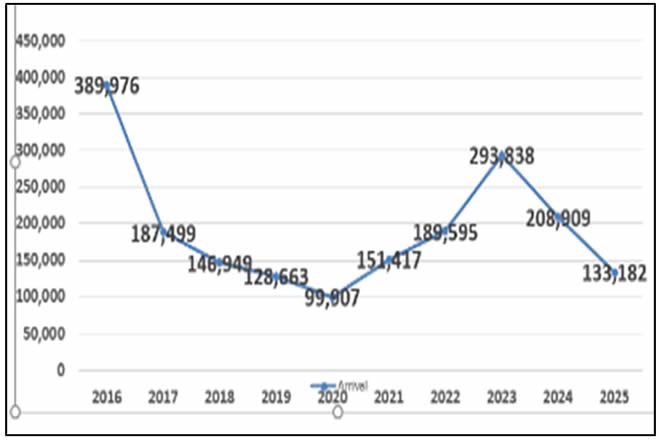
Figure 2: Total Immigrants entering Europe
Source: IOM
While these definitions have provided context, there is a need for closer examination of immigration trends. Post World War Europe promoted immigration. Countries like Germany, the UK, France and Belgium invited foreign workers to rebuild their economies and alleviate labour shortages. An estimated 13 million people immigrated from the 1950’s to 1990’s. At that time, immigration was presented as an economic necessity linked to national reconstruction, and public concern remained limited.
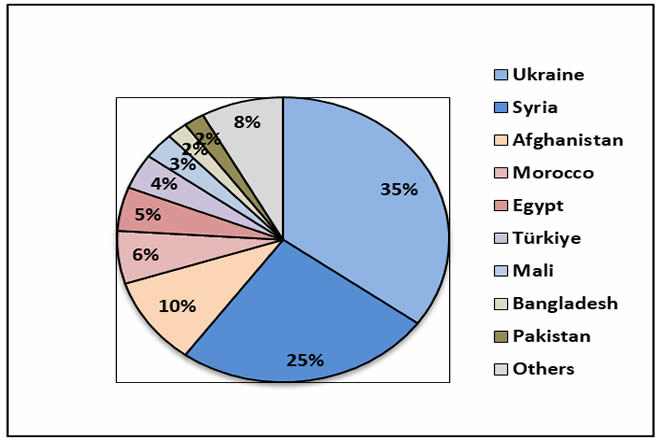
During the last decade, from 2015-2025, immigration to Europe has fluctuated. One million immigrants arrived in 2015 due to wars and state collapse in the Middle East. However, in recent years, immigration has decreased. In 2025, 0.14 million people immigrated to Europe. The majority of immigrants have arrived from Syria, Afghanistan, Morocco, Egypt, and Ukraine, with some from South Asia and Africa.
Figure 3: Estimate of Immigrants Entering Europe: 2025
Source: IOM
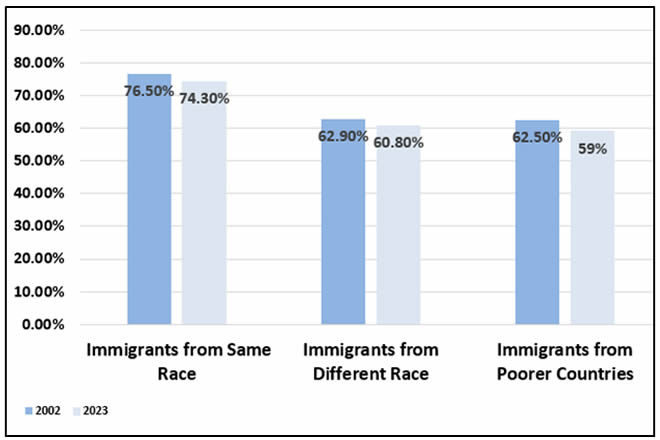
Increased immigration into Europe has contributed to anti-immigrant sentiments among Europeans. The European Social Survey conducted a survey from 2002 to 2023 to explore perceptions of Europeans about immigration. The survey indicated that support for immigrants from the same ethnic group has decreased from 76.5% to 74.3%, and for immigrants from different ethnic groups from 62.9% to 60.8%. For poorer countries, the figure has reduced from 62.5% to 59%. Despite the data revealing little increase in anti-immigrant sentiment in Europe, the normalisation of restrictive immigration policies demonstrates how prejudice is being expressed through action.
Figure 4: Change in Attitude towards Immigrants
Source: ESS
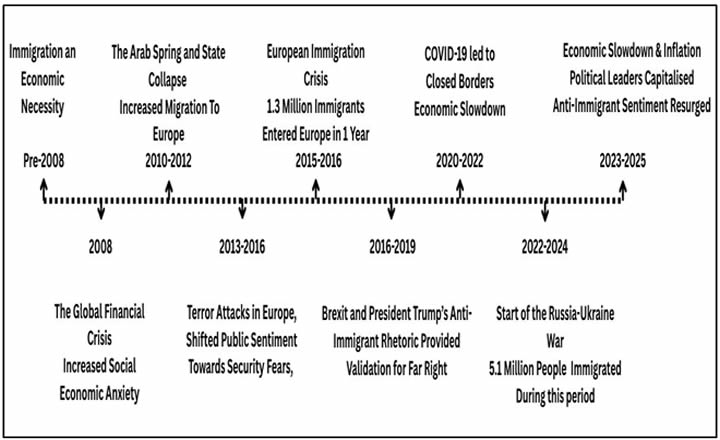
The rise in anti-immigrant sentiment in Europe is linked to successive geopolitical shocks. The Iraq War of 2003, the Arab Spring, the Syrian Civil War, the Afghanistan War, conflicts in the Sahel, and the Russia-Ukraine War of 2022 have been major geopolitical shocks. The increased scale and speed of immigration have introduced pressure not seen in earlier immigration. Consequently, immigration is being framed by European governments as a security issue rather than a humanitarian issue, reinforcing exclusionary policies.
Figure 5: Events Contributing to the Rise in Anti-Immigrant Sentiment
Source: Self-Compiled
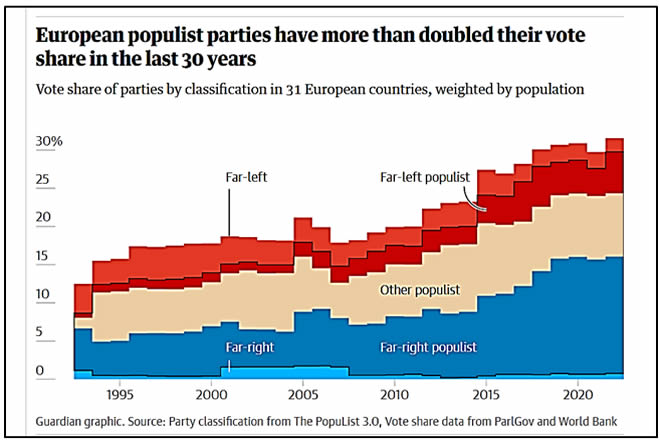
Populist parties have also witnessed a resurgence in recent years. The insecurities and distrust linked to the 2008 financial crisis, the 2015 immigration crisis, Brexit, and the economic slowdown linked to COVID-19 have fueled the revival of the far right.
The rise is evident in their growing vote share. In the latest national polls, Germany’s ‘Alternative for Germany’ party secured 26% of votes, the highest in the country. ‘France National Rally’ led polls ahead of the 2027 presidential elections. Hungary and Italy already have populist regimes, and similar trends are emerging in other European states.
Figure 6: Europe’s Populist Parties Stacked Vote Share
Source: The Guardian
Economic competition is another primary cause, as over the years, structural stagnation and supply chain disruption have impacted the economy of Europe. Consequently, the immigrants are framed as competitors for housing, jobs and welfare. This framing often leads society to become more receptive to anti-immigrant sentiment. Recent surveys reveal that around 70% of respondents in Greece and Italy, and 50% in Spain and France, think that immigrants take their jobs without contributing to the economy. Such sentiment neglects the structural causes of economic challenges within Europe.
The economic and security-linked insecurities are amplified by the media, which disproportionately frames immigrants through the lens of crisis, crime and cultural threat. This leads to a cumulative negative narrative that promotes anti-immigrant sentiment. Governments do this because the immigration issue allows the mobilisation of support without having to address complex structural problems.
Immigration has also become intertwined with the security and foreign policy agenda of Europe. Global conflicts have reoriented the immigration debate. States are becoming more focused on regional stability and border control. As a result, many European states have shifted towards restrictive approaches, reflecting rising public concern and political shifts. For example, Viktor Orban, Hungary’s president, threatened to deport 20 million people. Border control measures have been introduced by Germany, which was once a vocal supporter of immigration. Such border control measures are also being imposed by other EU member states.
Additionally, revisions of rules and regulations have been advocated for by EU states. In response, a pact on immigration and asylum has been finalised by the EU parliament, introducing new regulations to manage immigration.
External perspectives are also shaping the immigration discourse of Europe. In his recent address in the UN General Assembly, President Donald Trump remarked,
Europe is in serious trouble. They’ve been invaded by a force of illegal aliens…and nobody’s doing anything to change it, to get them out. It’s not sustainable. And because they choose to be politically correct, they’re doing just absolutely nothing about it… It’s time to end the failed experiment of open borders.
The rise of anti-immigrant sentiment poses significant challenges for Europe’s social integration efforts. If anti-immigrant sentiment continues to increase at the same pace, Europe may witness greater policy fragmentation, along with long-term economic stagnation, weakening Europe’s traditional consensus-driven approach.
Globally, the increased rise of such sentiment will accelerate the erosion of globalisation, impacting the social fabric of Europe. Additionally, Europe’s ability to act as a stabilising force will be impacted, creating more space for geopolitical competition and unpredictability. European states will push away from unified policy frameworks, towards divergent national positions. Consequently, the China-US strategic rivalry in Europe will also be impacted, with the US gaining more from a fragmented EU in comparison to China. If Europe continues to pull inward, despite declining population growth, the economy, international cooperation, and norms of free movement will be affected, leading to a more polarised and protectionist world.