
Founded in 1967 to preserve Southeast Asia as a zone of peace, freedom, and neutrality, ASEAN’s cohesion historically rested on consensus and non-interference. Yet as great-power competition intensifies across the Asia-Pacific, the very neutrality that once guaranteed ASEAN’s autonomy now constrains its collective response. Hence, this insight features how United States (US) and China rivalry is determining ASEAN’s neutrality, testing its unity and relevance in the regional order.
Figure 1: ASEAN Association of Southeast Asian Nations
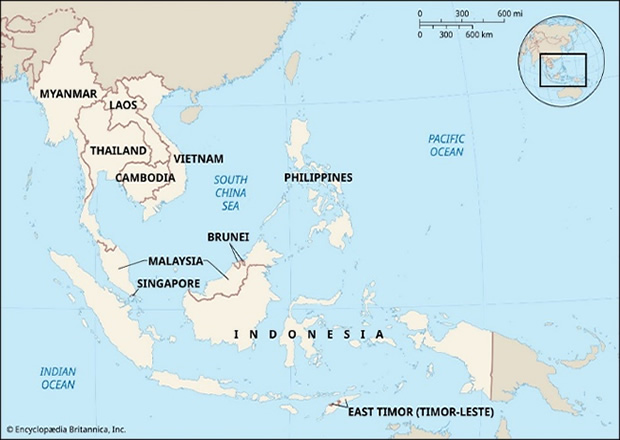
ASEAN was conceived during the turbulence of the Cold War. Its founding members, Indonesia, Malaysia, Philippines, Singapore, and Thailand, sought to insulate Southeast Asia from ideological confrontation.
The 1971 Zone of Peace, Freedom, and Neutrality (ZOPFAN) Declaration formalised this vision, later supported by institutions such as the ASEAN Regional Forum in 1994 and the East Asia Summit in 2005. These mechanisms were designed to anchor ASEAN’s centrality, keeping major powers engaged but at arm’s length.
ASEAN sits on the world’s busiest sea lanes, with the Strait of Malacca and Indonesia’s straits carrying about 38% of global maritime trade, nearly US$3.5 trillion a year. For China, these routes are even more critical, with around two-thirds of its total trade and almost 80% of its oil imports moving through these ASEAN-controlled chokepoints. Today, the association has expanded to 10 nations with a combined population of around 677 million and a GDP of $3.8 trillion, making it the world’s fifth-largest economy. Given its strategic importance, neutrality is difficult to sustain in the changing geopolitical landscape of the region.
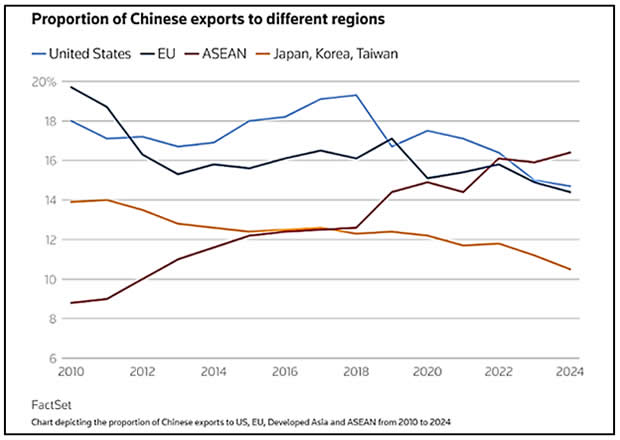
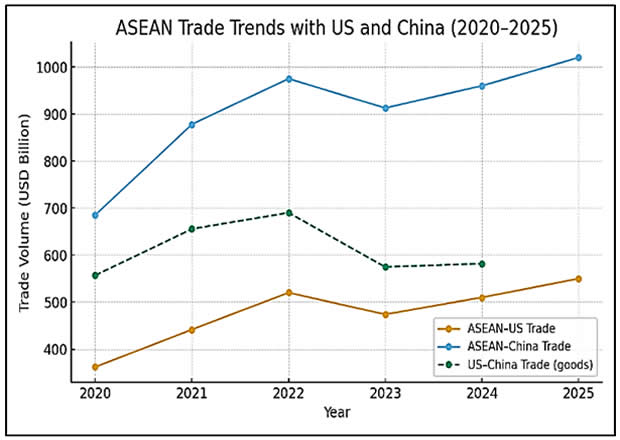
Geographically, China sits directly adjacent to the ASEAN region. Formal ASEAN–China relations began in 1991 and deepened after Beijing became a full dialogue partner in 1996. China’s influence on ASEAN has been transformative, but through economic power. The figures illustrate trade disparity between ASEAN’s exchanges with China and the US over recent years. Currently, ASEAN-China trade has reached nearly $1 trillion, making ASEAN number one trading partner of China, ahead of both European Union (EU) and US. As Western markets slowed, Southeast Asia absorbed 16.4% of China’s exports, compared to 14.7% for the US.
Source: Reuters
Through the Belt and Road Initiative (BRI), the Asian Infrastructure Investment Bank (AIIB), and the Regional Comprehensive Economic Partnership (RCEP), Beijing has embedded itself in ASEAN’s development model. All ten ASEAN members are part of RCEP, representing 30% of global GDP. China now finances 24 of Southeast Asia’s 34 mega projects, including China–Laos railway and Indonesia’s Jakarta–Bandung high-speed rail. Cambodia’s dependence is particularly acute; 44% of its Foreign Direct Investment (FDI) came from China between 1994 and 2014, and Chinese loans now equal up to 40% of its GDP. These economic ties are not neutral; they translate into political leverage.
Source: Self-compiled
In case of US, the formal engagement with ASEAN began in 1977 when it officially became a dialogue partner, but its military footprint in the region predates the organisation. During the Cold War, US operated over twenty major installations across ASEAN states. Today, American presence has re-emerged in subtler form. Under the Enhanced Defense Cooperation Agreement (EDCA) signed in 2014, US holds rotational access to eight military sites across the Philippines. It maintains logistics facilities at Singapore’s Changi Naval Base and limited use of Thailand’s U-Tapao Airfield.
Washington’s 2011 “Pivot to Asia” and the subsequent Indo-Pacific Strategy (IPS) aim to prevent any single power from dominating key sea lanes through which approximately $5 trillion in trade flows annually. With roughly 375,000 personnel under the US IPS and alliances such as AUKUS (Australia–UK–US Security Partnership) in 2021 and QUAD (Quadrilateral Security Dialogue: US-India-Japan-Australia) in 2007, America’s strategic posture reinforces deterrence and also pressures ASEAN members to hedge rather than unite. In 2022, the US–ASEAN relationship was elevated to a Comprehensive Strategic Partnership (CSP).
The geopolitical rivalry between China and the US finds its most tangible expression in the South China Sea, where ASEAN’s cohesion is repeatedly tested. While the Philippines and Vietnam have hardened their stance against China, their alignment with Washington has deepened under security partnerships and military aid frameworks. In 2024, the US and the Philippines launched joint patrol exercises using bases in the Philippines near the Taiwan Strait and the South China Sea. Meanwhile, Cambodia and Laos, heavily reliant on Chinese infrastructure financing, resist Western influence. ASEAN’s 2012 Cambodia summit failed to issue a joint statement over the South China Sea.
Figure 2: Claimants in the South China Sea
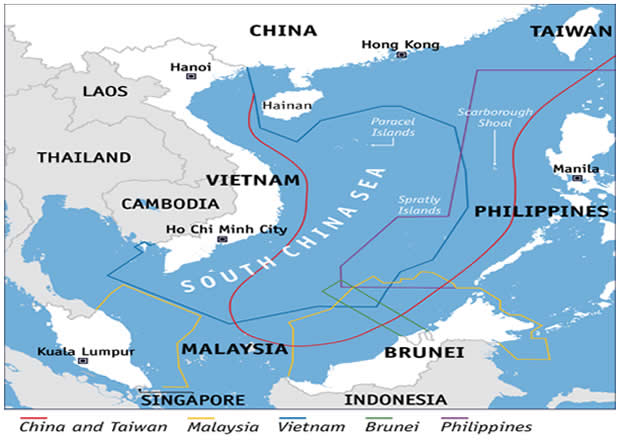
Moreover, the Spratly Islands dispute highlights ASEAN’s strategic dilemma between sovereignty and stability. As China, Vietnam, the Philippines, Malaysia, and Brunei maintain overlapping claims, Washington’s growing security cooperation and military activities under the IPS add complexity to the regional balance.
While the US frames its actions as support for freedom of navigation, they also sustain competitive dynamics that draw some ASEAN members closer to frameworks such as AUKUS and Quad, gradually testing the bloc’s cohesion.
By 2025, the South China Sea remains tense, with frequent maritime incidents and joint patrols involving external powers. Washington urges ASEAN states to deepen cooperation through the Indo-Pacific Economic Framework (IPEF), linking economics with strategy. Although ASEAN and China aim to finalise a binding Code of Conduct (COC) by 2026, external pressures and diverging interests continue to slow progress and test regional consensus.
Beyond the maritime sphere, ASEAN’s mainland disputes also include recurring Laos–Cambodia border tensions that highlight ASEAN’s limited capacity for intra-regional conflict resolution and reveal US influence. While both rely on Chinese investment, Washington’s Mekong–US Partnership uses development and governance aid to draw mainland states into its orbit. Framed as cooperation, these programs subtly shape regional alignments.
Moreover, the Thailand–Cambodia Kuala Lumpur Peace Accord in October 2025 showed Washington’s attempt to project influence in Southeast Asia’s politics. President Donald Trump claimed it as a US-backed success, presenting it as proof of America’s role in “restoring peace” to the Asia-Pacific. Washington’s effort to reassert diplomatic appearance in ASEAN affairs.
Also, the Myanmar crisis exemplifies ASEAN’s institutional strain. After the 2021 coup, ASEAN’s Five-Point Consensus stalled. The US responded with sanctions and support to opposition groups, reinforcing influence among ASEAN states, while China pursued non-interference and dialogic engagement with Myanmar’s regime. ASEAN’s split between restrictive and engagement approaches emphasises its position as a pivot between US strategic containment and China’s cooperative security posture.
In conclusion, ASEAN’s neutrality is under increasing strain as the US–China rivalry deepens across the Asia-Pacific. China’s rise as ASEAN’s leading trade partner and Washington’s push to maintain influence through alliances and high tariffs ensure this competition continues to intensify. This way, ASEAN’s cohesion could erode, weakening the relevance of ASEAN-led forums and intra-regional cooperation. Over time, deepening divisions may leave ASEAN less unified and central, and could even risk a gradual fragmentation of the association itself.